Saving: Should I save or invest? Use the date you'll need the money
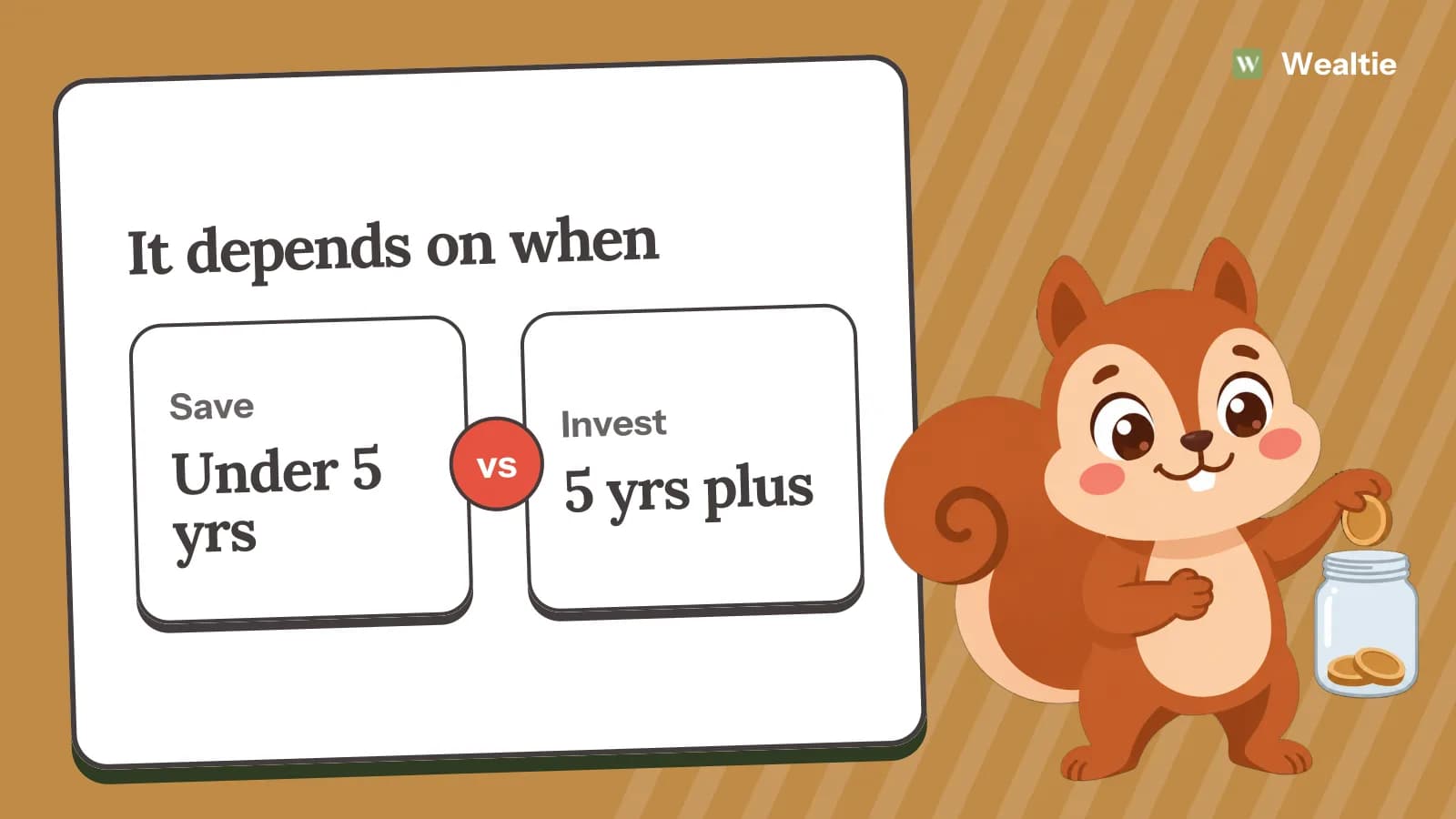
Should I save or invest? Save money you'll need within about five years, and consider investing money you won't need for longer, once your costly debt is paid and your emergency fund is full.
 By Wealtie Team · 3 min read
Key takeaways
- Money you'll need within about five years is usually better in savings, because investments can fall just before you need them.
- Money you won't need for longer has time to recover from a fall.
- Clear high-interest debt and fill an emergency fund before you invest.
- Saving and investing aren't a one-time choice, and most people end up doing both for different goals.
Should I save or invest for this goal?
Start with the date you'll need the money. Within about five years, save it. Further off than that, investing can make sense, as long as the steps below are done first.
The reason is what happens in a bad year. If you've got 10,000 in investments and the market falls by 2,000 the year you planned to spend it, you're short. If you've got ten or twenty years, there's time for it to recover. Savings won't fall that way, though inflation can erode what they buy.
| Goal | When you need it | Usually better in |
|---|---|---|
| Emergency fund | Any day | Savings |
| Car replacement | 2 years | Savings |
| House deposit | 4 years | Savings |
| Child's university | 12 years | Could be invested |
| Retirement | 25 years | Could be invested |
Five years is a rule of thumb, and the right cutoff depends on how much a fall would hurt.
What should you do before you invest?
Work through this order. It's the same one that applies to most spare money:
- Build a small cushion, so a surprise doesn't go on a credit card
- Pay off debt with a high interest rate
- Fill your emergency fund; the emergency fund calculator shows how long it'll take
- Save for anything you know you'll need within five years
- Invest what's left for the long term
Debt comes before investing because of what it costs. A credit card usually charges more than an investment could reasonably be expected to earn, so clearing it comes first. Pay off debt or save goes through the trade-off with numbers.
The exception in many countries is a workplace pension or retirement plan with employer matching. If your employer adds money when you do, that match is often worth taking even while you're working through this list. Check the terms of your own plan.
What's the difference between saving and investing?
Saving keeps the amount safe and available. Investing buys something whose value can go up or down, in the hope that over a long stretch it goes up by more than savings would pay.
Savings accounts generally have deposit protection up to a limit, which where to keep your emergency fund explains. Investments don't have that protection against a fall in value.
Can you do both at once?
Yes, and most people end up doing so, with different money for different jobs. Say you've got 200 a month to work with, your emergency fund's full, and you're saving for a car in two years. You could put 150 into a savings pot for the car and 50 into something long-term.
Give each pot one job. If the car fund and the retirement money sit together, you'll end up raiding one for the other. When the car's bought, the 150 can move to the next goal.
Review the split once a year, or when something big changes, like a new job, a baby or a paid-off debt. A goal that was ten years away and is now three has moved into savings territory, so start shifting that money as the date gets closer, and don't leave it all for the final month.
How much should you invest?
A share you can leave alone for years, even if it falls by a large amount. If you'd need to sell the moment it dropped, you've invested too much or too soon.
How much of your income to set aside overall is covered in how much of your income should you save. What to invest in is outside what we can tell you. Your country's financial regulator will have plain guidance, and a regulated adviser can look at your situation.
What if you've left it late?
Then the same date test applies, with less room. If you're ten years from retiring and haven't started, the priority is getting a saving habit going and finding out what your workplace or state pension will pay, before making any decisions about risk.
Don't try to make up the time by taking on bigger risks. A large fall close to the date you need the money is the hardest one to recover from.
How do you see it all in one place in Wealtie?
Add an account for each pot, name it after the goal, and update it when the balance changes. Your net worth tracker adds them into one total, and moving money between your accounts is a transfer, so it isn't counted as spending. How to set financial goals helps you decide which pots to have.
The Free plan includes two accounts. Pro has no limit.
Questions people ask
Save money you'll need within about five years, and consider investing money you won't need for longer. Clear costly debt and fill your emergency fund first.
Save, if you plan to buy within about five years, since a fall in investments right before you buy could leave you short. A longer timeline gives you more options.
Pay off high-interest debt first, since it usually costs more than investments can reasonably be expected to earn. Employer pension matching is the common exception.
Once costly debt is paid, your emergency fund is full, and you've got money you won't need for at least five years. Workplace pension contributions may be worth starting sooner if your employer matches them.
This article is general information, not financial, tax or legal advice. Your situation is your own; check the numbers that apply to you before you act on them.