Saving: How to budget for annual expenses without wrecking one month a year
How to budget for annual expenses comes down to one sum and one decision: add up every bill that comes once a year, divide by 12, and count either the monthly amount or the bill against your budget.
 By Wealtie Team · 3 min read
Key takeaways
- Add up every bill that comes once or twice a year, divide the total by 12, and set that amount aside each month.
- Twelve months of bank and card statements will find annual bills that a list from memory misses.
- Count either the monthly set-aside or the bill against your budget, never both.
- A renewal that's close needs more per month in the first year, then drops to the normal amount once it has been paid.
What counts as an annual expense?
Any cost that comes once or twice a year and that you can see coming. Car insurance paid in one go, a yearly subscription, a car service, a professional fee, the vet's booster, a TV licence.
The usual problem is finding them. Open twelve months of bank and card statements and write down anything that doesn't appear every month. A list from memory tends to catch the insurance and miss the 40 software renewal that comes in August.
How much should you set aside each month?
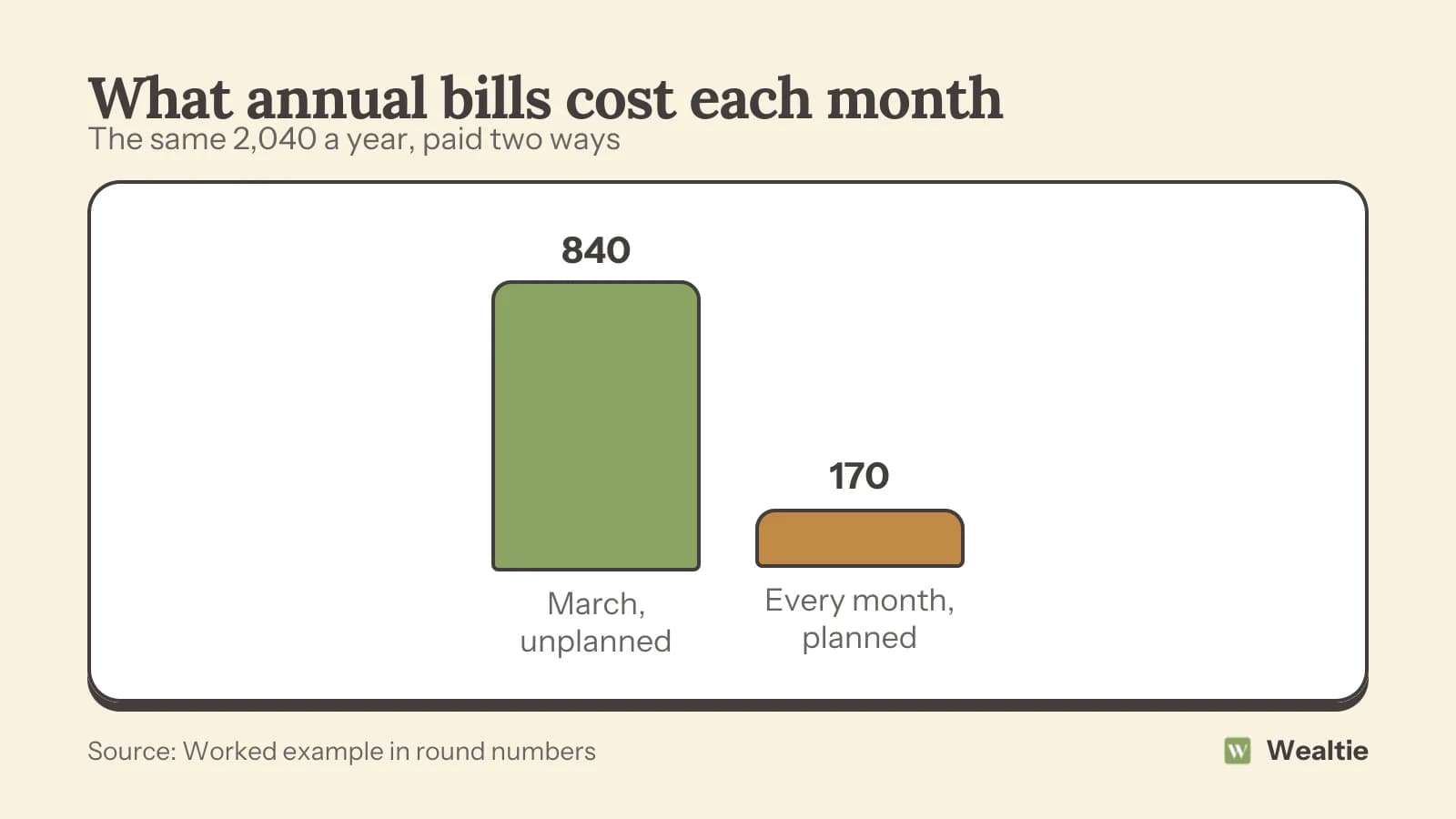
Add up the year's bills and divide by 12. Here's a worked example in round numbers that work in any currency:
| Bill | Amount | Month it's due |
|---|---|---|
| Car insurance | 840 | March |
| Yearly subscriptions | 120 | May |
| Car service | 480 | September |
| Gifts and holidays | 600 | December |
| Total | 2,040 |
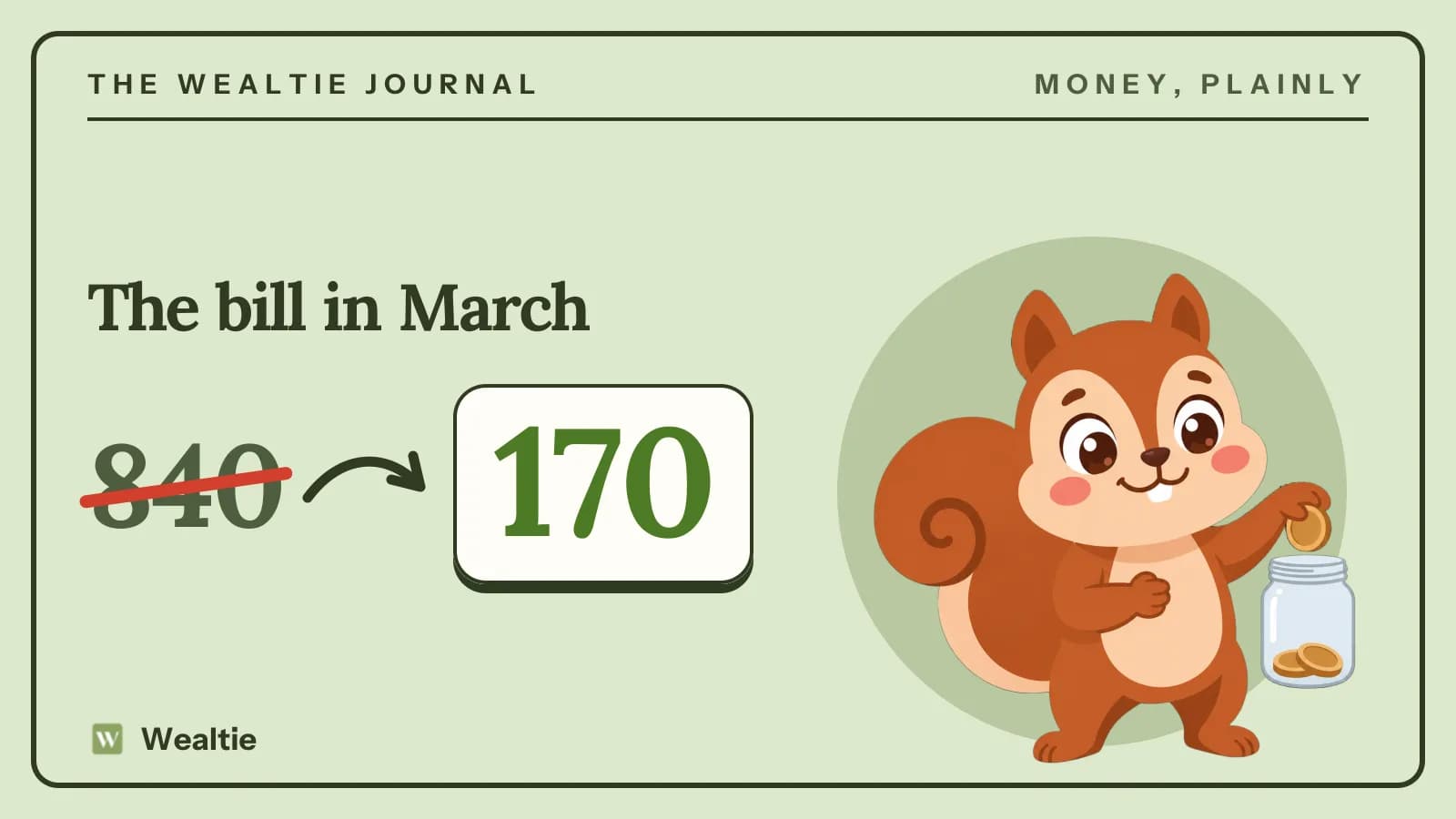
2,040 divided by 12 is 170 a month. Without a plan, March costs 840 on top of everything else. With one, every month costs 170.
A bill that's close needs more at first. With the insurance due in four months, that's 210 a month until March, then 70 a month from then on. The mechanics of running this as a pot are in what is a sinking fund.
How do you budget for annual expenses in a monthly budget?
Pick one of two ways to count them, because using both counts the same money twice.
Count the set-aside. The 170 is a line in your budget each month. When the insurance comes out of the savings pot, you don't count it as this month's spending, since you've already budgeted for it.
Count the bill. The budget stays as it is in ordinary months, and you raise it for the month the bill lands. The 170 still moves to savings each month, as a transfer and not as spending.
The first suits a budget on paper or in a spreadsheet, where you choose what counts. The second suits an app that adds up your transactions, where the bill will appear in the month it's paid.
Which annual expenses get forgotten most?
The ones that renew quietly or never arrive as a bill. Check this list against your statements:
- Car: insurance, road tax or registration, the service, an inspection
- Home: home or contents insurance, a boiler service
- Subscriptions: cloud storage, software, breakdown cover, anything you bought on a yearly plan
- Health: dental check-ups, glasses, the vet
- Work: professional fees, a licence renewal, an accountant
- People: birthdays, holidays, back to school
If a cost's too uncertain to date, like the vet, give it a yearly amount anyway and add it to the total.
What if your income changes month to month?
Set aside a share of what comes in, not a fixed amount. If the annual bills come to 2,040 and you expect to earn about 34,000 this year, move 60 out of every 1,000 you're paid. Slow months put in less and good months put in more.
Check the pot each quarter against what's due next. There's more on this in the guide to how to budget on irregular income.
What if a bill arrives before you've saved for it?
Pay what the pot holds and take the rest from that month's budget. Then carry on as planned.
If the insurance is 840 and the pot holds 500, there's 340 to find in March instead of the whole amount. If the renewal offers monthly payments, check what they add to the total before you take them. Some insurers charge for spreading the cost, and the quote will show it.
How do you keep annual bills from creeping up?
Check the price about six weeks before each renewal. Insurance, phone and software renewals tend to roll over at whatever the new price is unless someone looks. How to organize bills has a monthly check that catches them.
After each renewal, update the amount and redo the division. If the insurance goes from 840 to 960, the monthly figure goes up by 10.
How does Wealtie handle annual bills?
A recurring transaction set to Yearly logs itself on the due date and counts against that month's budget, so Wealtie works the second way above. The bill tracker shows what's coming next. Free includes one recurring transaction, and Pro has no limit.
To keep the month honest, raise the budget for the month a big bill lands; editing the amount doesn't touch your streak. On Pro, a budget tracker can run on a yearly period instead, which puts the whole bill inside a limit that covers the year.
The monthly 170 goes from your everyday account to a savings account as a transfer, and transfers don't count as spending.
Questions people ask
Add up every bill that comes once or twice a year, divide by 12, and set that amount aside each month. Then count either the set-aside or the bill against your budget, not both.
Go through twelve months of bank and card statements and write down anything that doesn't appear every month. Check your email for renewal notices too, since some yearly charges are easy to forget.
Paying all at once is usually cheaper if you have the money set aside, because some providers charge extra for spreading the cost. Compare the total of twelve instalments with the single price on your renewal quote.
Yes, as a monthly set-aside or as a bump in the month the bill lands. Leaving them out is what makes a budget fail in the months they arrive.
This article is general information, not financial, tax or legal advice. Your situation is your own; check the numbers that apply to you before you act on them.