Saving: How to set financial goals for 2027 that you'll still have in March
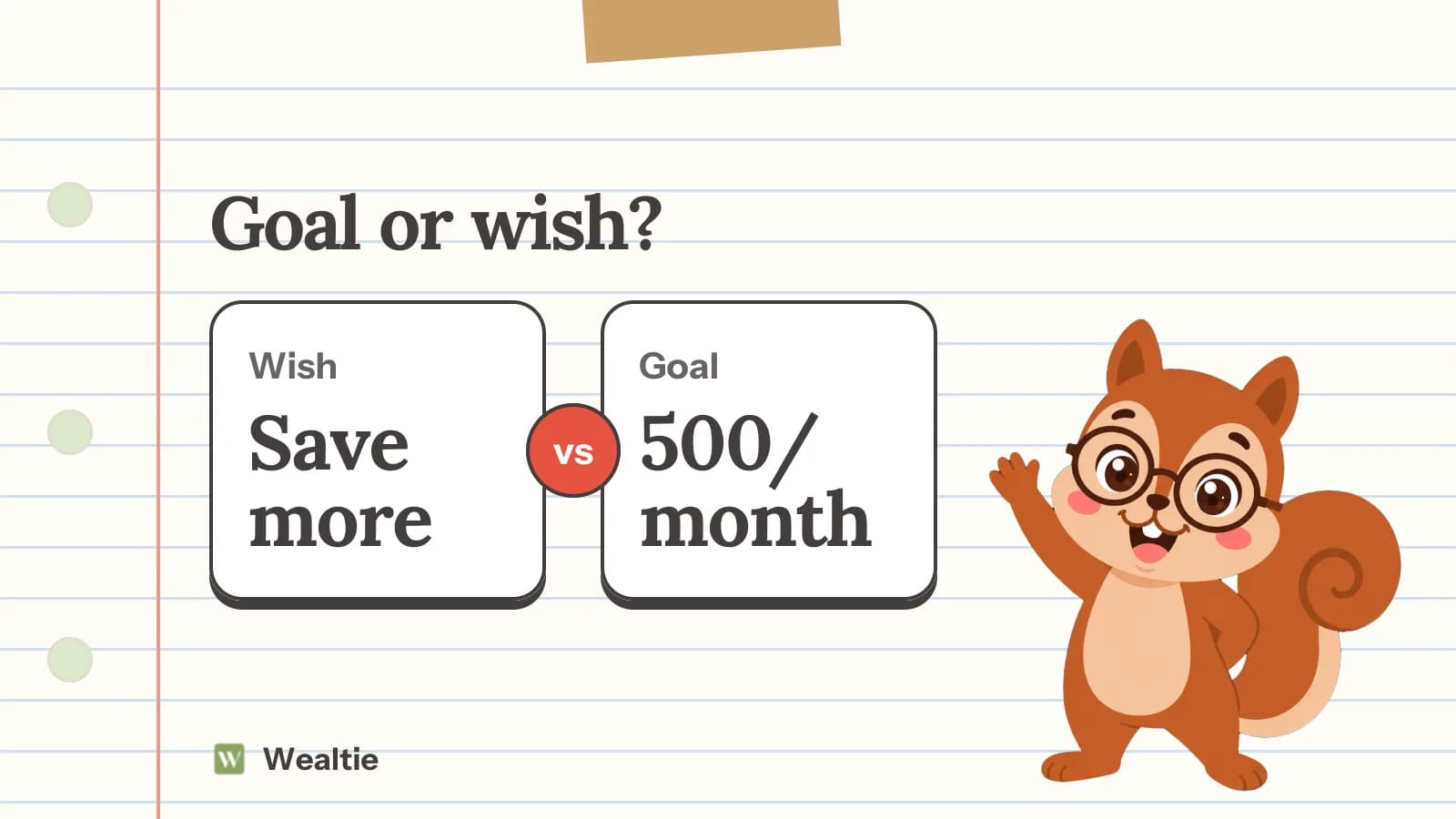
To set financial goals, pick one or two for the year, give each a number, a date and a monthly amount, and move that amount automatically on payday. "Save more" isn't a goal; "save 3,000 by July, 500 a month" is. Order matters too: a small emergency fund comes before almost everything else.
 By Wealtie Team · 3 min read
Key takeaways
- A financial goal needs a number, a date and the monthly amount that gets you there; without the monthly amount, it's a wish.
- One or two goals at a time get done; a list of eight gets abandoned by February.
- The usual order is a starter emergency fund, then high-interest debt, then a fuller emergency fund, then longer goals.
- Move the monthly amount automatically on payday, before you can spend it.
- Check progress monthly and adjust the date, not the habit, when life gets in the way.
How do you set financial goals?
Pick one or two, give each a number and a date, and divide the number by the months until the date. That monthly amount is the goal you'll live with every day.
"Save more" and "get better with money" are directions, not goals. Nobody can tell in March whether they're on track. "Save 3,000 by July" can be checked, and once you divide it out, "500 a month from January" can be automated. That's the version that survives.
What makes a financial goal stick?
A number, a date, a monthly amount, and somewhere for the money to go.
| Vague | Specific |
|---|---|
| Build savings | 3,000 in a separate savings account by 1 July: 500 a month for six months |
| Pay off my card | Card balance of 2,400 at zero by October: about 270 a month at 24% |
| Stop dreading yearly bills | 1,800 sinking fund for insurance and car costs: 150 a month |
| Save for a house | 30,000 deposit in five years: 500 a month |
The numbers in the table are a worked example in round numbers, the same in any currency. Notice what the right-hand column gives you: something to automate on payday, and a balance to check against in any given month.
How many financial goals should you have?
One or two at a time. Each goal needs its own monthly amount, and they all come out of the same paycheck.
A list of eight goals is how every one of them stalls. Add up the monthly amounts before you commit. If they come to more than you can move on payday, drop one or push a date back. Finish a goal, then start the next with the same monthly amount; the habit's already there.
Which financial goal should come first?
Usually, in this order:
- A starter emergency fund. One month of take-home pay, or 500 if that's far off. Without it, the next surprise undoes every other goal. How much should be in an emergency fund explains the first target.
- High-interest debt. Credit cards charging over 20% cost more than almost any saving earns. Above about 10% interest, paying debt usually beats saving more.
- A fuller emergency fund: three to six months of essential costs.
- Known yearly costs in a sinking fund, so insurance and Christmas stop wrecking one month a year.
- Longer goals: a deposit, retirement savings above any employer match, a car.
Retirement contributions that come with an employer match can run alongside step 1, because the match is money you'd otherwise leave behind.
How do you reach a financial goal faster?
Automate the monthly amount, then add every windfall.
- Automate it on payday. A transfer set for the day your pay lands happens whether or not you remember.
- Add windfalls. Tax refunds, bonuses, gifts. Half to the goal is a rule you'll keep.
- Raise the amount with every pay rise. Add at least part of each rise before spending catches up.
- Find the monthly amount in the budget, not the leftovers. Money that's "whatever's left" at the end of the month is usually nothing. How much of your income should you save works out what's realistic on your pay.
If the first goal is small and urgent, a short burst helps. How to save $1,000 fast has a three-month plan.
What do you do when you fall behind?
Move the date, not the habit. If January's car repair ate two months of saving, the goal is now September instead of July, and the 500 a month carries on.
Check once a month: the balance, the date, and whether the monthly amount still fits. Life changes. A goal that changes with it is still a goal; one that's quietly dropped isn't.
How do you track financial goals?
Give each goal its own account or pot, and look at all of them in one place once a month.
In Wealtie, add each savings pot as an account, and the net worth tracker shows the total and each balance, with transfers counted as transfers, not spending. Set your monthly budget so the goal amounts come out first, and Budget Health warns you mid-month if spending is about to eat into them. The Free plan includes a monthly budget and income goal; on Pro, budgets and goals can be set for any period, from daily to yearly.
Questions people ask
Pick what you want, put a number and a date on it, and divide the number by the months until the date. That monthly amount is the real goal. Move it automatically each payday.
One month's pay in an emergency fund, a high-interest card paid off, a sinking fund for yearly bills, or a deposit savings target. Pick one or two that fit where you are now.
One or two at a time. Each needs its own monthly amount, and the amounts have to fit in your budget together. Finish one, then start the next.
Build a small emergency fund first, then pay off debt above about 10% interest, such as credit cards, before building savings further. Without a buffer, the next surprise goes back on the card.
Goals you can reach within a year: a starter emergency fund, a holiday fund, paying off one card. Long-term goals, like a house deposit or retirement, take years and need their own monthly amount alongside.
This article is general information, not financial, tax or legal advice. Your situation is your own; check the numbers that apply to you before you act on them.