Saving: Where to keep your emergency fund (and where not to)
Keep your emergency fund in a separate savings account at an insured bank or credit union, one you can draw on within a few days without a penalty. A high-yield savings or money market deposit account fits. That's where to keep an emergency fund; stocks, money market funds and cash at home are where not to.
 By Wealtie Team · 5 min read
Key takeaways
- An emergency fund belongs in a separate, insured savings account you can draw on within a few days without a penalty, not in the account your card spends from.
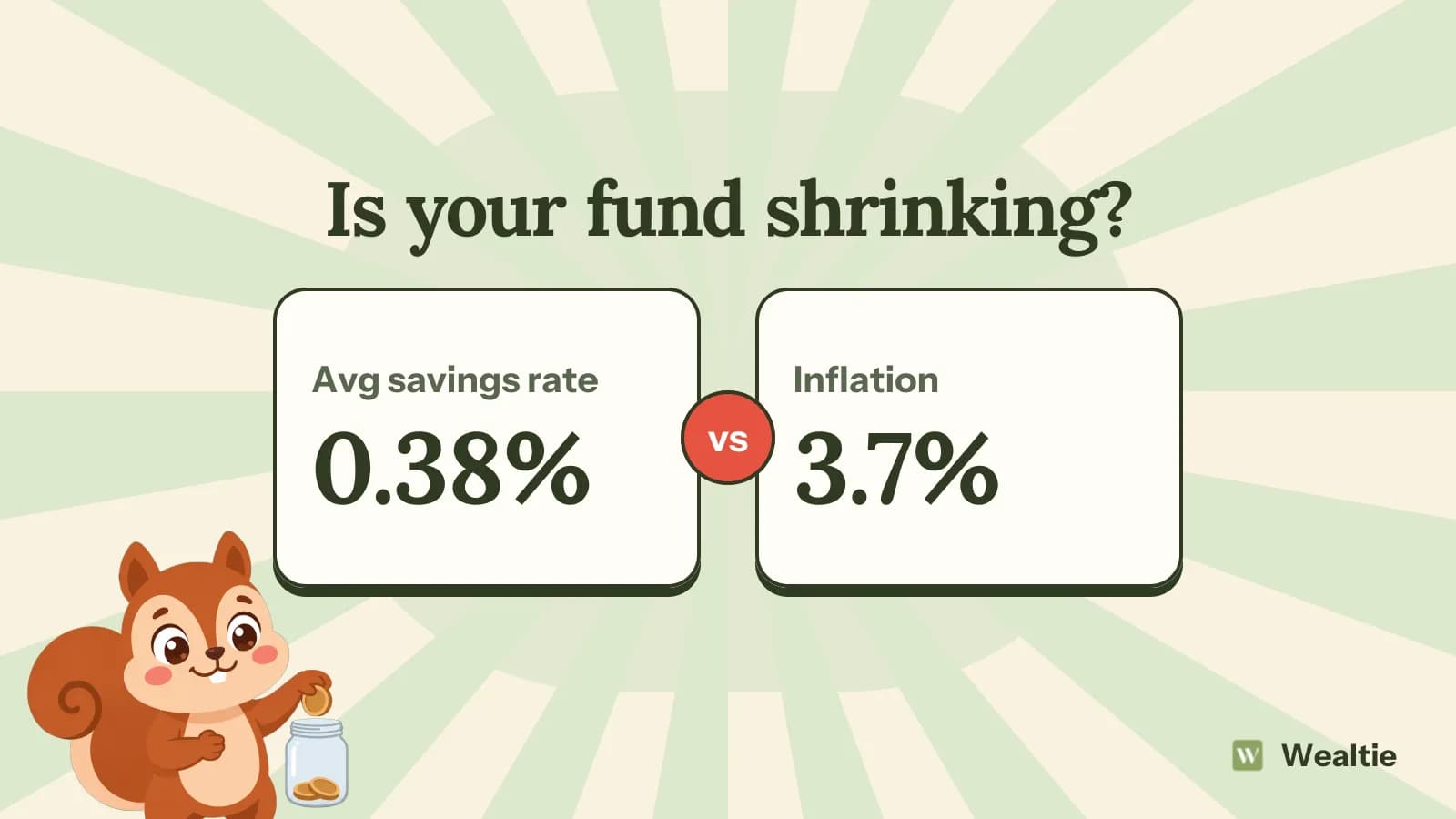
- The national average savings rate was 0.38% in October 2026, while the 13-week Treasury bill paid 4.14%, so the rate your account pays makes a real difference.
- A money market deposit account is an insured bank deposit; a money market fund is an investment that isn't covered by the FDIC.
- FDIC insurance covers up to $250,000 per depositor, per bank, for each ownership category; the UK's FSCS covers £120,000 since December 2025.
- Count the fund in your net worth and record money moved in and out as transfers, so it stays visible without looking like spending.
Where should you keep your emergency fund?
In a separate savings account at an insured bank or credit union, one you can get money out of within a few days, without a penalty.
The Consumer Financial Protection Bureau's guide to emergency funds puts the test in one line: somewhere "safe, accessible, and in a place where you're not tempted to spend it on non-emergencies." Each part rules something out:
- Safe rules out anything whose price can fall, like stocks or crypto. They can be down 20% in the month you lose your job, which is when you'd have to sell.
- Accessible rules out anything with a lock-in or a penalty for taking money out early.
- Not tempting rules out your everyday account, where the fund looks like spending money.
That leaves a savings account or a money market deposit account at a bank or credit union with deposit insurance. Which one comes down to the interest rate.
Why not keep it in your checking account?
Because money in the account your card spends from gets spent, and it earns close to nothing while it waits.
The national average rate on interest checking was 0.07% in October 2026, according to the FDIC's national rates. More important than the rate: a fund sitting next to your spending money looks like spending money. A separate account adds one step between you and it, which is enough to stop the "just this once" withdrawals that aren't emergencies.
Keep it at the same bank if a transfer there arrives instantly. Keep it at a different bank if you'd rather not see the balance every time you check your account. Both work, as long as it isn't in the account your card draws from.
Is a high-yield savings account good for an emergency fund?
Yes. For most people it's the best fit, because it's insured, you can take money out without a penalty, and it pays more than an ordinary savings account.
The gap between ordinary and good rates is wide right now. The national average savings rate was 0.38% in the FDIC's figures for 19 October 2026. The 13-week Treasury bill, the usual benchmark for what safe cash can earn, paid 4.14% on 23 October 2026, according to the US Treasury. Prices rose 3.7% in the year to September 2026, according to the Bureau of Labor Statistics.
Here's what that means for a $5,000 emergency fund over a year, before tax:
| Where it earns | Rate | Interest in a year | After 3.7% inflation |
|---|---|---|---|
| Interest checking, national average | 0.07% | $3.50 | −$181.50 |
| Savings, national average | 0.38% | $19 | −$166 |
| At the 13-week Treasury bill rate | 4.14% | $207 | +$22 |
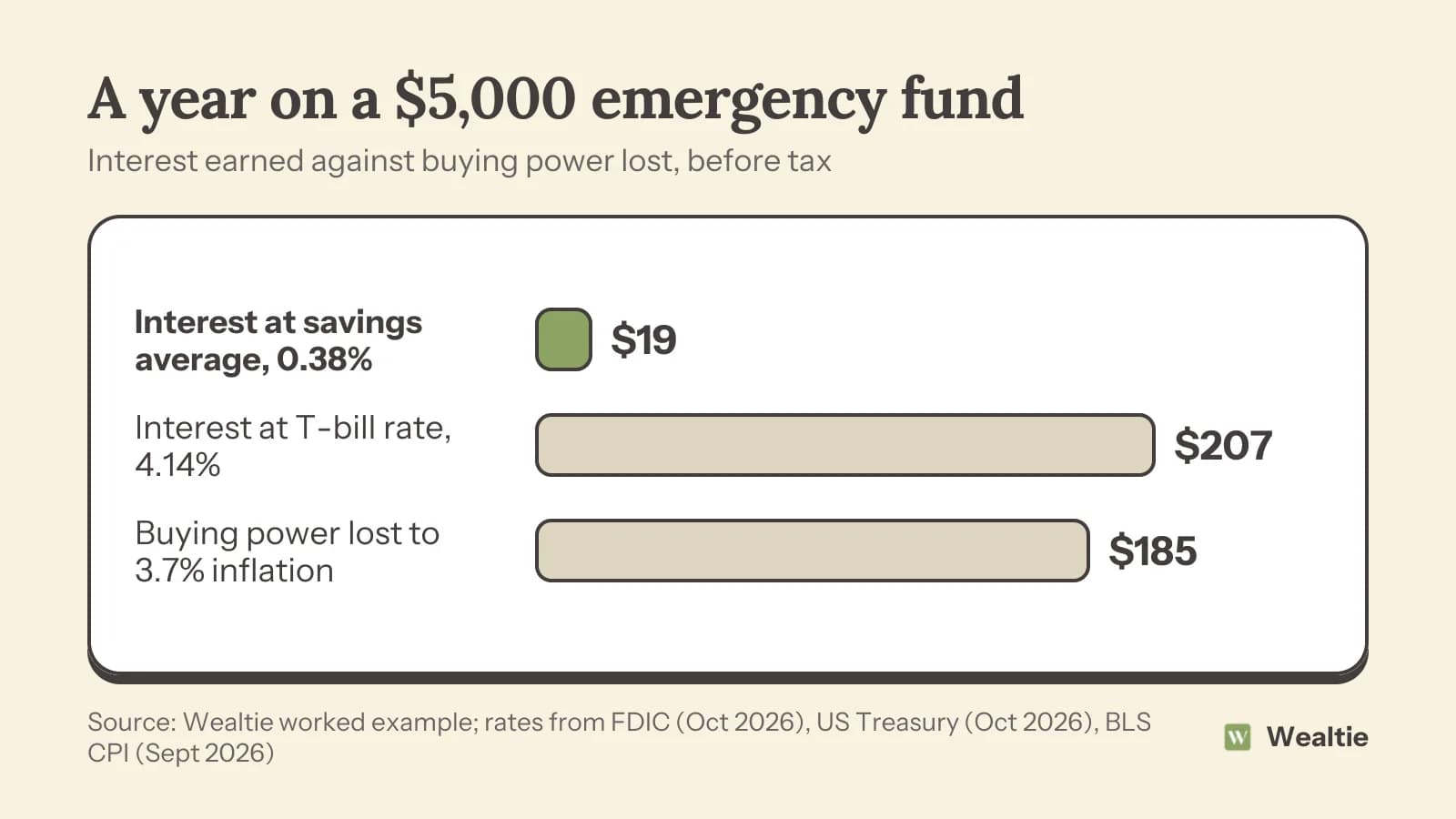
The last row isn't a savings account. It's the ceiling for safe cash right now, and the reason to check what your own account pays. An account paying close to it keeps the fund's buying power. One paying the average loses about $166 of it a year.
Money market account or money market fund?
A money market account is a bank deposit and is insured. A money market fund is an investment and isn't.
The names are close and the products aren't. A money market deposit account is a savings account under another name, covered by the FDIC like any deposit. A money market fund is a mutual fund. Investor.gov, the SEC's investor site, says money in one "is not guaranteed by the FDIC like bank accounts are", and that "there is a risk you may lose some or all of the money you invested".
Here's how the usual options compare:
| Where | Insured? | Getting money out | For an emergency fund |
|---|---|---|---|
| Savings account | Yes, FDIC or NCUA | Usually same day to 3 business days | Yes |
| High-yield savings account | Yes, FDIC or NCUA | Usually 1 to 3 business days | Yes, the usual best fit |
| Money market deposit account | Yes, FDIC or NCUA | Usually 1 to 3 business days | Yes |
| Money market fund | No | Sell, then transfer | Not for the first month |
| Certificate of deposit (CD) | Yes, FDIC or NCUA | Usually a penalty for early withdrawal | Not for the first month |
| Treasury bills | No, but backed by the US government | Sell, or wait until they mature | Only for a large fund |
| Stocks or crypto | No | Price may be down when you sell | No |
| Cash at home | No | Instant | A small amount only |
The CFPB's guide notes that cash at home "can be stolen, lost, or destroyed". A few hundred dollars for a power cut or a card that stops working is reasonable. The fund itself belongs in a bank.
How much of it is insured?
Up to $250,000 per depositor, per bank, for each ownership category, at FDIC-insured banks. That's more than almost any emergency fund.
The FDIC covers checking, savings, money market deposit accounts and CDs. It doesn't cover stocks, bonds, mutual funds, crypto or Treasury bills, even when an insured bank sells them to you. Credit unions have the same $250,000 cover through the NCUA.
Should you split your emergency fund between accounts?
Once it's bigger than a month of costs, splitting it by how fast you'd need each part is worth the extra account.
- The first month of costs: somewhere you can reach today, like a savings account at your main bank. This covers a car repair or a vet bill.
- The rest: a higher-paying savings or money market deposit account, a transfer or two away. This covers a job loss, where you need money over weeks, not hours.
- Beyond three to six months: if the fund keeps growing past what you'd need, some people put the far end in CDs or Treasury bills, which fix a rate for a set term. That's the part you'd only touch in month five of an emergency.
How much should be in an emergency fund sets the targets: one month of income first, then three to six months of essential costs. The emergency fund calculator shows how many months each target takes at what you can save.
How do you keep track of a fund you don't see every day?
Count it in your total, and record every move in and out of it as a transfer, not as spending or income.
A fund at a separate bank is easy to lose sight of. You stop seeing it in your banking app, so you don't know if it's growing, and a withdrawal for a "nearly emergency" goes unnoticed.
Wealtie's net worth tracker keeps your card, cash and savings accounts in one total, and a transfer between your own accounts never counts as spending. Moving $300 to the fund on payday doesn't make your budget look $300 worse, and the $800 you take out for a repair is a transfer back, with the repair itself logged as the expense. The Free plan includes two accounts, which covers an everyday account and the emergency fund.
How much to put in each month is the other half. How much of your income should you save works through the numbers on $3,000 a month.
Questions people ask
In a separate savings account at an FDIC- or NCUA-insured bank or credit union, such as a high-yield savings or money market deposit account. It should be reachable within a few days, without a penalty, and apart from your spending account.
Yes, for most people that's the best fit. It's insured up to $250,000 at FDIC-insured banks, you can withdraw without a penalty, and it pays more than the 0.38% national average savings rate.
A money market deposit account and a high-yield savings account both work, because both are insured bank deposits. A money market fund is different: it's an investment, isn't FDIC-insured, and can lose value.
Only a small amount, for a power cut or a card that stops working. The CFPB warns cash can be stolen, lost or destroyed, and it earns nothing while prices rose 3.7% in the year to September 2026.
In an easy-access savings account at a bank or building society covered by the FSCS, which protects up to £120,000 per person per banking licence since 1 December 2025. Check whether two brands share one licence.
Keep it in an account paying close to the inflation rate. Prices rose 3.7% in the year to September 2026; at the 0.38% national average savings rate, $5,000 loses about $166 of buying power in a year.
Sources
- An essential guide to building an emergency fund · Consumer Financial Protection Bureau · checked 24 October 2026
- National Rates and Rate Caps (as of October 19, 2026) · Federal Deposit Insurance Corporation · checked 24 October 2026
- Daily Treasury Bill Rates, 2026 · U.S. Department of the Treasury · checked 24 October 2026
- Consumer Price Index – September 2026 · U.S. Bureau of Labor Statistics · checked 24 October 2026
- Money Market Funds: Investor Bulletin · U.S. Securities and Exchange Commission (Investor.gov) · checked 24 October 2026
- Understanding Deposit Insurance · Federal Deposit Insurance Corporation · checked 24 October 2026
- Banks, building societies and credit unions: what we cover · Financial Services Compensation Scheme · checked 24 October 2026
- Directive 2014/49/EU on deposit guarantee schemes · European Union (EUR-Lex) · checked 24 October 2026
This article is general information, not financial, tax or legal advice. Your situation is your own; check the numbers that apply to you before you act on them.