Saving: How to build an emergency fund from nothing, one month at a time
Here's how to build an emergency fund: set a first target of one month's income, then move a fixed amount to a separate account every payday. On an income of 3,000, saving 150 a month gets you there in 20 months.
 By Wealtie Team · 3 min read
Key takeaways
- Start with a first target of one month's income, because a smaller goal gets finished sooner.
- On an income of 3,000, saving 150 a month reaches that first target in 20 months, and 300 a month takes 10.
- Set the transfer for payday, so the money moves before the month's spending starts.
- Keep the fund in a separate account, so it doesn't get spent by accident.
- After you use the fund, pause other saving goals and refill it first.
How much should your first target be?
One month of income. That covers most car repairs or a broken boiler, and it's a target you can reach within a year or two.
The bigger targets come later. How much should be in an emergency fund goes through three and six months of essential costs, and the emergency fund calculator works out how long each one takes.
How long does it take to build an emergency fund?
Divide the target by what you can move each month. Here it is on an income of 3,000, in round numbers that work in any currency:
| Saved each month | Months to reach 3,000 |
|---|---|
| 100 | 30 |
| 150 | 20 |
| 300 | 10 |
| 500 | 6 |
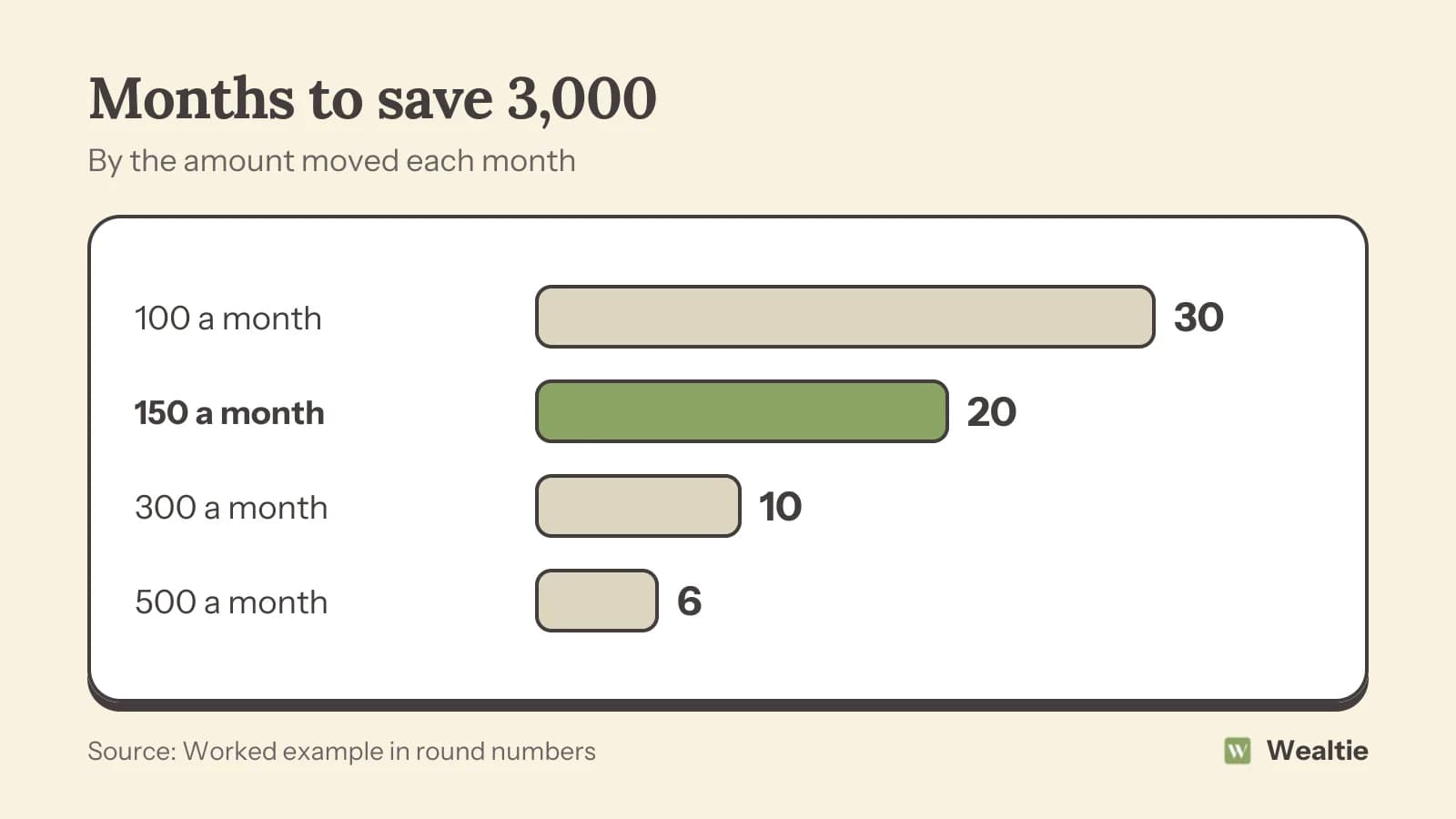
Thirty months feels long. It also ends with 3,000 where there used to be nothing, and every month along the way the fund covers a bit more. By month six at 100 a month, you've got 600, which pays for a lot of ordinary car trouble.
Where does the money come from?
From a number you pick before the month starts. Look at your last three months of spending, find what's left in a typical month, and start with a little less than that.
If nothing's left, take the amount from one category and name it: 40 less on eating out, 30 from a subscription you've stopped using. Small amounts count here. How to save on a low income covers the months when there's little to cut.
Windfalls speed it up. A tax refund or a bonus can go straight in, and one of those can be worth several months of transfers. Selling something you no longer use is the quickest start: a bike, an old phone or a spare chair can put a couple of hundred in the fund in a weekend.
Should you save while you've got debt?
Yes, a small amount. Keep making the minimum on every debt and build a cushion of 500 to 1,000 first. Without one, the next car repair goes on the card and undoes months of repayments.
Once the cushion's there, put extra money toward the debt with the highest rate until it's gone, then come back to the one-month target. Pay off debt or save works through the numbers.
How do you make it happen every month?
Set an automatic transfer for payday. The money moves before the rent, the shopping and the Friday night, so you don't have to decide each month whether to save it.
Pick an amount you won't have to cancel. You can raise it after a pay rise, once you've seen what the lower amount felt like.
Where should you keep it while it grows?
Somewhere separate from your everyday account that you can reach within a day or two. Separate, because money sitting beside your spending money tends to get spent. Where to keep your emergency fund compares the options.
What happens when you need to use it?
Use it, then refill it. That's what it's there for, and what counts as an emergency has a test for the cases that feel borderline.
Once the bill's paid, put the transfer back to its normal amount and pause any other saving goals until the fund's full again.
How do you keep going for 20 months?
Break the target into stages and write down when you reach each one. For 3,000, that's 750, 1,500, 2,250 and the full amount. Look at the balance once a month and leave it alone the rest of the time.
If a month goes badly, lower the transfer for that month and leave it running. Twenty moved in a bad month keeps the routine in place, and the routine's harder to restart than the amount is to raise.
When is the fund big enough?
When it reaches the target you set, and then you stop. One month of income is the first stop. Three months of essential costs is a sensible next one, or six if you're the only earner or your income swings.
After that, point the transfer at something else: a goal, a deposit, longer-term savings. Money beyond the target isn't making you any safer.
How do you track an emergency fund in Wealtie?
Add the savings account as its own account, then move money into it as a transfer. Transfers aren't counted as spending, so your budget tracker stays clean, and the fund's balance sits in your total across accounts. The Free plan includes two accounts, which is enough for one everyday and one fund. Tracking an emergency fund in Wealtie has the steps.
Questions people ask
Start with whatever amount you can move on payday, even 20 or 30, and take it from one named category. Add windfalls like a tax refund when they come, and raise the transfer once it's running.
Divide your target by what you can save each month. A target of 3,000 takes 20 months at 150 a month and 10 months at 300.
Build a small fund first, then put extra money toward high-interest debt. A small cushion means the next surprise bill doesn't go back on the card.
Put in an amount you can keep up every month, a little below what's left in a typical month. It's better to raise a small transfer later than to cancel a big one.
This article is general information, not financial, tax or legal advice. Your situation is your own; check the numbers that apply to you before you act on them.