Saving: How much should be in an emergency fund? Start with one month
Aim for one month of take-home income in your emergency fund first. In CFPB research, 44% of people with some savings but less than a month of income had trouble paying a bill in the past year. Among those with at least a month saved, 6% did.
 By Wealtie Team · 3 min read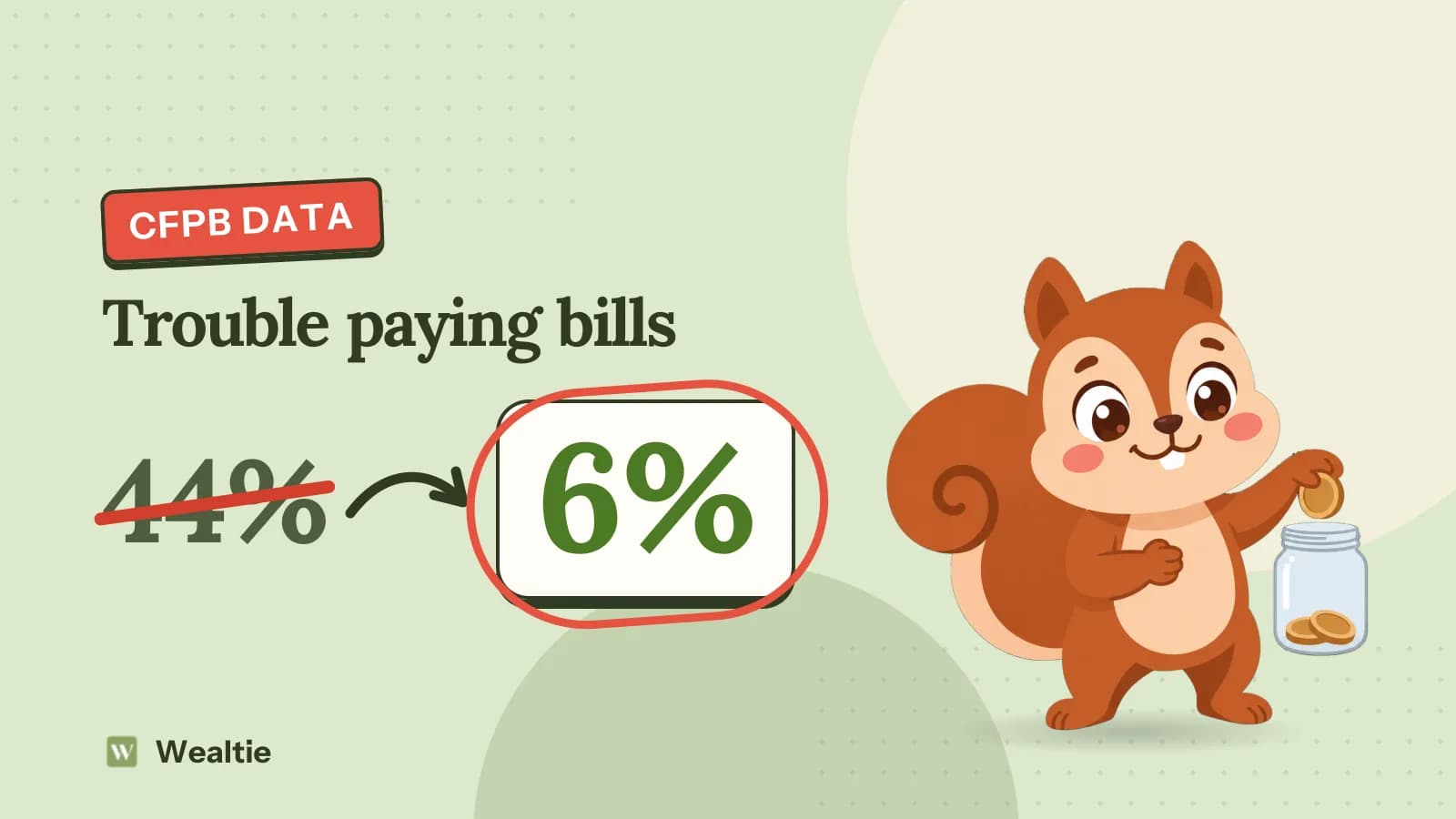
Key takeaways
- The first emergency fund target worth chasing is one month of take-home income, because that's where trouble paying bills drops from 44% to 6% in CFPB data.
- 63% of US adults would cover a surprise $400 expense with cash, savings or a card they pay off at the next statement, according to the Federal Reserve's 2025 survey.
- The typical income dip or expense spike is about three weeks of income, so one month covers the usual shock with a little to spare.
- The three-to-six-months rule has no single official source; past one month, size the fund by how long it would take you to replace lost income.
- Keep the fund in a separate, insured account you can reach in a day, and move money into it on payday before anything else.
How much should be in an emergency fund?
One month of take-home income, to start. That's the line where the data shows the biggest change, and it's a number most people can reach within a year or two.
The Consumer Financial Protection Bureau split survey respondents into three groups: no emergency savings, some savings but less than a month of income, and at least a month of income. Then it matched their answers to their credit records.
| In the past 12 months | No emergency savings | Less than a month of income | At least a month of income |
|---|---|---|---|
| Had trouble paying a bill | 79% | 44% | 6% |
| Overdrew a checking or savings account | 35% | 19% | 4% |
| Has debt 60+ days past due | 40% | 19% | 5% |
Going from nothing to something helps. Going from something to a full month helps far more: trouble paying bills falls from 44% to 6%.
Why is one month the line that matters?
Because one month is bigger than the typical shock. Research by the JPMorgan Chase Institute, cited in the same CFPB report, found that the median expense spike or income dip is about three weeks of income, and the typical family has more than one a year.
A fund smaller than that gets wiped out by an ordinary bad month: a car repair, a slow invoice, a dentist bill. A fund of one month absorbs it and still leaves something for the next one.
How many people have that much?
Fewer than you'd think. In the CFPB data, 24% of consumers had no emergency savings at all and 39% had less than a month of income. Only 37% had a month or more.
The Federal Reserve asks a smaller question every year: could you cover a surprise $400 expense? In its 2025 survey, 63% of adults said they'd pay it with cash, savings or a credit card they pay off at the next statement. The other 37% would have to borrow, carry a balance or find the money some other way.
What does that look like in real numbers?
Work in stages, each with its own number. On a take-home income of $3,200 a month, with $2,200 of essential costs (rent, utilities, groceries, insurance, transport, minimum debt payments) and $200 a month going into the fund:
| Stage | Target | Months at $200 a month |
|---|---|---|
| Cover the $400 surprise | $400 | 2 |
| One month of income | $3,200 | 16 |
| Three months of essential costs | $6,600 | 33 |
The second stage is the one the CFPB data rewards. The third is where most advice starts, and it's why so many people never begin: 33 months is a long way off when the car needs tyres now.
Is three to six months the right target after that?
It's a common rule of thumb, not a standard. There's no single official source for it, and the CFPB's own guidance says the amount depends on your situation.
A more useful question: how long would it take you to replace your income if it stopped? Hold more than three months if:
- your pay changes month to month (see how to budget on irregular income),
- one income covers the whole household,
- finding work in your field usually takes a while.
Where should you keep it?
In a separate, insured bank or credit union account you can reach within a day. The CFPB calls a bank or credit union account one of the safest places for emergency savings, and suggests somewhere you're not tempted to spend it.
Separate matters more than it sounds. Money sitting in your everyday account gets spent on everyday things.
How do you build it without it stalling?
Move the money on payday, before anything else, and log it. The CFPB recommends a recurring transfer from checking to savings so it happens without a decision each month.
In Wealtie, give the fund its own account. The net worth tracker shows it next to your card and cash, and a transfer between your own accounts isn't counted as spending, so your budget tracker stays honest while the fund grows. The Free plan includes 2 accounts, which is enough for a spending account and the fund.
What if you have to use it?
Then it did its job. Spend what the emergency needs, no more, and point the next payday transfers back at the fund until it's where it was.
Go back one stage rather than starting over. If a $1,200 repair takes a $3,200 fund down to $2,000, you're still past the $400 stage, and at $200 a month you're six months from one month of income again. Pause the extra goals until then; they'll wait, and the next surprise won't.
Questions people ask
Start with one month of take-home income. CFPB research found trouble paying bills fell from 44% to 6% once people had at least a month of income saved. After that, add months of essential costs based on how long it would take you to replace your income.
It's a good first milestone but usually not enough on its own. It covers many single surprises, like a car repair, but one month of take-home income is the level where the CFPB data shows the biggest drop in trouble paying bills.
Neither number is a rule. Three months of essential costs suits steady income from more than one earner; lean towards six or more if your pay varies, you're the only earner, or work in your field takes a while to find.
In a separate, insured bank or credit union savings account you can reach within a day. Keeping it apart from your everyday account stops it being spent on everyday things.
Sources
- Emergency Savings and Financial Security: Insights from the Making Ends Meet Survey and Consumer Credit Panel · Consumer Financial Protection Bureau (March 2022) · checked 10 October 2026
- Economic Well-Being of U.S. Households in 2025: Executive Summary · Board of Governors of the Federal Reserve System (May 2026) · checked 10 October 2026
- An essential guide to building an emergency fund · Consumer Financial Protection Bureau · checked 10 October 2026
This article is general information, not financial, tax or legal advice. Your situation is your own; check the numbers that apply to you before you act on them.