Saving: Should you pay off debt or save first? An order that works
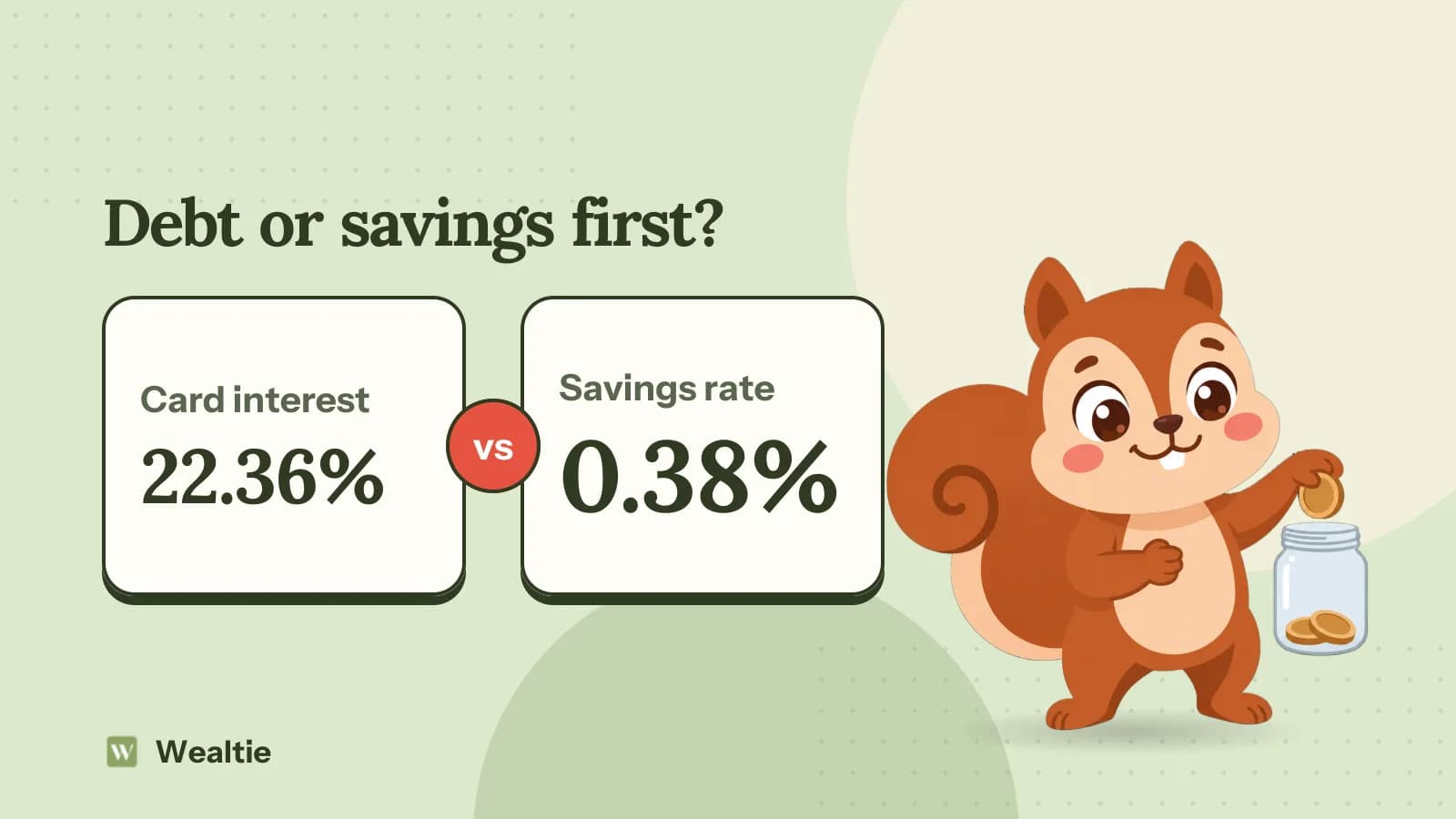
Pay off debt or save? Both, in order: a small emergency fund first, then high-interest debt, then a full emergency fund. A credit card charged 22.36% on average in August 2026 while the average savings account paid 0.38%, so every spare dollar on the card earns far more than it would saved.
 By Wealtie Team · 3 min read
Key takeaways
- Build a small emergency fund first, around 500 or one month of essentials, so the next surprise doesn't go back on the card.
- Then put every spare dollar on high-interest debt: US cards averaged 22.36% on accounts paying interest in August 2026, against 0.38% on the average savings account.
- Paying off a debt at 22% is a guaranteed 22% return; no savings account comes close.
- Once high-interest debt is gone, build the full emergency fund, then decide on low-interest debt case by case.
- If your employer matches retirement contributions, contribute enough to get the full match even while paying off debt.
Should you pay off debt or save first?
Both, in a set order. Paying off debt and saving pull on the same spare money, and doing them in the wrong order costs you either interest or a setback. This order works for most people:
- A small emergency fund: about 500, or one month of essentials.
- Any employer retirement match: contribute enough to get it in full.
- High-interest debt: credit cards, store cards, payday loans and other expensive borrowing.
- A full emergency fund: three months of essentials or more.
- Low-interest debt and longer-term saving, side by side.
The rest of this post explains why each step sits where it does.
Why save a small emergency fund first?
Because without one, the next surprise goes back on the card, and the payoff plan goes backwards.
A car repair, a vet bill or a broken phone happens to almost everyone in a year. If there's no cash for it, it goes on a credit card at the same rate you're trying to escape. A small buffer breaks that loop. It doesn't need to be large: 500, or one month of essentials, is enough to stop most surprises from becoming new debt. How much should be in an emergency fund explains why one month is the first target that matters.
Keep it in a separate savings account, so it isn't spent by accident, and don't let it grow much past the target until the expensive debt is gone.
Why pay off high-interest debt before saving more?
Because the interest you pay on it is far higher than any interest you'll earn on savings.
Credit card accounts that paid interest were charged 22.36% a year on average in August 2026, according to the Federal Reserve's G.19 release. The average savings account paid 0.38% in October 2026, by the FDIC's national rates. High-yield accounts pay more, but nowhere near 22%.
| 1,000 for a year | Interest |
|---|---|
| Owed on a card at 22.36% | You pay about 224 |
| Saved at 0.38% | You earn about 4 |
Paying off a debt at 22% is the same as earning a guaranteed 22% return. Nothing else on offer does that. Once the buffer is in place, every spare dollar is worth more on the card than in savings.
Debt snowball vs avalanche explains which debt to pay first when you have several.
Why take an employer match before paying debt?
Because a match is extra pay you only get if you contribute. If your employer adds 50 cents for every dollar you put into a retirement plan, up to a limit, that's an instant 50% return on the money. No debt costs that much. Contribute enough to get the full match, then send everything else to the debt.
If there's no match, skip this step until the high-interest debt is gone.
What comes after the high-interest debt is gone?
The full emergency fund. Once the expensive debt is cleared, take the amount you were paying on it each month and point it at savings until you have three months of essentials or more. You're already used to living without that money, so the switch is painless.
After that, low-interest debt, like many mortgages or some student loans, can usually be paid on schedule while you save for other goals. Paying it off early is a reasonable choice, but not an urgent one.
What does that look like in numbers?
Here's a worked example in round numbers, the same in any currency. You have 300 a month spare and 2,000 on a credit card at 22.36%.
- Months 1 and 2: 300 a month to savings, giving a 600 starter fund. The card gets its minimum payment from your regular budget.
- Months 3 to 10: 300 a month to the card instead, which clears the 2,000 in eight months.
- After that: the whole 300 moves to savings, building the full emergency fund.
The order matters more than the exact numbers. If a surprise comes in month 6, it's paid from the 600, the fund is topped up, and the card payoff continues a little later.
How do you keep both on track?
Give each one its own line in your budget and move the money on payday.
In Wealtie, add the savings account to your accounts and log each payday move as a transfer, so it doesn't count as spending. Set the card payment as a recurring transaction, and include both in your monthly budget. When the card is paid off, change the recurring payment into a transfer to savings instead.
Questions people ask
Save a small emergency fund first, about 500 or one month of essentials, then put spare money on high-interest debt, then build a full emergency fund. Low-interest debt can be paid on schedule while you save.
Pay off the card, once you have a small buffer. US cards averaged 22.36% interest on accounts paying interest in August 2026, while the average savings account paid 0.38%, so money on the card saves far more than it earns in savings.
Because without a buffer, the next car repair or bill goes straight back on the card. A small emergency fund keeps your payoff plan from going backwards.
Not before you have a full emergency fund. Debt at a low rate, like many mortgages, can be paid on schedule while you save; paying it off early is a choice, not a priority.
Not if your employer matches them. Contribute at least enough to get the full match, since that's extra pay, and put the rest toward high-interest debt.
Sources
- Consumer Credit - G.19 (release of 7 October 2026) · Board of Governors of the Federal Reserve System · checked 6 November 2026
- National Rates and Rate Caps, October 2026 · Federal Deposit Insurance Corporation · checked 6 November 2026
This article is general information, not financial, tax or legal advice. Your situation is your own; check the numbers that apply to you before you act on them.