Budgeting: What is personal cash flow, and how do you make it positive?
Personal cash flow is the money that comes in each month minus the money that goes out. If it's positive, you're building savings, and if it's negative, you're drawing on savings or borrowing to cover the gap.
 By Wealtie Team · 3 min read
Key takeaways
- Personal cash flow is money in minus money out over a month.
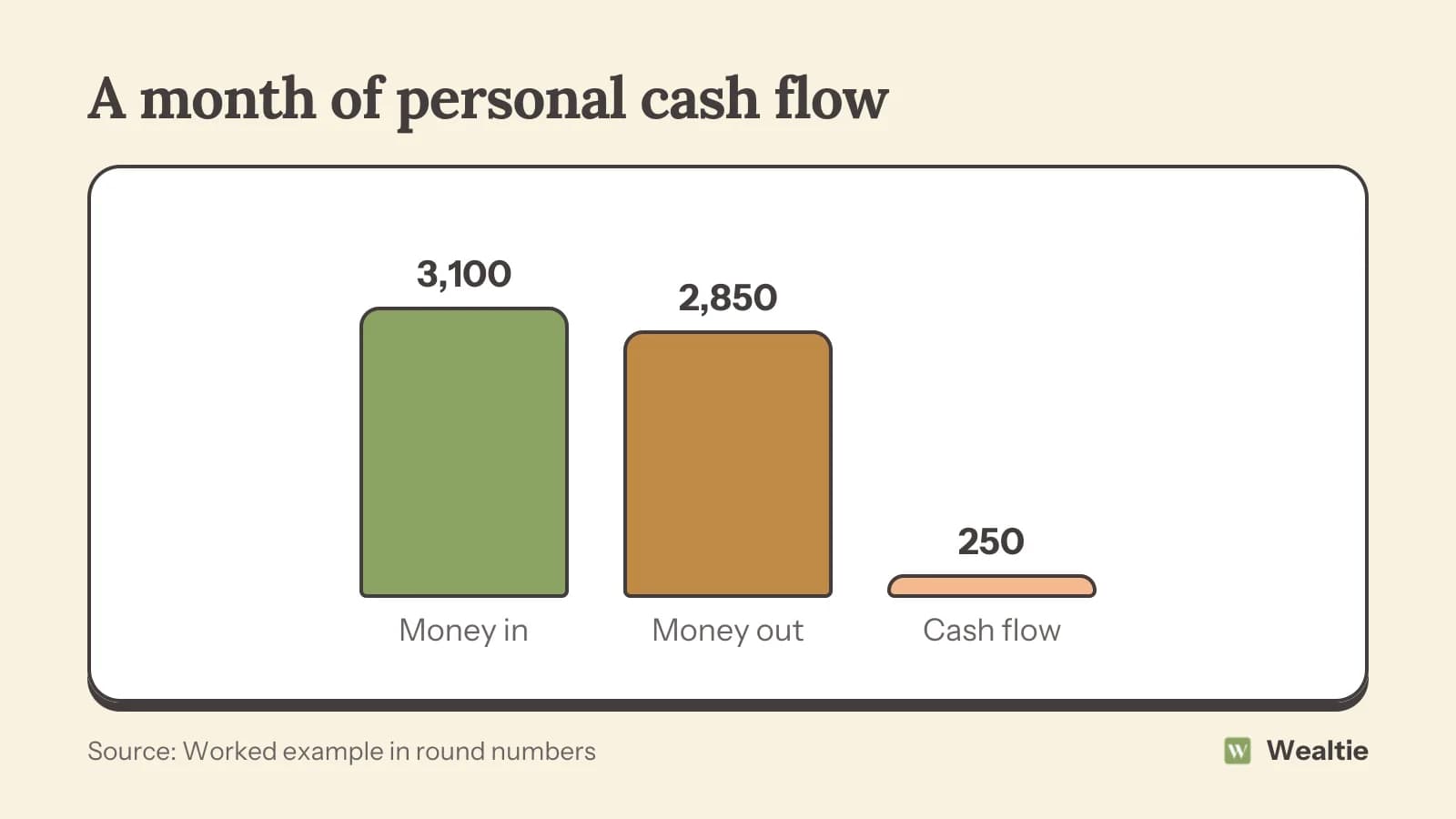
- In a worked example, 3,100 in and 2,850 out gives positive cash flow of 250.
- Timing matters as well as the total: a positive month can still have days where the account runs short.
- Fix negative cash flow by raising income, cutting fixed costs or both, since small cuts rarely close a large gap.
What is personal cash flow?
The difference between what comes in and what goes out over a period, usually a month. Businesses track it closely, and it works the same way for a household. It answers one question: are you getting ahead or falling behind?
Positive cash flow means money's left over, which can go to savings or debt. Negative cash flow means you're spending more than you take in, and the gap is coming from savings, a credit card or an overdraft.
How do you work out personal cash flow?
Add up everything that came in, then everything that went out, and subtract. Here's a worked month in round numbers that work in any currency:
| Line | Amount |
|---|---|
| Take-home pay | 2,800 |
| Side income | 300 |
| Money in | 3,100 |
| Rent | 1,100 |
| Bills | 300 |
| Groceries | 450 |
| Transport | 160 |
| Everything else | 840 |
| Money out | 2,850 |
| Cash flow | +250 |
Count only real money in and out, and use a full month so every bill is in it. A transfer from your current account to savings isn't money out, it's money moving. Count the savings as part of your positive cash flow, not as spending.
Why does timing matter?
Because a month can be positive overall and still have days where the account runs dry. If your pay arrives on the 25th and rent leaves on the 1st, you're fine. If rent leaves on the 20th, you might be short for five days, even in a positive month.
So look at when money moves as well as how much. A simple way to see it is to put each payday and each big bill on a calendar for the month and check the balance never drops below your buffer. Line up the big bills to leave just after payday, and keep a small buffer in the account for the rest. How to organize bills shows how to move due dates.
What if your cash flow is negative?
Find out by how much, and whether it's a one-off or every month. A single negative month because of a car repair is a different problem from a gap of 150 every month. The second one adds up to 1,800 a year.
To fix a regular gap, look at the biggest numbers first:
- Fixed costs, like rent, car payments and insurance
- Debt payments, which might be cheaper if consolidated or renegotiated
- Income, through a pay rise, extra hours or side work
Small cuts like coffee rarely close a large gap on their own. They help, but rent, transport and debt usually decide it. A bare bones budget helps if you need to cut fast, and how to negotiate bills can bring the fixed ones down.
How does irregular income change it?
It makes each month's number swing. One month might be strongly positive and the next negative. What matters is the average over several months, and whether you've got enough savings to cover the low ones.
Work out your cash flow over three or six months, not one. Keep a running total for each month in a note, since the trend tells you more than any single month. If the average is positive, you need a buffer to smooth it. If it's negative, the same fixes apply. The guide on how to budget on irregular income goes into this.
What should you do with positive cash flow?
Give it a job before it disappears. Without a plan, a surplus tends to get absorbed into ordinary spending. A simple order:
- A small emergency cushion
- High-interest debt
- A full emergency fund
- Goals and longer-term saving
Setting up an automatic transfer for the surplus on payday is the easiest way to make sure it goes somewhere. Pay yourself first covers the setup.
How is cash flow different from net worth?
Cash flow is about a period: money in and out over a month. Net worth is a snapshot: everything you have minus everything you owe, on one day. Positive cash flow is how net worth grows over time, since each month's surplus adds to what you've got. That's why a positive monthly number matters even when it's small.
How do you see your cash flow in Wealtie?
Log income and spending, and the monthly view in spending analytics shows the month against the one before. On Pro, the income side includes what you kept: income against expenses, the net, and the share of income you still have. Transfers between your accounts aren't counted as spending, so savings don't make cash flow look negative. The income tracker shows money in against your goal.
Questions people ask
The money that comes in each month minus the money that goes out. Positive means you have money left over; negative means you're spending more than you earn.
Add up all the money that came in, subtract everything that went out, and leave out transfers between your own accounts.
Usually fixed costs that are too high for your income, debt payments, or irregular income in a low month. One-off costs can cause a single negative month.
Look at the biggest numbers first: rent, transport, debt payments and income. Small cuts help but rarely close a large gap alone.
This article is general information, not financial, tax or legal advice. Your situation is your own; check the numbers that apply to you before you act on them.



