Budgeting: How to organize bills so nothing is paid late again
To organize bills, make one list of every bill with its amount, due date and how it's paid, then move due dates so they fall just after payday and automate the fixed ones. Yearly bills get a monthly amount set aside, so nothing arrives as a surprise. The whole system takes an evening to set up.
 By Wealtie Team · 3 min read
Key takeaways
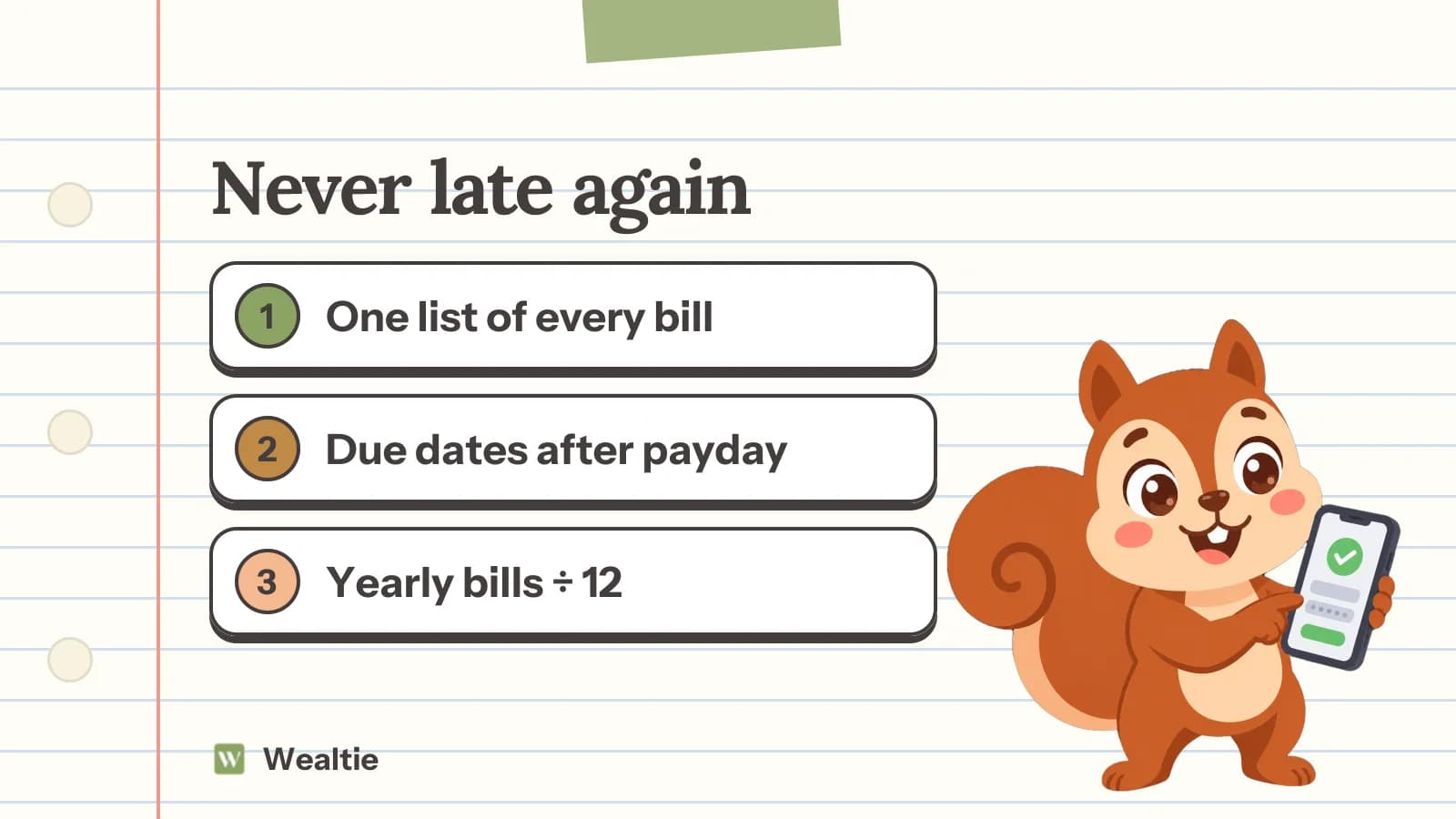
- Start with one list of every bill: name, amount, due date, how it's paid and whether the amount changes.
- Move due dates to the few days after payday, so money arrives before bills leave.
- Automate fixed bills by direct debit or autopay; check variable bills before they're paid.
- Give yearly and quarterly bills a monthly amount in a separate pot, so they never hit one month alone.
- A short monthly check, ten minutes after payday, catches price rises, failed payments and forgotten renewals.
How do you organize bills?
Make one list of every bill, move due dates to just after payday, automate the fixed ones, and set aside a monthly amount for the yearly ones. Then check it once a month.
Most late payments aren't about money. They're about a bill nobody remembered, a due date that falls two days before payday, or a yearly renewal that landed in a month with nothing spare. A simple system fixes all three.
Step 1: list every bill in one place
Go through three months of bank and card statements, and twelve months for yearly bills. Write each one down with five details.
Here's a worked example in round numbers, the same in any currency:
| Bill | Amount | Due date | Paid by | Changes each month? |
|---|---|---|---|---|
| Rent | 1,100 | 1st | Standing order | No |
| Energy | 160 | 15th | Direct debit | Yes |
| Phone | 45 | 22nd | Card | No |
| Internet | 60 | 3rd | Direct debit | No |
| Car insurance (monthly) | 120 | 10th | Direct debit | No |
| Streaming and apps | 30 | various | Card | No |
| Gym | 15 | 28th | Card | No |
| Monthly total | 1,530 |
The "changes each month?" column matters. Fixed bills can be automated and forgotten. Bills that change need a quick look before they're paid.
Step 2: move due dates to after payday
If you're paid on the 25th, the safest window for bills is the 26th to the 5th. Money arrives, then leaves.
Most providers let you change a due date; it's usually a setting in your account or a short phone call. Rent is the hardest to move, so move everything else around it. If you're paid every two weeks, split the list between the two paychecks so each covers its share.
Grouping bills into one window also means one check, not seven scattered through the month.
Step 3: automate what you can
Fixed bills go on direct debit, standing order or autopay. Variable bills get checked first.
Automation stops forgotten payments, but it can also hide price rises. For a bill that changes, energy or a credit card, either check the amount before the payment date, or automate the minimum and pay the rest by hand. Keep enough in the account on the payment day: an automated bill that bounces is worse than a manual one paid on time.
Step 4: plan for yearly and quarterly bills
Divide each by 12 and move that amount into a separate pot every month.
Continuing the example, yearly bills for a TV licence or software (180), the car's registration and service (600) and a yearly subscription bundle (240) come to 1,020, or 85 a month. When each bill arrives, the money is already there. A sinking fund is the name for exactly this pot.
Step 5: check the list once a month
Ten minutes, the day after payday: did everything go out, did anything change, and is anything renewing next month?
It catches price rises before they become normal, failed payments before they become late fees, and renewals before they roll over at a higher price. Cancel what you no longer use while you're there, and compare quotes on anything renewing in the next six weeks, especially insurance, phone and energy.
What if you can't pay a bill this month?
Call the provider before the due date, not after. Many will move the date, spread the payment or set up a short-term plan if you ask early, and some have hardship schemes for exactly this.
If more than one bill is at risk, pay in order of what protects you most: housing first, then energy and water, then anything that could lead to losing something you need, like a car you drive to work. Debts like credit cards come after, with at least the minimum if you can manage it. Write down who you spoke to and what was agreed. And once the month is over, look at what caused the gap: often it's timing that can be fixed for good with step 2.
How do you keep bills in one place?
A spreadsheet, a calendar or an app all work, as long as there's one list and you look at it monthly.
Wealtie's bill tracker lets you add each bill as a recurring transaction that logs itself on its due date, so fixed bills appear in your spending without you entering them each month. The Free plan includes one recurring transaction; Pro has unlimited. With bills logged, your monthly budget shows what's left after them, and Budget Health warns you mid-month if spending is heading over. How to stop overspending covers the categories that tend to squeeze the bills.
Questions people ask
Make one list of every bill with its amount and due date, move due dates to just after payday, automate the fixed ones, and set aside a monthly amount for yearly bills. Check the list once a month.
Keep a single list or calendar with each bill's due date and amount, and log each payment as it leaves. A budgeting app with recurring transactions can log fixed bills automatically on their due date.
Fixed bills, yes, as long as the money is in the account on the day. For bills that change, like energy or a card, check the amount before it's paid, or autopay the minimum and pay the rest by hand.
Split the bills between the two paychecks so each covers its share, and move due dates to fall a few days after the paycheck they're assigned to.
Divide each yearly bill by 12 and move that amount into a separate account every month. When the bill arrives, the money is already there.
This article is general information, not financial, tax or legal advice. Your situation is your own; check the numbers that apply to you before you act on them.