Budgeting: Should you pay off your car loan early? What overpaying saves
Should you pay off your car loan early? It saves interest and frees up your budget sooner: On a 20,000 five-year loan at the Fed's latest average of 7.54%, an extra 100 a month saves about 970 and 13 months.
 By Wealtie Team · 3 min read
Key takeaways
- Overpaying a car loan reduces the interest and shortens the term.
- In the Fed's G.19 data, 60-month new car loans at commercial banks averaged 7.54% in the third quarter of 2026 (preliminary).
- On 20,000 at that rate, an extra 100 a month saves about 970 in interest and 13 months; an extra 200 saves about 1,560 and 22 months.
- Check for early repayment fees, and clear costlier debt and build an emergency fund first.
Should you pay off your car loan early?
Often, if the loan charges a meaningful rate and you've got the basics covered. Every extra payment, however small, reduces the balance that interest is charged on, so you pay less in total and finish sooner. The money you free up when the loan ends can then go to savings or other goals, which is often the bigger win over time.
What does overpaying save?
Here's a worked example. In the Federal Reserve's G.19 data, 60-month new car loans at commercial banks averaged 7.54% in the third quarter of 2026 (preliminary). On a 20,000 loan over five years at that rate, in round numbers that work in any currency:
| Regular | 100 extra a month | 200 extra a month | |
|---|---|---|---|
| Monthly payment | 401 | 501 | 601 |
| Months to pay off | 60 | 47 | 38 |
| Total interest | 4,068 | 3,098 | 2,508 |
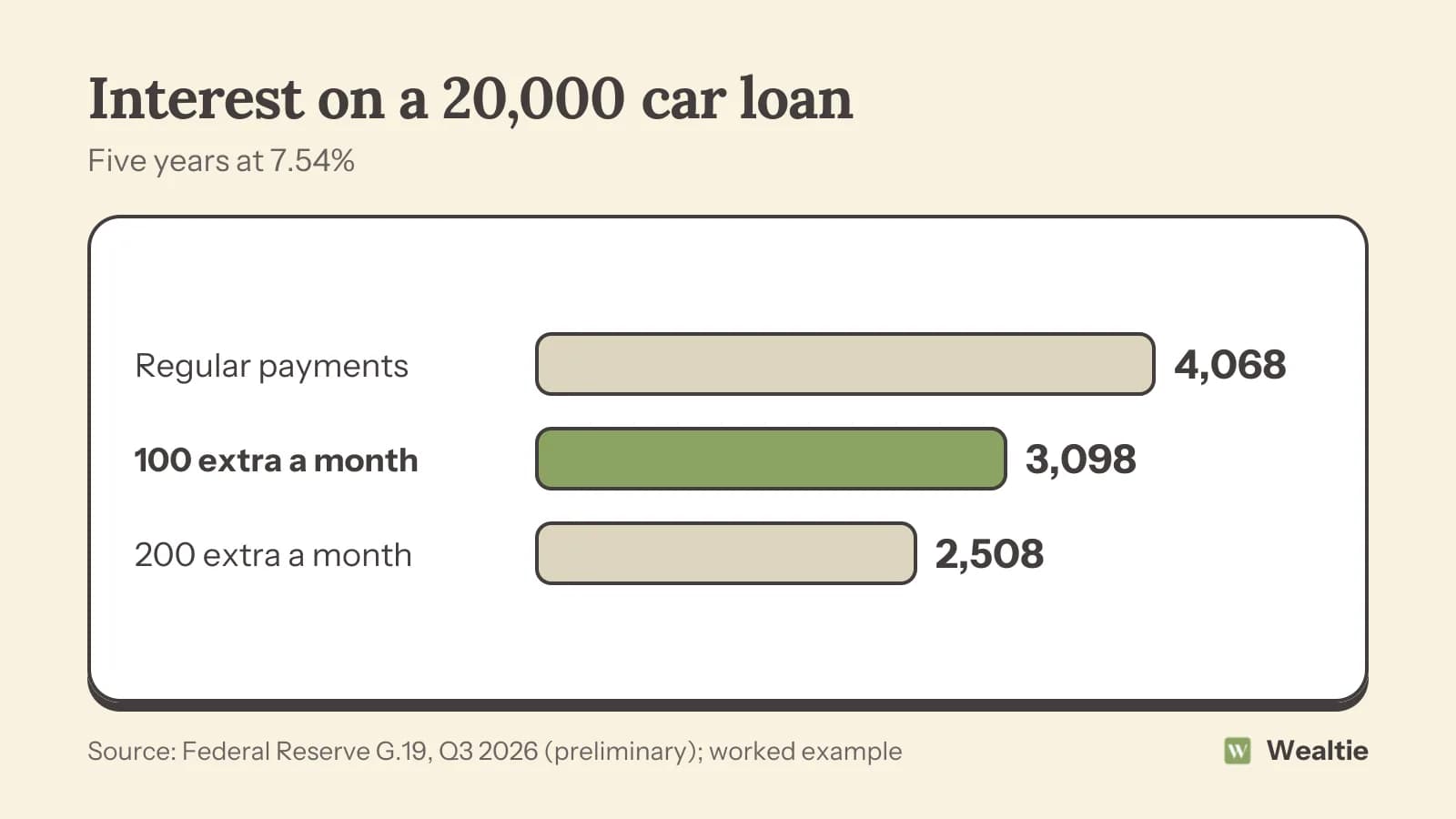
An extra 100 a month saves about 970 and 13 months. An extra 200 saves about 1,560 and 22 months. Your own figures depend on your rate and balance, so ask your lender for a payoff quote or use their calculator. Even 50 extra a month makes a difference over five years, and owing less sooner helps if the car's written off or you need to sell early.
What should you check first?
A few things before you overpay:
-
Early repayment fees. Some loans charge a fee for paying early, which can cancel out part of the saving.
-
How overpayments are applied. Make sure extra money reduces the balance, not just next month's payment.
-
Costlier debt. Credit cards usually charge much more, so clear those first. Should you pay your credit card in full explains why. Ask whether overpayments shorten the term or lower the monthly payment. Shortening the term usually saves more.
-
An emergency fund. Money paid into a car loan isn't available for a job loss or a repair. How much should be in an emergency fund helps set the target.
When isn't overpaying the best move?
When the rate is very low, such as a promotional 0% deal, or when you'd be left without savings. On a 0% loan there's no interest to save, so keeping the money in savings until the end is usually better.
If you're likely to sell or trade in the car soon, check the settlement figure, since paying it down helps most if the car's worth less than you owe. It also depends on what else you'd do with the money. If you've got a pension with employer matching that you're not maxing, that match can be worth more than the interest saved.
Lump sum or monthly overpayments?
Either works. Monthly overpayments are easy to automate. A lump sum, like a bonus or a tax refund, can make a big dent at once. What to do with a tax refund puts the car loan in the order with other uses. The earlier you overpay, the more you save, because the balance is highest at the start. Set monthly overpayments as a standing order a day after the regular payment, so they're applied to the balance.
What should you do when the loan's paid off?
Keep making the payment, but to yourself. Move the same amount into a savings pot each month. In a few years, you'll have the deposit for the next car, or the whole price, and you won't need another loan. How to save for a car has the steps.
Ask the lender for confirmation that the loan's closed, and check that any security on the car has been released. Update your insurance if the lender was named on the policy.
Should you pay it off with a lump sum from savings?
Compare the rate your savings earn with the loan rate, since the difference is what you'd save. If your savings are well beyond your emergency fund and earn less than the loan costs, using some of them can make sense. Keep enough for emergencies, though. A paid-off car is no help if a surprise bill goes on a credit card.
How do you track a car loan in Wealtie?
Set the loan payment up as a monthly recurring transaction with the bill tracker, with the number of payments left, and the card shows how far through you are. Log overpayments as their own expense in a Car category, so your expense categories show what you've put in. When you finish early, switch the rule off.
Questions people ask
Often, if the rate is meaningful and you've cleared costlier debt and have an emergency fund. On 20,000 at 7.54%, an extra 100 a month saves about 970.
Some loans charge an early repayment fee. Check your agreement or ask the lender before overpaying.
In the Fed's G.19 data, 60-month new car loans at commercial banks averaged 7.54% in the third quarter of 2026 (preliminary).
Keep paying the same amount into savings each month, so you can buy the next car without a loan.
Sources
- Consumer Credit G.19, Terms of Credit · Board of Governors of the Federal Reserve System · checked 9 November 2026
This article is general information, not financial, tax or legal advice. Your situation is your own; check the numbers that apply to you before you act on them.



