Saving: How to save for a car and pay cash, or put down a big deposit
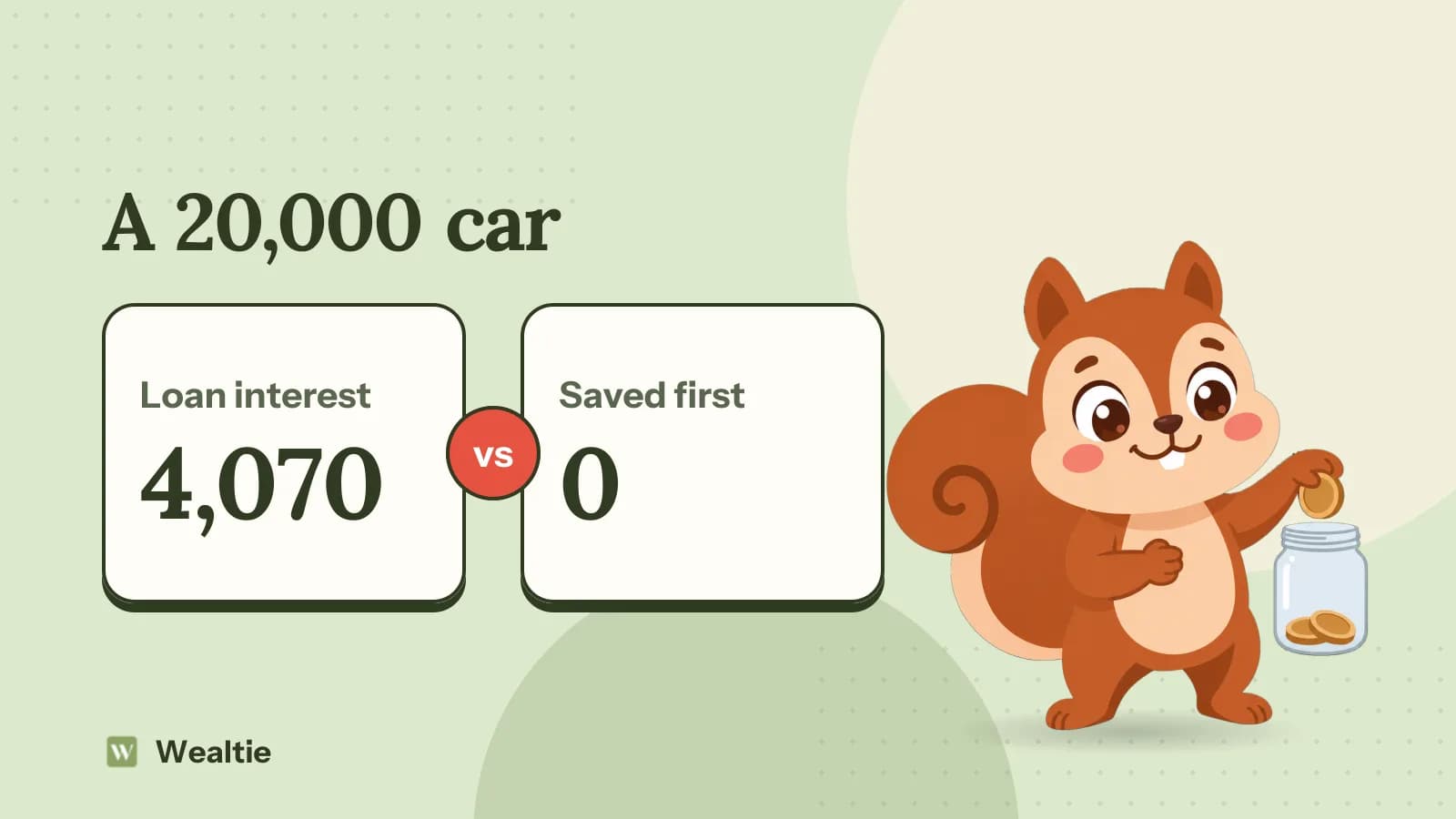
To save for a car, pick a price, divide it by the months until you need the car, and move that amount to a separate account each payday. Saving 400 a month buys a 20,000 car in about four years; borrowing it over five years at the August 2026 average rate of 7.54% would cost about 4,070 in interest.
 By Wealtie Team · 3 min read
Key takeaways
- Start with the price you'll pay, including taxes and fees, and the date you need the car; the monthly amount follows from those two numbers.
- A 60-month loan of 20,000 at 7.54%, the August 2026 average new-car rate at commercial banks, costs about 401 a month and about 4,070 in interest.
- Saving that same 400 a month instead buys the car in about 50 months with no interest at all.
- If you can't wait, saving a large deposit first cuts the loan, the payment and the interest.
- Keep car savings in a separate savings account, and keep paying into it after you buy, for the next car and the repairs in between.
How do you save for a car?
Decide the price and the date, work out the monthly amount, and move it to a separate account every payday.
- Set the price, including sales tax, registration and fees, not only the sticker price.
- Set the date you need the car by.
- Divide the price by the months until then. That's your monthly amount.
- Automate it: a transfer to a separate savings account on payday.
- Check the plan every few months and adjust the car or the date if the numbers don't fit.
If the monthly amount is too high, the car is too expensive for the date. Choose a cheaper car, or a later date, before you look at a loan.
How long does it take to save for a car?
Price divided by monthly savings. Here's a worked example in round numbers, the same in any currency:
| Car price | At 200 a month | At 400 a month | At 600 a month |
|---|---|---|---|
| 5,000 | 25 months | 13 months | 9 months |
| 10,000 | 50 months | 25 months | 17 months |
| 20,000 | 100 months | 50 months | 34 months |
A used car you can buy with savings in a year or two often beats a newer one bought with a five-year loan. How much car can I afford covers the full monthly cost of running one, which matters as much as the price.
Is it cheaper to save or to take a car loan?
Saving, because you pay no interest. The question is how much the loan would cost.
Commercial banks charged an average of 7.54% on 60-month new-car loans in August 2026, according to the Federal Reserve's G.19 consumer credit release. At that rate, a 20,000 loan over five years costs about 401 a month, and about 4,070 in interest over the loan.
Saving the same 400 a month instead buys the car in about 50 months, slightly longer than the loan would last, with no interest. You pay for the car before you drive it, instead of after. That's the trade: four years of waiting against about 4,070.
What if you need a car sooner?
Save a deposit first, and borrow less.
With 8,000 saved, the same 20,000 car needs a 12,000 loan. At 7.54% over 60 months, that's about 241 a month and about 2,440 in interest, around 1,630 less than borrowing the full price. A shorter loan saves more interest again, with a higher payment.
Keep the deposit separate from your emergency fund. Emptying the fund to buy a car means the first repair goes on a card.
Where does the monthly amount come from?
From your budget, decided before the month starts, and from anything you can sell.
- Count your current car. If you're replacing one, its sale or trade-in value is part of the savings. Check what similar cars sell for, so you know what it's worth before a dealer makes an offer.
- Look at the changeable categories. Eating out, shopping and subscriptions are where most spare money hides. The budget calculator shows what's left once essentials and savings are counted.
- Save windfalls. A tax refund, a bonus or birthday money can take months off the timeline.
- Keep paying a loan you've just finished. If you've paid off a car loan or another debt, move that payment straight into car savings. You're already used to living without it.
Where should you keep the car savings?
In a separate, insured savings account you can reach when you buy.
The account should be apart from your everyday spending, so the money isn't used for something else, and it should pay some interest while it waits. Where to keep your emergency fund compares the options; the same logic applies to car savings.
What car costs come after the purchase?
Insurance, fuel, servicing, tyres and repairs, all of which need their own lines in your budget.
Keep the car savings habit going after you buy. A smaller monthly amount into the same account becomes a repair fund and, eventually, the deposit for the next car. Insurance is often the biggest yearly bill; how to save money on car insurance covers how to bring it down.
How do you track a car savings goal?
In Wealtie, add the car savings account to your accounts and log each payday move as a transfer, so it doesn't count as spending and your net worth stays accurate. Include the monthly amount in your budget as a fixed line, so it's set aside before the month's spending starts.
Questions people ask
Divide the price by what you can save each month. At 400 a month, a 20,000 car takes about 50 months; a 10,000 used car takes 25 months.
Paying cash costs less, because you pay no interest. A 20,000 loan over 60 months at 7.54% costs about 4,070 in interest. Financing makes sense if you need the car now, and a large deposit reduces what it costs.
As much as you can without emptying your emergency fund. Every 1,000 you put down is 1,000 less borrowed, which lowers both the monthly payment and the total interest.
In a separate, insured savings account you can reach when you buy. Keeping it apart from your current account stops it being spent by accident.
Sales tax and registration, insurance, and a repair fund. Car costs don't stop at the purchase, so keep saving a monthly amount after you buy.
Sources
- Consumer Credit - G.19 (release of 7 October 2026) · Board of Governors of the Federal Reserve System · checked 6 November 2026
This article is general information, not financial, tax or legal advice. Your situation is your own; check the numbers that apply to you before you act on them.