Budgeting: Should you pay your credit card in full? What carrying a balance costs
It's better to pay your credit card in full every month, because a balance you carry starts costing interest. On 3,000 at 22.36% a year, paying 300 a month adds about 351 in interest.
 By Wealtie Team · 3 min read
Key takeaways
- Paying your statement balance in full by the due date means you normally pay no interest on purchases.
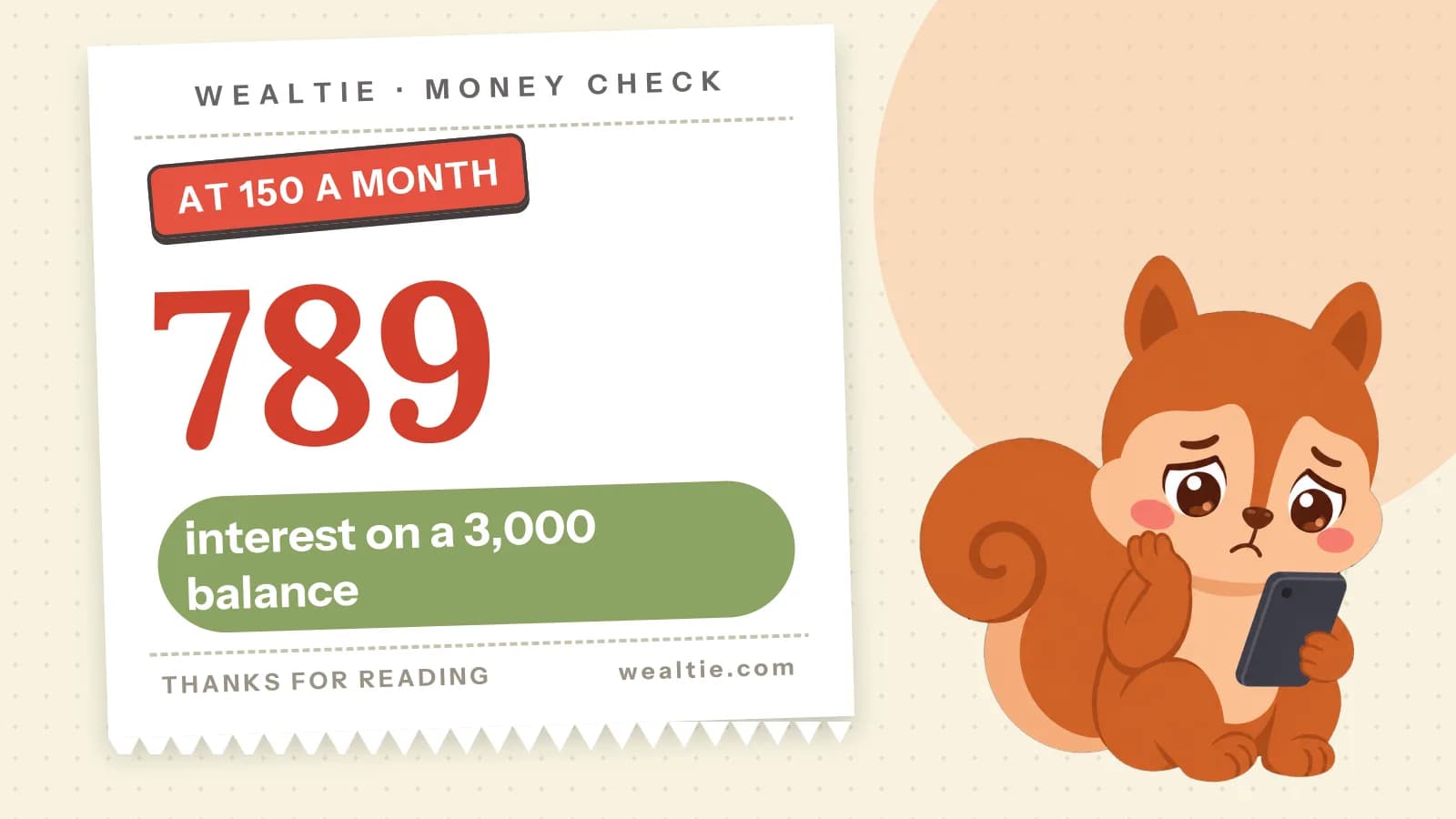
- On 3,000 at 22.36% a year, paying 150 a month takes 26 months and costs about 789 in interest.
- Doubling the payment to 300 cuts that to 12 months and about 351 in interest.
- Carrying a balance doesn't help your credit score, and you don't need to pay interest to build one.
Should you pay your credit card in full?
Yes, whenever you can. If you pay the full statement balance by the due date, most cards charge no interest on your purchases that month. Once you carry a balance, that free period usually stops and interest applies, often from the day you bought something.
How much does carrying a balance cost?
More than most people expect, because the rate's high and the balance shrinks slowly. In the Federal Reserve's G.19 data, the rate on credit card accounts assessed interest at commercial banks was 22.36% in the third quarter of 2026 (a preliminary figure). Here's what that means on a balance of 3,000, with no new spending:
| Paid each month | Months to clear | Interest paid |
|---|---|---|
| 150 | 26 | 789 |
| 300 | 12 | 351 |
| 600 | 6 | 179 |
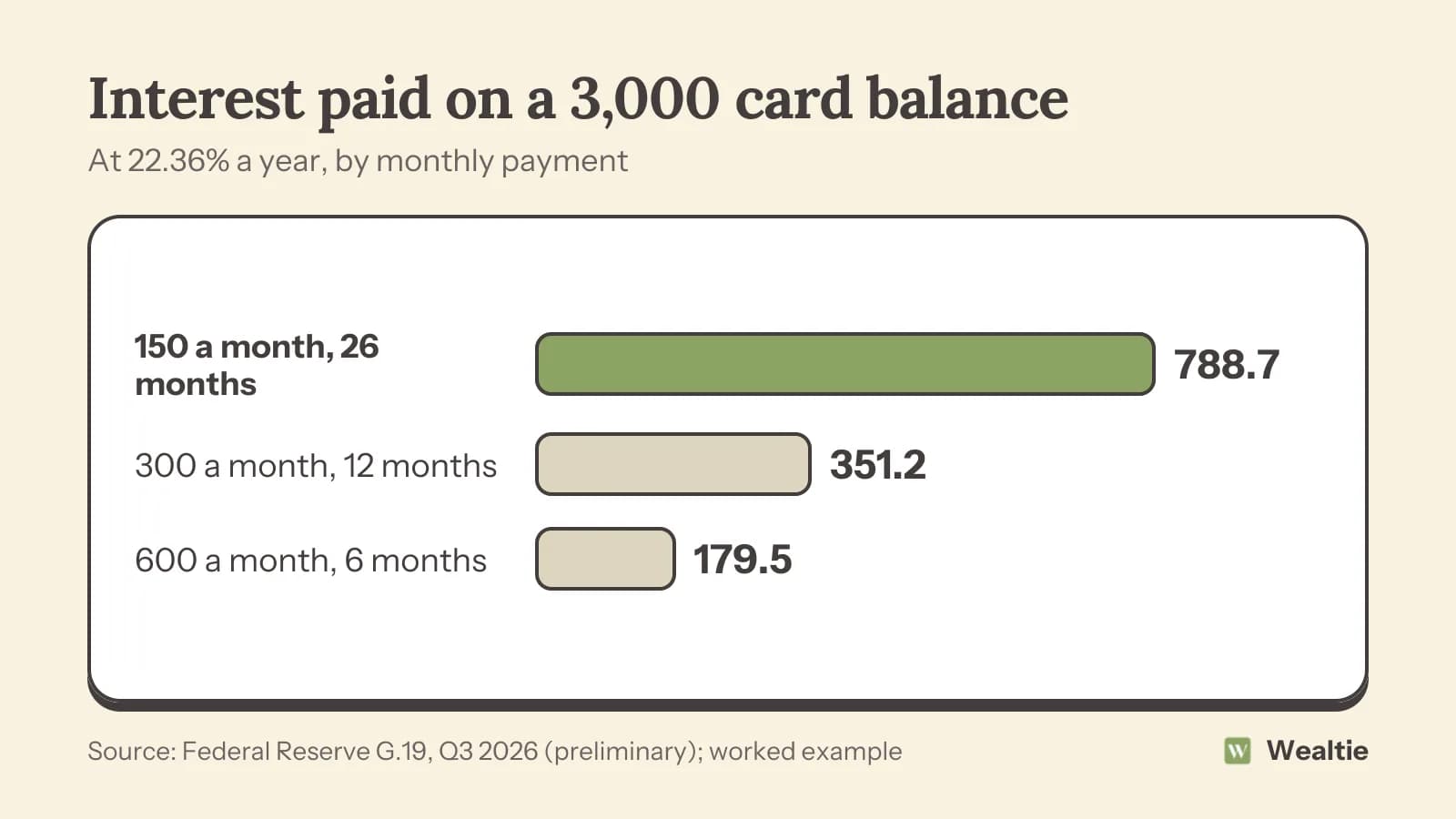
Use the rate on your own statement if it's different, since cards vary a lot. Those are worked figures, and new purchases on the card would push all of them up.
In the first month alone, 3,000 at that rate costs about 56 in interest.
Does paying the minimum hurt?
Paying the minimum keeps you from missing a payment, which is a lot better than paying nothing, but it's the slowest way out. What the minimum payment costs works through how long that takes.
Pay the minimum on everything if you have to, and put any extra toward one card at a time.
Does carrying a balance help your credit score?
No. You don't need to pay interest to build a credit history. Using a card and paying it off on time shows lenders what they want to see.
The thing that's measured is how you pay, and how much of your available credit you're using. Leaving a balance on the card to pay interest on doesn't add to either. If someone's told you to keep a small balance rolling, you can stop.
What if you can't pay the full amount?
Pay as much as you can, as early as you can, and set a fixed payment until it's gone. Interest usually builds up daily, so an earlier payment costs you a bit less.
Stop adding to the balance while you clear it. Use a debit card for everyday spending until the balance is at zero. If you've got more than one card, the debt snowball or avalanche helps with the order.
If you've got savings sitting beside the debt, compare the rates. Savings that pay a few percent a year while a card charges over 20% is a losing arrangement, so use the savings to clear the card and keep a small cushion. Pay off debt or save has the worked numbers.
When is paying in full hard to do?
When the card's being used to cover a shortfall. If the balance keeps coming back, the problem is the budget and paying more won't fix that alone.
Look at what went on the card last month. Was it one-off, like a car repair? Then a small fund will handle the next one. Was it groceries and bills? Then outgoings are higher than income, and how to stop living paycheck to paycheck is the place to start. If you're falling behind, call the card company before you miss a payment.
How do you set up paying in full?
Set the automatic payment to the full statement balance. Most card apps have that as an option, alongside the minimum and a fixed amount.
Then make sure the money's in the account on the date. Log card purchases as you make them, so you know what's coming. Treat each purchase as if the money's already left, since it's going to.
If your payday and the due date don't line up, ask the issuer to move the due date. Many will, and a date a few days after payday makes it much easier to clear the whole balance. Turn on a payment reminder as well, in case the automatic payment fails or the account runs short. A missed payment can bring a late fee and can end any promotional rate you've got.
How do you stay ahead of the card bill in Wealtie?
Log each card purchase as you make it, and it counts against your monthly limit straight away, weeks before the statement arrives. The expense tracker shows what's gone where, and a monthly budget in the budget tracker tells you when spending's getting close to what you can clear in full. Budget Health warns you mid-month if your pace would take you over.
Questions people ask
Yes, because paying the statement balance in full by the due date normally means no interest on purchases. Carrying a balance costs money and doesn't improve your credit score.
No. On-time payments and low use of your available credit are what help, and neither requires paying interest.
Interest applies to the unpaid part, and new purchases usually start costing interest too. You won't be marked as late as long as you pay at least the minimum.
About 789 if you pay 150 a month at 22.36% a year, or about 351 if you pay 300 a month. Your own rate may be different.
Sources
- Consumer Credit G.19, Terms of Credit · Board of Governors of the Federal Reserve System · checked 9 November 2026
This article is general information, not financial, tax or legal advice. Your situation is your own; check the numbers that apply to you before you act on them.