Budgeting: Status quo bias: why sticking with what you have costs you
Status quo bias is our tendency to keep things as they are, even when a change would leave us better off. In a worked example, leaving savings in an old account and staying on an expired insurance deal costs 450 a year.
 By Wealtie Team · 3 min read
Key takeaways
- Status quo bias makes us stick with old accounts, tariffs and habits.
- Loyalty often costs more, since new customers get better deals.
- A yearly review of bills and accounts beats status quo bias.
- Small switches add up over many years.
What is status quo bias?
Status quo bias is the tendency to prefer things as they are and avoid change, even when a change would help. The economists William Samuelson and Richard Zeckhauser described it in 1988, showing that people stick with existing choices more often than a calm comparison would suggest. Change takes effort, carries a small risk of making things worse and requires a decision, so doing nothing feels easier.
With money, status quo bias keeps people in old bank accounts, savings accounts paying little interest, insurance that renews at a higher price and phone or broadband plans long after the contract ends. Each one may cost only a little more than the alternative, but over years the cost of staying put can be large.
How much can staying put cost?
Here's a worked example of three things left unchanged, in round numbers that work in any currency:
| Left unchanged | Yearly cost |
|---|---|
| Savings in an old low-rate account | 200 |
| Car insurance auto-renewed | 150 |
| Broadband out of contract | 100 |
| Total | 450 |
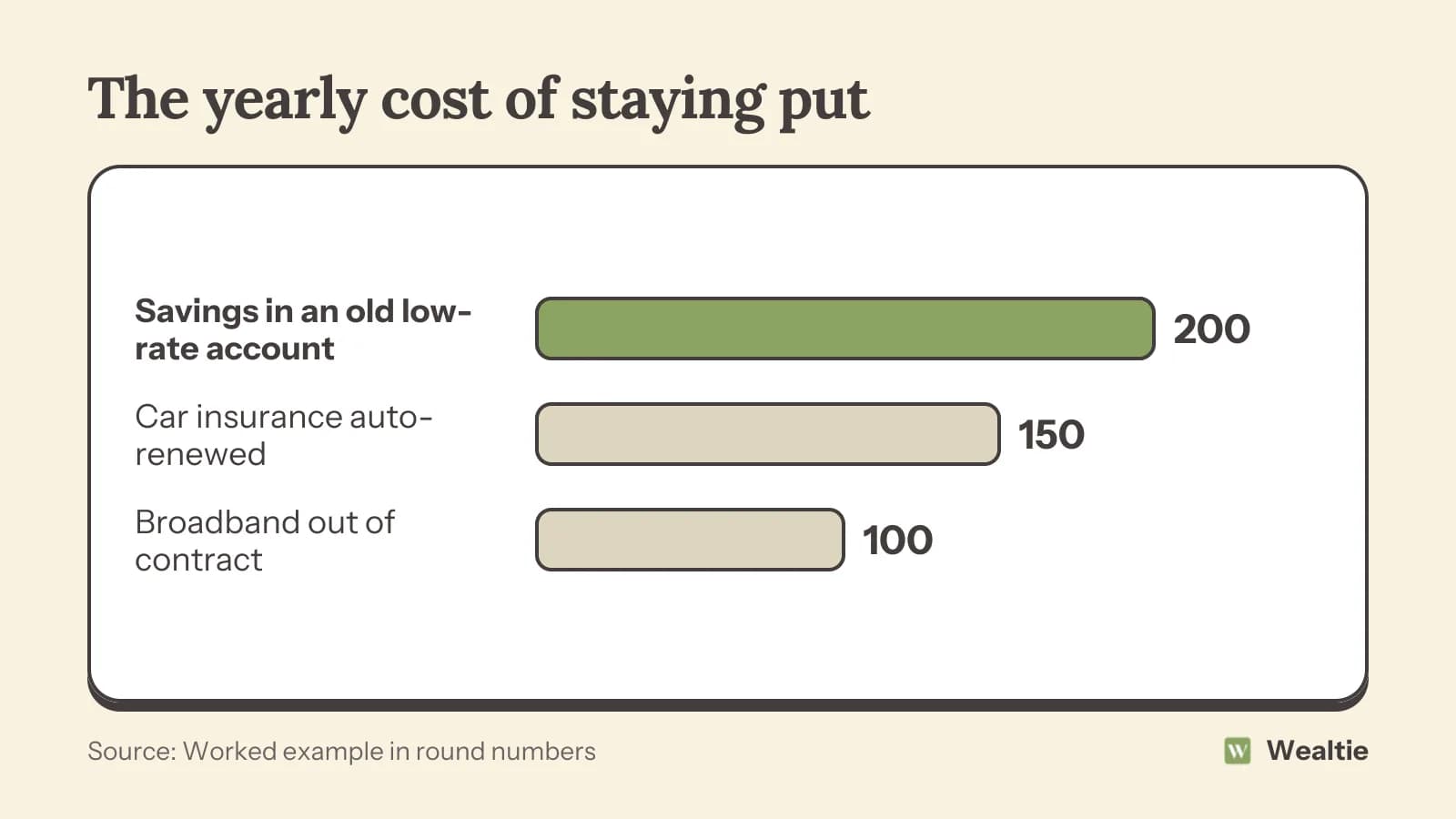
That's 450 a year, or 2,250 over five years, for doing nothing. Many companies offer their best prices to new customers, while existing customers on old deals pay more. That's sometimes called the loyalty penalty.
Why do we stick with the status quo?
Change feels like effort
Comparing, filling in forms and switching takes time. Doing nothing takes none.
Losses feel bigger than gains
The small risk that a new choice turns out worse can feel more important than the likely saving.
We assume the current choice was good
If you chose something once, it's easy to assume it's still a good choice, even if the market has moved on.
Defaults are sticky
Automatic renewals and default options make staying put the easy path.
How do you beat status quo bias?
Schedule a yearly money review
Pick a day each year, perhaps in spring or at the start of the year, to check your bills, accounts and policies. How to spring clean your finances covers what to look at.
Put renewal dates in your calendar
Add a reminder a few weeks before each insurance, phone or broadband contract ends. That's the moment to compare or negotiate.
Ask your provider for a better deal
Often, a quick call to say you're thinking of leaving gets you a lower price without switching. How to negotiate bills covers what to say.
Make switching easier
Many switching services move your account, direct debits and payments for you. How to switch bank accounts shows how simple it can be.
Start with the biggest saving
Rather than reviewing everything at once, start with the bill that could save the most, like insurance or broadband. How to save money on car insurance and how to save money on your internet bill are good places to start.
Is staying put ever the right choice?
Yes. Sometimes your current deal is still competitive, or the saving from switching is too small to be worth the hassle. The aim isn't to switch everything constantly, but to make an active choice rather than staying by default. Checking once a year and deciding to stay is very different from never checking at all.
Status quo bias isn't only about bills. It also keeps people in spending habits that no longer suit them, like a gym membership they rarely use, a car that's more than they need or a daily routine that includes takeaway coffee out of habit rather than choice. Asking "would I choose this today if I were starting fresh?" is a simple way to spot where the status quo is costing you.
Couples and families can be especially prone to it, since changing a shared arrangement means everyone agreeing. Setting aside an hour together once a year to look at joint bills and accounts makes it a shared habit rather than one person's chore.
It's also worth keeping a short list of what you pay for and when each contract ends. When the list is in one place, reviewing it takes minutes rather than an afternoon of searching through emails, and you're much more likely to act.
Finally, celebrate the savings when you do switch. Moving the difference into savings or towards a goal makes the benefit visible and encourages you to keep reviewing in future years.
Over time, these small, regular checks become automatic, and the loyalty penalty stops quietly draining your budget.
How can Wealtie help you spot what to review?
Add bills, insurance and subscriptions as recurring transactions in Wealtie, and log them in their own expense categories. Seeing each one's yearly cost makes it easier to decide which to review first and to notice when a price creeps up at renewal.
Questions people ask
Status quo bias is the tendency to keep things as they are and avoid change, even when a change would leave you better off.
It keeps people on old tariffs, low-interest accounts and auto-renewed policies. In a worked example, it cost 450 a year.
The loyalty penalty is when existing customers pay more than new customers for the same service because they don't switch or negotiate.
Schedule a yearly money review, put renewal dates in your calendar, ask providers for better deals and start with the biggest saving.
This article is general information, not financial, tax or legal advice. Your situation is your own; check the numbers that apply to you before you act on them.