Saving: Average savings by age: what Americans have, and what to aim for
The median family headed by someone under 35 had $5,000 in checking and savings in 2025, rising to $14,000 at 75 and over, in the Federal Reserve's Survey of Consumer Finances. Those are average savings by age; a better target is one month of income first, then three to six months of expenses.
 By Wealtie Team · 3 min read
Key takeaways
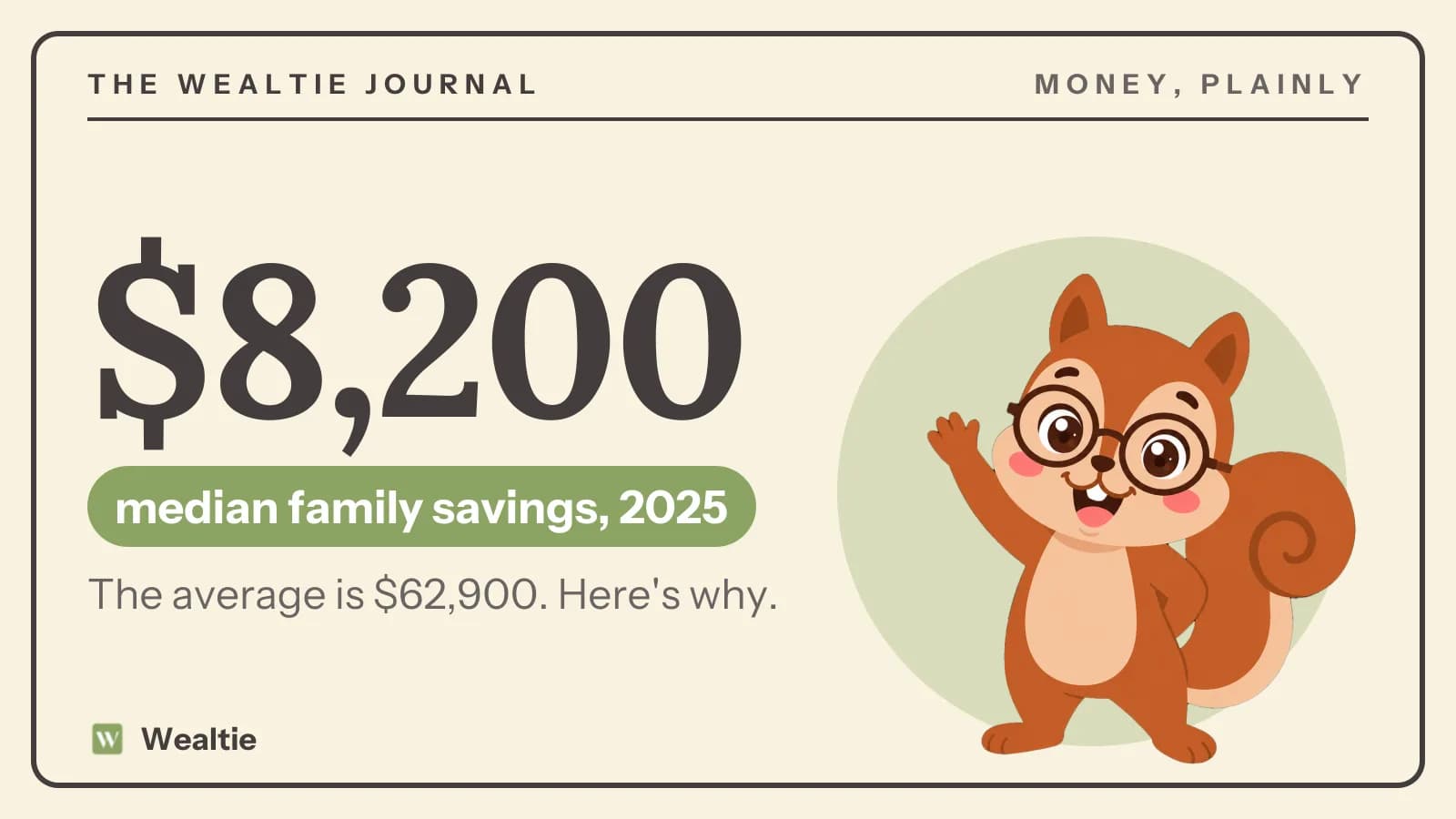
- The median US family had $8,200 in transaction accounts (checking, savings and money market) in 2025, according to the Federal Reserve's Survey of Consumer Finances.
- Median balances rose with age, from $5,000 for families headed by someone under 35 to $14,000 for those 75 and over.
- Retirement accounts are a separate pot: among families who had one, the median balance was $21,000 under 35 and $239,000 at 55 to 64.
- Medians are far below means because a few families hold very large balances; the mean transaction account balance was $62,900.
- Your target should come from your own costs, not your age: one month of income first, then three to six months of essential expenses.
What are average savings by age?
The median US family had $8,200 in checking, savings and money market accounts in 2025, according to the Federal Reserve's Survey of Consumer Finances. By age of the person heading the family, the medians ran from $5,000 to $14,000.
| Age of family head | Median in checking and savings (2025) |
|---|---|
| Under 35 | $5,000 |
| 35 to 44 | $6,600 |
| 45 to 54 | $9,400 |
| 55 to 64 | $10,000 |
| 65 to 74 | $10,000 |
| 75 and over | $14,000 |
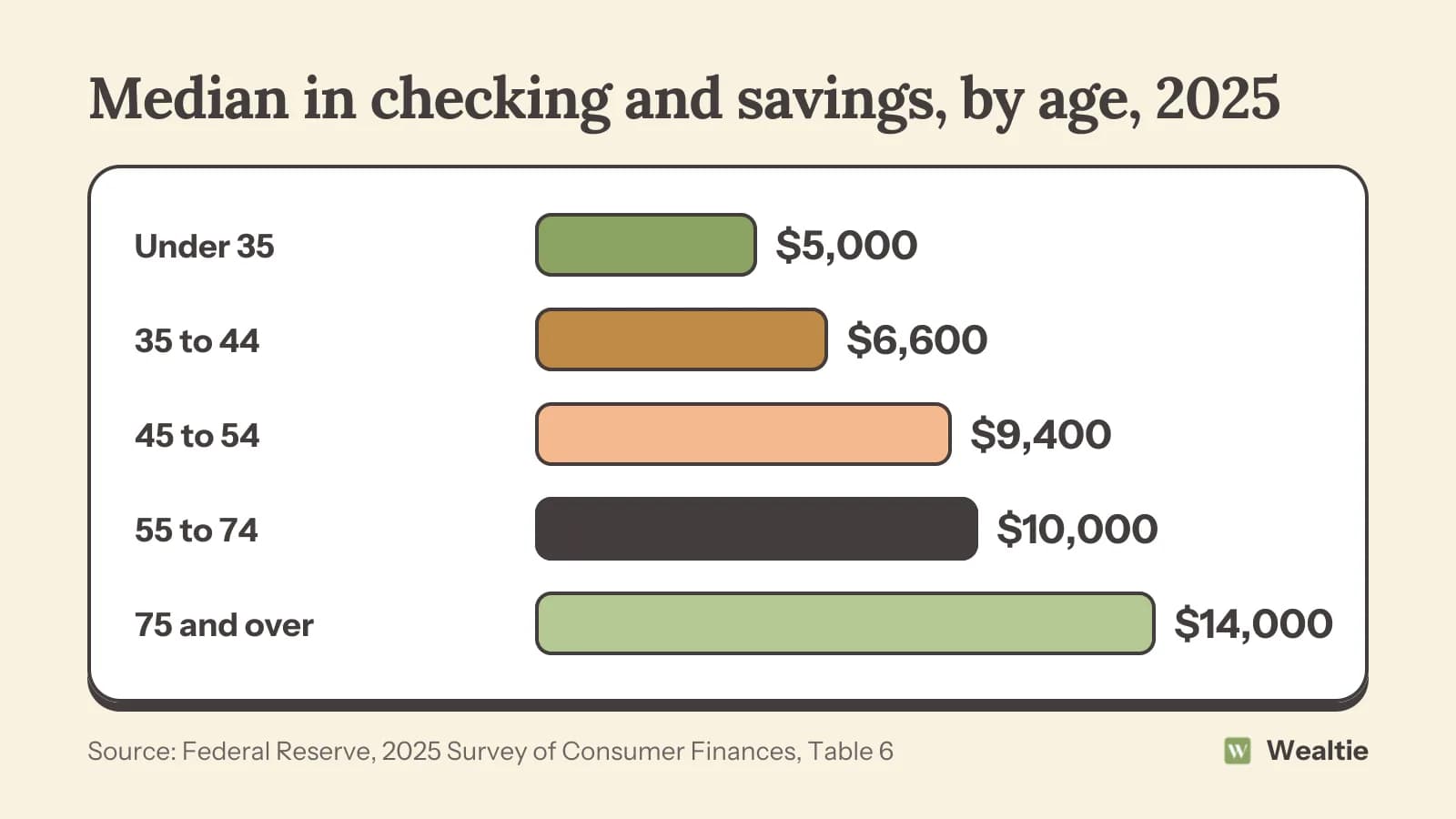
These figures, from the survey's detailed tables, are "transaction accounts": checking, savings, money market accounts and prepaid cards. Almost every family has one: 98.7% in 2025. They don't include retirement accounts, which are a separate pot.
The survey counts families by the age of the person who heads them, so a couple and a single person are each one family. It runs every three years; 2025 is the latest.
Why is the average so much higher than the median?
Because a few families hold very large balances. The mean transaction account balance in 2025 was $62,900, nearly eight times the median of $8,200.
The median is the family in the middle: half had more, half had less. That makes it the better picture of a typical household. When you see a headline saying the "average American" has tens of thousands in savings, it's usually the mean, and most people have far less.
The spread by income is wider than by age. The median family in the bottom fifth of incomes had $800 in transaction accounts; in the top tenth it was $105,000. Renters had a median of $2,100, homeowners $14,500.
What about retirement savings by age?
Retirement accounts are a separate and much bigger pot, for the families who have one. Among those families, the median balances in 2025 were:
| Age of family head | Have a retirement account | Median balance, if they have one |
|---|---|---|
| Under 35 | 49% | $21,000 |
| 35 to 44 | 60% | $61,000 |
| 45 to 54 | 63% | $133,000 |
| 55 to 64 | 63% | $239,000 |
| 65 to 74 | 49% | $257,000 |
| 75 and over | 45% | $257,000 |
About four in 10 families in most age groups had no retirement account at all, so these medians describe the families who do.
How much should you have saved at your age?
Your target should come from your costs, not your age. Two people aged 35 with different rents and different jobs need different amounts.
A more useful order:
- One month of take-home pay in an emergency fund. How much should be in an emergency fund explains why this comes first.
- Three to six months of essential costs: rent, bills, food, transport and minimum debt payments. More if your income is irregular or you're the only earner.
- Retirement savings in tax-advantaged accounts, alongside the emergency fund once the first month is in place.
- Specific goals: a deposit, a car, a wedding.
Here's a worked example in round numbers, the same in any currency. Take-home pay is 3,000 a month and essential costs are 2,000. The first target is 3,000. Three months of essentials is 6,000, and six months is 12,000. Those numbers don't change whether you're 28 or 48; your rent does.
If you're below the median for your age, you're in the bottom half of a survey, not behind a rule. The step that matters is the next one: a fixed amount moved on every payday. How much of your income should you save works out what that amount looks like on your pay.
Where should savings be kept?
Emergency money in a separate, insured savings account you can reach within days; long-term money in accounts meant for the long term.
The SCF counts both checking and savings, but they do different jobs. Money that sits in a checking account with your debit card tends to get spent. Where to keep your emergency fund compares the options.
How do you track savings against a target?
Look at all your accounts in one total once a month, and compare it with the target you set from your costs.
In Wealtie, add your checking, savings and cash accounts and the net worth tracker shows them in one total, with transfers between them counted as transfers, not spending. The Free plan includes two accounts; Pro has unlimited accounts. Your monthly budget then shows what's left to save after spending, and Budget Health warns you mid-month if spending is about to eat into it.
Questions people ask
The median US family had $8,200 in checking, savings and money market accounts in 2025, according to the Fed's Survey of Consumer Finances. The mean was $62,900, pulled up by a small number of very large balances.
Aim for one month of take-home pay in an emergency fund first, then three to six months of essential costs. For comparison, the median family headed by someone under 35 had $5,000 in checking and savings in 2025.
Three to six months of essential expenses in cash, plus retirement savings on track for your plan. The median family aged 35 to 44 had $6,600 in transaction accounts and, among those with one, $61,000 in retirement accounts in 2025.
Among families with a retirement account in 2025, the median was $21,000 under 35, $61,000 at 35 to 44, $133,000 at 45 to 54, $239,000 at 55 to 64 and $257,000 at 65 to 74, according to the Fed.
A small number of families hold very large balances, which pulls the mean up. The median, the family in the middle, is a better picture of a typical household: $8,200 against a mean of $62,900 in 2025.
Sources
- Changes in U.S. Family Finances from 2022 to 2025: Evidence from the Survey of Consumer Finances · Board of Governors of the Federal Reserve System · checked 1 November 2026
- 2025 Survey of Consumer Finances, historical tables (Table 6, nominal) · Board of Governors of the Federal Reserve System · checked 1 November 2026
This article is general information, not financial, tax or legal advice. Your situation is your own; check the numbers that apply to you before you act on them.