Saving: How to save $1,000 fast: a three-month plan with the numbers
The fastest realistic way to save $1,000 is $77 a week for 13 weeks: about $200 a month trimmed from two or three categories, plus $400 of one-off money from things you sell or extra hours. Here's how to save 1000 dollars fast, with the numbers.
 By Wealtie Team · 4 min read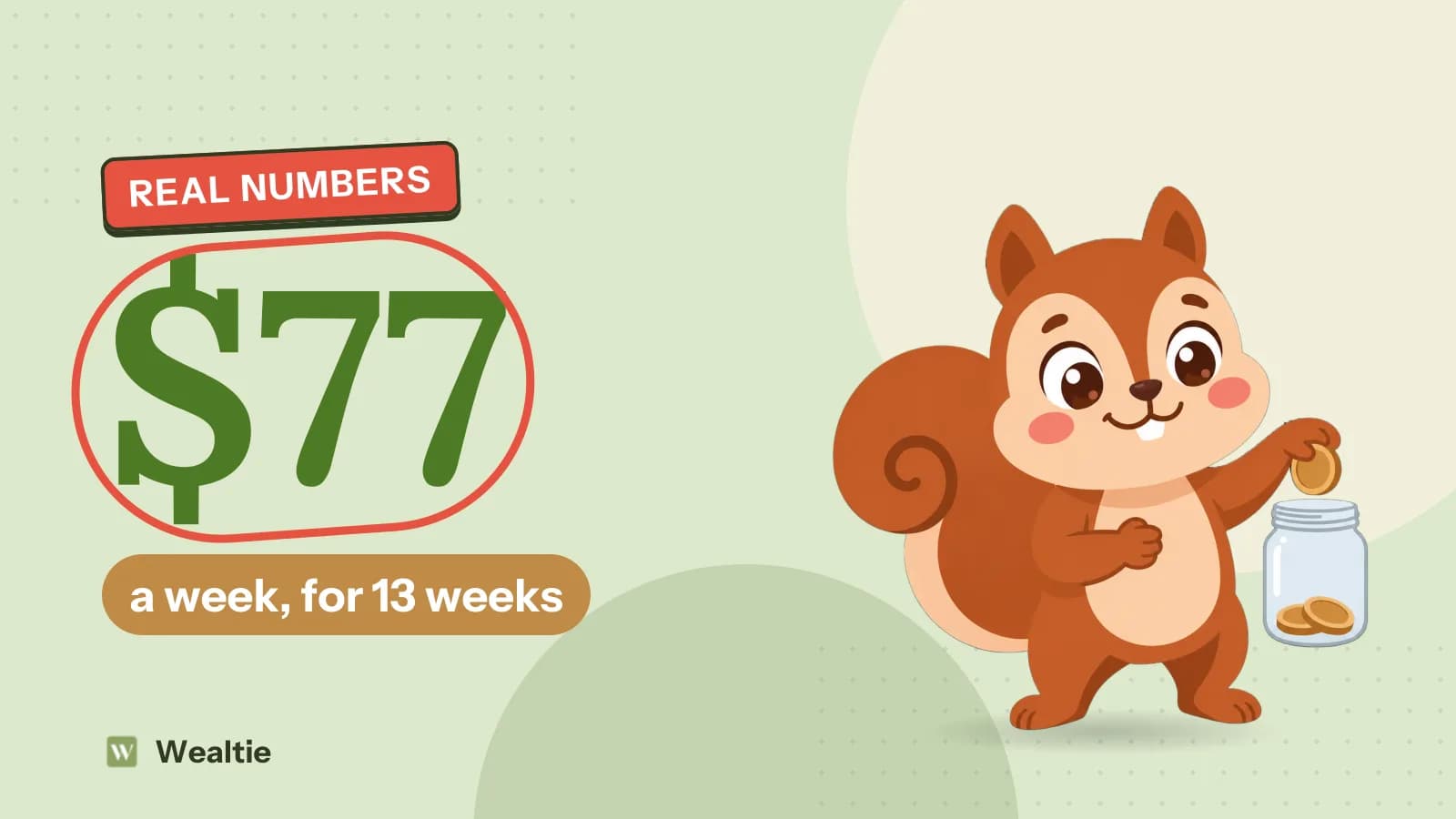
Key takeaways
- Saving $1,000 in three months takes $77 a week, or about $334 a month.
- Cutting $334 a month from an ordinary budget is hard to keep up; one-off money from a sale or a few extra paid hours can cover part of it.
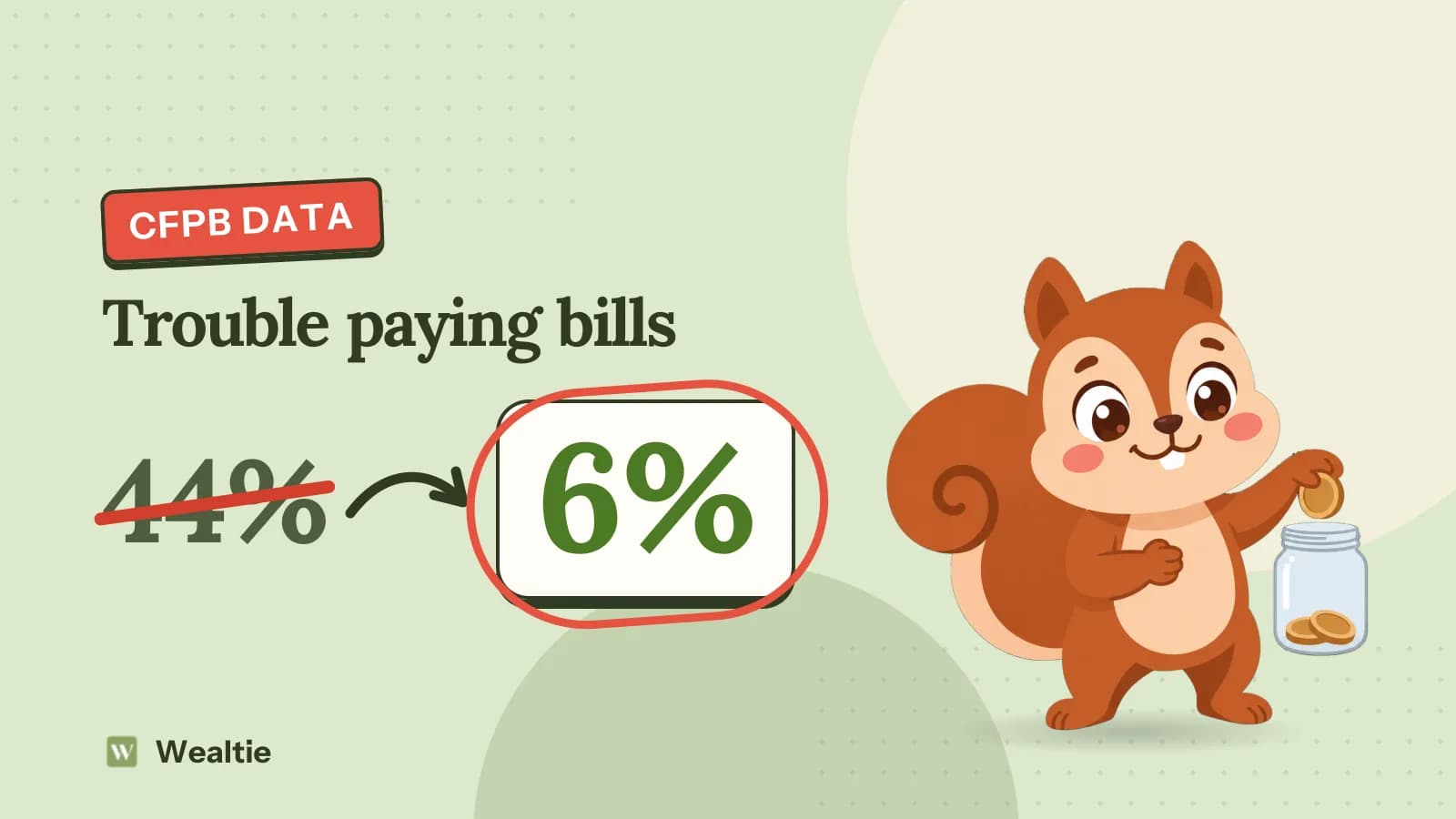
- In the Fed's 2025 survey, 37% of US adults wouldn't cover a $400 emergency expense with cash or its equivalent.
- Moving the money to a separate account on payday works better than saving whatever is left at the end of the month.
- Saving $1,000 in 30 days means $250 a week, which usually needs one-off money rather than cuts.
Why aim for $1,000 first?
Because $1,000 covers the $400 surprise bill the Fed asks about twice over, with room left.
In the Federal Reserve's 2025 Survey of Household Economics and Decisionmaking, 63% of US adults said they'd cover a $400 emergency expense with cash, savings or a credit card paid off at the next statement. The other 37% would borrow, carry a balance, sell something or not pay. Asked about the largest emergency they could handle from savings alone, 18% said under $100 and another 12% said $100 to $499.
$1,000 is a starter amount, not the finish line. The longer goal is in how much should be in an emergency fund: one month of income first, then more.
How much do you need to save each week?
$77 a week gets you to $1,000 in 13 weeks, which is three months.
Pick the deadline first and the weekly number follows. Weekly beats monthly here: $77 is a number you can check against on a Friday, and a bad week costs you one week, not a month.
| Deadline | Per week | Per day |
|---|---|---|
| 4 weeks | $250 | $35.71 |
| 8 weeks | $125 | $17.86 |
| 13 weeks (3 months) | $76.92 | $10.99 |
| 26 weeks (6 months) | $38.46 | $5.49 |
| 52 weeks (1 year) | $19.23 | $2.75 |
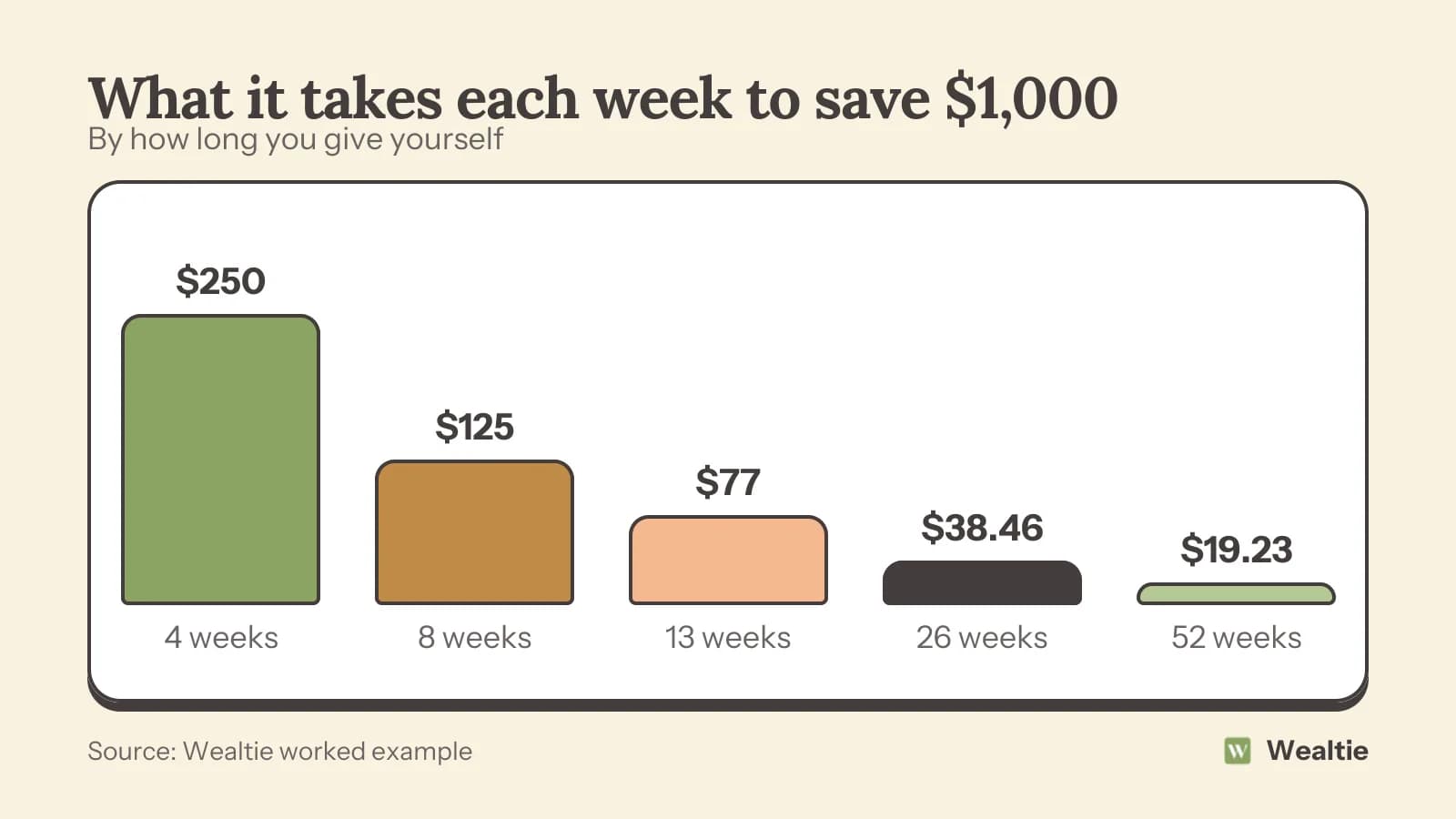
Start this week and 13 weeks ends in mid-January, the month the holiday card bills arrive.
Where does $77 a week come from?
From two places: a few categories you trim for three months, and some money you bring in once.
Start with last month's spending, not a list of tips. Write down every category and its total. The ones worth trimming are the ones that move from month to month, because those are choices. Rent and insurance don't move. Eating out does.
For scale, the average US household spent $3,945 on food away from home in 2024, about $330 a month, according to the BLS Consumer Expenditure Survey. It spent $3,609 on entertainment, about $300 a month.
A worked example
Round numbers, and they work in any currency. Three months, $1,000:
| Source | Per month | Over 3 months |
|---|---|---|
| Eating out and takeaway, $330 down to $220 | $110 | $330 |
| Groceries bought from a list | $50 | $150 |
| Two subscriptions cancelled | $40 | $120 |
| Selling a few things you don't use | — | $250 |
| One extra shift or a weekend of paid work | — | $150 |
| Total | $200 | $1,000 |
Trimming gets you $600. The last $400 comes from money you make once. Cutting $334 a month out of an ordinary budget usually means cutting something you'll put back by week five, and then the whole plan goes with it.
If you can't find $200 a month to trim, stretch the deadline before you squeeze harder. Six months at $38 a week still gets you there.
How do you stop the money from getting spent?
Move it out on payday, into an account you don't spend from.
Money left in your everyday account gets spent, mostly because it looks available. A separate savings account, even at the same bank, adds one step between you and the money.
Do it on the day your pay lands: $154 every two weeks, or $334 on a monthly payday. Track it as a transfer, not as spending, so your budget doesn't look $334 worse than it is. Wealtie's net worth tracker keeps card, cash and savings in one total and treats transfers between them as moves, not spending.
How do you keep the cuts from creeping back?
Lower your monthly budget by the amount you're trimming, and check it mid-month instead of at the end.
If you spent $2,500 last month and you're trimming $200, the budget for the next three months is $2,300. Checking only at the end of the month tells you what went wrong after it's too late. A budget tracker that forecasts the month helps here: Wealtie's Budget Health warns you mid-month if your spending pace will take you over.
If a real emergency lands in week six, use the money. That's what it's for. Then restart the count from what's left.
Can you save $1,000 in 30 days?
Yes, but almost always with one-off money, because $250 a week is more than most people can trim.
A month gives small cuts no time to add up. The worked example above trims $200 a month, so a 30-day plan needs about $800 from somewhere else. That usually means selling something worth that much, a block of paid work, a tax refund or a bonus you were going to spend. If none of those is on the table, the 13-week plan is the faster one in practice, because it's the one you'll finish.
You saved $1,000. Now what?
Keep the weekly transfer running and point it at the next target.
You've already found $77 a week, so stopping now hands that money back to everyday spending. Two places to send it next:
- The rest of your emergency fund. The emergency fund calculator shows how many months it takes to reach one month of income, then three.
- A sinking fund for bills you know are coming, like car insurance or holidays. What is a sinking fund shows how to work out the monthly amount.
Questions people ask
It takes 13 weeks at $77 a week, or a year at about $19 a week. Pick the deadline first and divide $1,000 by the number of weeks to get your weekly amount.
Saving $1,000 in 30 days takes $250 a week, so you'll usually need one-off money: selling things, extra paid work, a refund or a bonus. If you trim $200 from a month's spending, the other $800 has to come from somewhere else.
Saving $1,000 a month is about 12% of the average US household's pre-tax income, which BLS put at $104,207 a year in 2024. It's a strong rate as long as the bills still get paid on time from what's left.
Keep the same weekly transfer going and point it at your next target, usually one month of income in an emergency fund. After that, a sinking fund for yearly bills stops them from wrecking one month.
Keep it in a separate savings account from the one your card spends from. The point is one extra step between you and the money, not the interest rate.
Sources
- Economic Well-Being of U.S. Households in 2025: Savings and Investments · Board of Governors of the Federal Reserve System · checked 12 October 2026
- Consumer Expenditures in 2024 (news release, December 19, 2025) · U.S. Bureau of Labor Statistics · checked 12 October 2026
- Public opinions and social trends, Great Britain: May 2026 · Office for National Statistics · checked 12 October 2026
This article is general information, not financial, tax or legal advice. Your situation is your own; check the numbers that apply to you before you act on them.