Budgeting: Is a hybrid car worth it? Fuel savings vs higher price
Is a hybrid car worth it? It often is for town drivers, and in a worked example, a hybrid costing 3,000 more saves 600 a year in fuel and breaks even in five years.
 By Wealtie Team · 3 min read

Key takeaways
- A hybrid car is worth it mainly for drivers who do a lot of town and stop-start driving.
- Fuel savings must repay the higher purchase price.
- Plug-in hybrids save most when charged often.
- Compare total costs, including insurance, servicing and resale value.
Is a hybrid car worth it?
Hybrid cars combine a petrol engine with an electric motor and battery, which helps them use less fuel, especially in towns where the car can run on electric power at low speeds and recover energy when braking. They usually cost more to buy than an equivalent petrol car, so whether a hybrid car is worth it depends on how much fuel you'll save and how long you'll keep the car.
Here's a worked example of yearly fuel costs, in round numbers that work in any currency:
| Car | Yearly fuel cost |
|---|---|
| Petrol car | 1,500 |
| Self-charging hybrid | 900 |
| Plug-in hybrid, charged often | 600 |
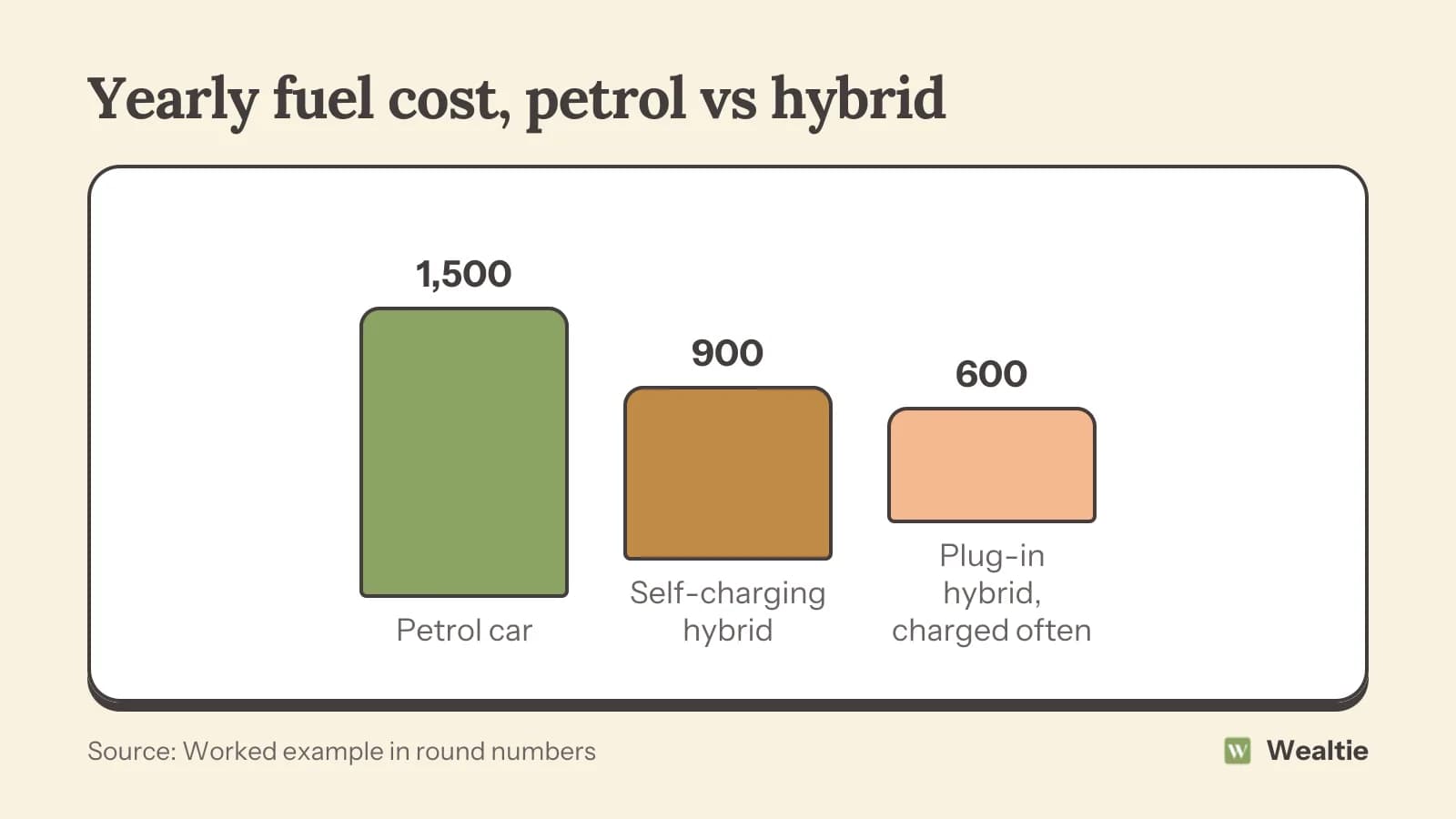
A self-charging hybrid saves 600 a year compared with petrol. If it costs 3,000 more to buy, it takes about five years to break even. A plug-in hybrid charged often can use even less fuel, though you'll pay for electricity, perhaps around 200 a year, so the net saving is about 700.
What types of hybrid are there?
Self-charging hybrids
These charge their battery from the engine and braking. You can't plug them in. They save most in town and stop-start traffic, and less on long motorway journeys.
Plug-in hybrids
These have bigger batteries you charge from a socket, giving a short all-electric range for daily trips. They save the most if you charge them every day and mostly drive short distances. If you rarely charge them, they can use as much fuel as a petrol car, since they carry a heavy battery.
Mild hybrids
These have a small electric system that helps the engine but can't drive on electric power alone. Savings are modest.
Who saves most with a hybrid?
Town drivers
Lots of stop-start driving lets the electric motor do more work, which means bigger fuel savings.
Short commuters with charging
A plug-in hybrid used for a short daily commute and charged at home can run mostly on electricity.
High-mileage town drivers
The more you drive in town, the faster the fuel savings repay the higher price.
Who might not save?
Motorway drivers
On long, steady motorway journeys, hybrids often use about as much fuel as an efficient petrol or diesel car.
Plug-in owners who don't charge
Without regular charging, a plug-in hybrid loses most of its advantage.
Low-mileage drivers
If you drive little, fuel savings may never repay the higher price.
What other costs should you compare?
Purchase price
Hybrids usually cost more new, though second-hand hybrids can be good value. How to buy a used car without overpaying covers buying used.
Insurance and tax
Insurance and road tax can be higher or lower depending on the model and local rules.
Servicing and battery
Hybrids often have lower brake wear, but specialist servicing can cost more. Check the battery warranty.
Resale value
Hybrids can hold their value well, which improves the overall cost.
Is an electric car better?
For drivers who can charge at home and mostly do shorter trips, a fully electric car may save even more. Electric car running costs covers that comparison, and how much car can you afford? covers the full cost of any car.
Test drive before you buy. Hybrids feel different to drive, with quiet electric starts and smooth acceleration in town, and some people love them while others prefer a traditional engine. A test drive on your usual routes, including some town driving, gives you a feel for how much the electric motor will be used day to day.
Think about where you'll charge if you're considering a plug-in hybrid. If you can't charge at home or work, a self-charging hybrid may suit you better, since you'll get the fuel savings without needing a socket. Electric car running costs covers charging costs, which are worth factoring in if you plan to charge at home.
Finally, consider how long you'll keep the car. The longer you keep it, the more years of fuel savings you'll enjoy after the break-even point. If you change cars every couple of years, the higher purchase price may never pay for itself, unless resale values stay strong.
Keeping a log of fuel costs for the first year with your hybrid shows whether the savings match your expectations.
Ask about the battery warranty and what replacing a battery would cost outside it. Most hybrid batteries last many years, but knowing the terms gives you peace of mind, especially when buying used.
How can Wealtie help you compare running costs?
Log fuel, charging and car costs in a transport expense category for a few months. Knowing what you spend on fuel now makes it easy to work out how much a hybrid would save and how long it would take to break even. A monthly budget for driving keeps the comparison honest after you switch.
Questions people ask
It often is for town drivers, since fuel savings can repay the higher price. In a worked example, a hybrid broke even in about five years.
Not much. Hybrids save most in town and stop-start traffic. On long motorway trips, savings are small.
It is if you charge it often and mostly drive short distances. Without regular charging, it loses most of its advantage.
Compare yearly fuel costs with the extra purchase price, and include insurance, servicing and resale value.
This article is general information, not financial, tax or legal advice. Your situation is your own; check the numbers that apply to you before you act on them.