Budgeting: How much car can I afford? The payment, the full cost and a table
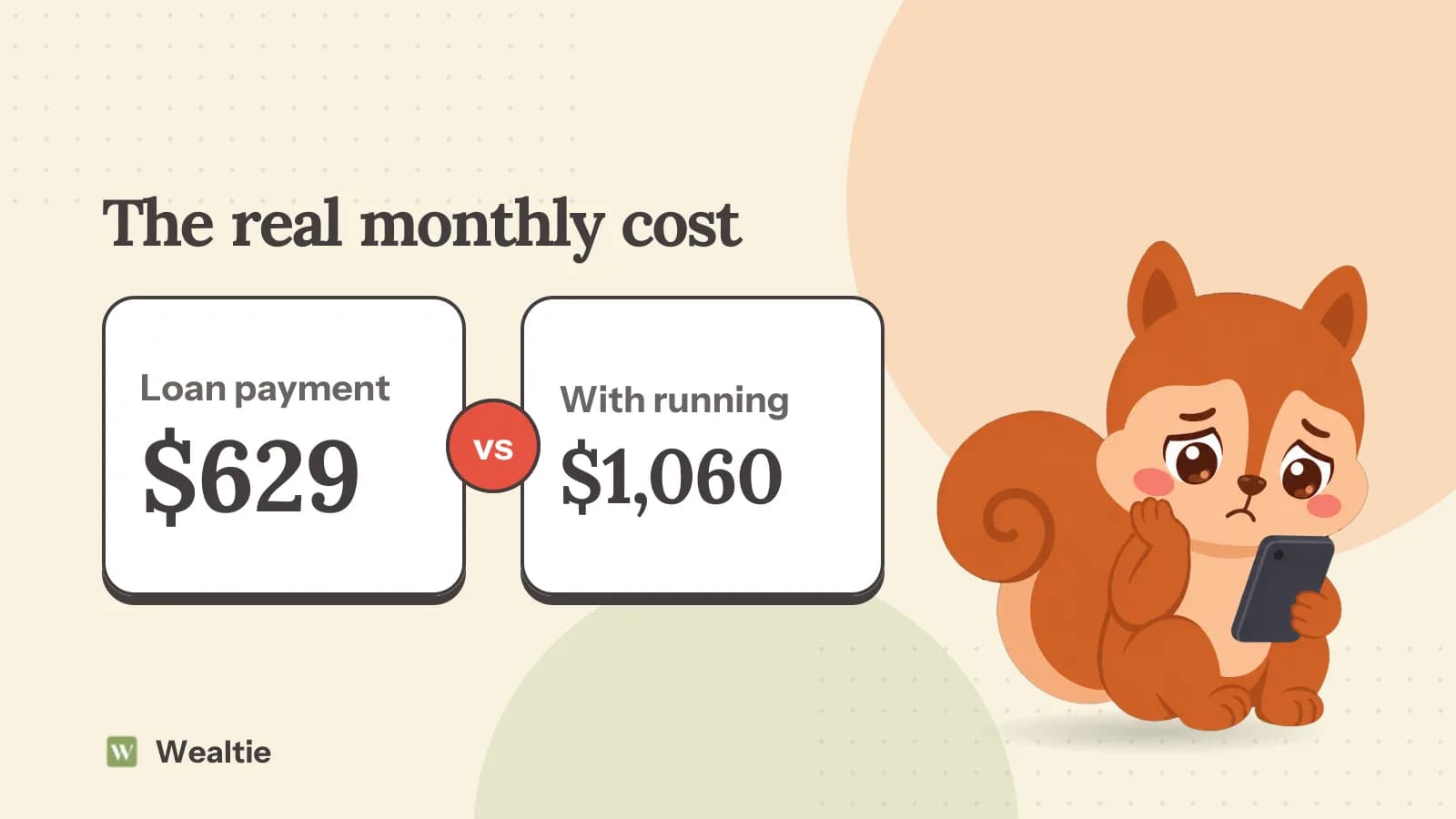
The car you can afford is the one whose full monthly cost, loan payment plus insurance, fuel and upkeep, fits your budget alongside rent and savings. With the average new car at $50,562 and new car loans averaging 9.45% in September 2026, a $30,000 loan over 60 months costs about $629 a month before anything else.
 By Wealtie Team · 3 min read
Key takeaways
- The average new vehicle sold for $50,562 in September 2026, and the average new car payment was $776 a month, according to Cox Automotive and Kelley Blue Book.
- New car loans averaged 9.45% in September 2026 on a 72-month loan in Cox Automotive's affordability index.
- At 9.45%, a $30,000 loan costs about $629 a month over five years and $7,759 in interest; stretched to six years, the payment drops to $547 but interest rises to $9,419.
- The payment is only part of the cost: insurance, fuel, maintenance and parking can add several hundred a month.
- Set the total monthly car cost first, then work back to a price, rather than starting from the car you like.
How much car can I afford?
The car whose full monthly cost fits your budget: the loan payment plus insurance, fuel, maintenance and parking, alongside rent, bills and savings.
Most people start from a car and ask whether they can make the payment. It works better the other way round. Decide what you can spend on the car each month in total, take off the running costs, and the rest is the payment. The payment tells you the price.
What do cars and car loans cost in 2026?
The average new vehicle sold for $50,562 in September 2026, just below the record, according to Kelley Blue Book. A compact car averaged $27,977 and a compact SUV $37,614.
Borrowing is expensive too. In Cox Automotive's affordability index, the average new car loan rate was 9.45% in September 2026, and the typical new car payment was $776 a month, on a 72-month loan. That was the highest monthly payment since December 2023.
Used cars are getting slightly cheaper: their prices fell 1.5% in the 12 months to September 2026, while new vehicle prices rose 0.6%, according to the BLS Consumer Price Index.
What does a car loan cost per month?
At the September 2026 average rate of 9.45%:
| Amount borrowed | 48 months | 60 months | 72 months |
|---|---|---|---|
| $20,000 | $502 | $420 | $365 |
| $30,000 | $753 | $629 | $547 |
| $40,000 | $1,004 | $839 | $730 |
A longer loan lowers the payment and raises the total. On $30,000, five years costs about $7,759 in interest and six years about $9,419: $1,660 more for a payment $82 lower. It also means owing more than the car is worth for longer, which matters if you need to sell it early.
What does a car really cost each month?
The payment plus everything that keeps the car on the road. For many people that's several hundred more.
- Insurance: the average US household spent $2,153 on vehicle insurance in 2025, about $179 a month, in the BLS Consumer Expenditure Survey. Get a quote for the exact car before you buy; it varies a lot by model.
- Fuel: monthly miles ÷ miles per gallon × the local price.
- Maintenance and repairs: repair prices rose 5.8% over the year to September 2026, according to the BLS. Older cars need more.
- Parking, tolls, registration and tax.
Here's a worked example in round numbers. A $30,000 loan over 60 months at $629, insurance at $180, fuel at $170 and maintenance at $80 comes to about $1,060 a month. That's the number to fit in your budget, not $629.
How do you work out your car budget?
Start from take-home pay and what's left after rent, bills and savings, then decide how much of it the car gets.
One common rule of thumb keeps total car costs, payment and running costs together, within 10% to 15% of take-home pay. On 5,000 a month, that's 500 to 750. In the example above, a 750 car budget minus about 430 of running costs leaves roughly 320 for the payment, which at 9.45% over five years pays off about $15,000. That's a very different car from the average.
If that feels low, it's because new cars have become expensive relative to income. Cox Automotive estimates it took 35.7 weeks of median income to buy the average new vehicle in September 2026.
How do you make a car more affordable?
Put more down, borrow for a shorter time, and shop the loan as hard as the car.
- A bigger down payment shrinks the loan and the interest. Many buyers aim for 10% to 20%, without touching the emergency fund.
- Compare loan offers from your bank or credit union before you visit the dealer, so you know what a good rate looks like.
- Consider a used or smaller car. The gap between a compact car and the average new vehicle was over $22,000 in September 2026.
- Save for the next car now. A monthly amount into a sinking fund turns the next purchase into a bigger down payment, or no loan at all.
How do you track the full cost of a car?
Give the car its own budget category and log every cost against it: payment, insurance, fuel, repairs and parking.
In Wealtie, set the car payment and insurance as recurring transactions that log themselves on the due date, and log fuel and repairs as you go. Your monthly budget shows the car's real monthly cost next to everything else, and Budget Health warns you mid-month if spending is heading over.
Questions people ask
Work back from the monthly amount your budget can take for the whole car, not just the payment. Subtract insurance, fuel and upkeep, and the rest is your payment. At 9.45% over 60 months, $629 a month pays off about $30,000.
$776 a month for a new vehicle in September 2026, the highest since December 2023, according to Cox Automotive's affordability index, based on a 72-month loan at an average 9.45%.
It lowers the payment but raises the total interest and keeps you owing more than the car is worth for longer. On $30,000 at 9.45%, six years costs about $1,660 more in interest than five.
As much as you can without touching your emergency fund. A bigger down payment shrinks the loan, the interest and the risk of owing more than the car is worth. Many buyers aim for 10% to 20%.
A used car usually costs less to buy and to insure, but may cost more to maintain. Compare the full monthly cost of each, including insurance and expected repairs, not just the price.
Sources
- Kelley Blue Book Report: Average New-Vehicle Transaction Prices, September 2026 · Cox Automotive / Kelley Blue Book · checked 1 November 2026
- New-Vehicle Affordability Declines in September as Prices, Payments Rise (Cox Automotive/Moody's Analytics Vehicle Affordability Index) · Cox Automotive · checked 1 November 2026
- Consumer Price Index – September 2026 · U.S. Bureau of Labor Statistics · checked 1 November 2026
- Consumer Expenditures in 2025, table 1400: Size of consumer unit · U.S. Bureau of Labor Statistics · checked 1 November 2026
This article is general information, not financial, tax or legal advice. Your situation is your own; check the numbers that apply to you before you act on them.