Budgeting: How to track your spending so you know where the money goes
To work out how to track your spending, start by going through last month's statements, then choose one way to log purchases as you go and check it once a week. A month of honest tracking usually shows two or three surprises.
 By Wealtie Team · 3 min read
Key takeaways
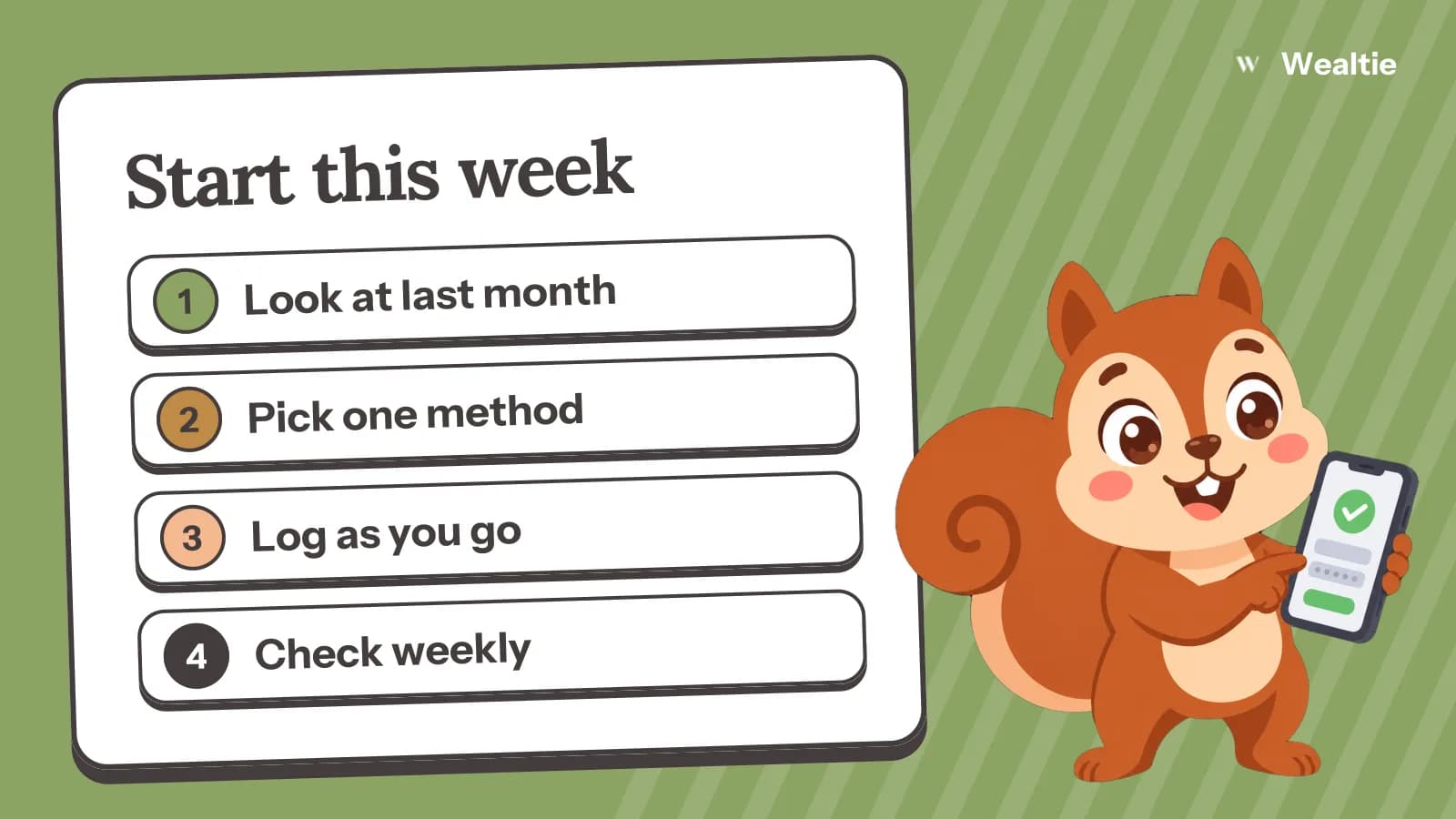
- Start by going through last month's bank and card statements, so you know your starting point.
- Choose one method, whether an app, a notebook or a spreadsheet, and use it for everything.
- Log purchases on the day, since a week of catching up is where most tracking gives up.
- A five-minute weekly check catches mistakes and keeps the habit going.
How do you track your spending?
Look back first, then track forward. Going through last month tells you where your money went. Tracking from today tells you where it's going while you can still change it. The method matters less than doing it every day for a month.
Where should you start?
With last month's statements. Go through every bank account and card and put each purchase into a few rough groups. Here's a worked example in round numbers that work in any currency:
| Group | Last month |
|---|---|
| Rent and bills | 1,100 |
| Groceries | 420 |
| Eating out and coffee | 260 |
| Transport | 180 |
| Subscriptions | 90 |
| Everything else | 310 |
| Total | 2,360 |
Include every account: current accounts, credit cards, savings you spent from, and cash. Missing one card can hide a whole category, and online orders billed to a partner's card are easy to miss.
Most people find at least one group much bigger than they'd have guessed. That's the most useful thing you'll learn in the first week.
Which tracking method should you use?
The one you'll keep using. Each has a trade-off:
- An app: quick to log on the spot and adds things up for you
- A spreadsheet: flexible and free, but you'll need to enter or import everything
- A notebook: simple and visible, but you'll add up by hand
- Bank statements alone: no effort, but you only see spending after it's happened, and cash disappears
If you share costs with a partner, agree who logs shared purchases, or you'll end up with two records and two totals. Use one method for everything. Splitting tracking between an app and a notebook usually means one of them falls behind. The budget spreadsheet has a template if that's your choice.
How often should you log?
On the day you spend, ideally at the time. Each entry takes a few seconds when it's fresh. Leave it a week and you'll be trying to remember what a 14.60 payment was for, which is where most people give up.
Logging on your phone right after paying works best for most people, with a few taps while you're still at the till. If you can't log at the time, pick a moment each evening, like after dinner, and enter the day's spending then. Keep receipts in one pocket of your bag until you've logged them.
What about cash?
Track it the same way as card spending. Cash is where tracking most often leaks, because it doesn't show on a statement. Treat your wallet as an account: when you take money out, it moves into the wallet, and when you spend it, you log it. How to track cash spending has the full system, and counting your wallet once a week keeps it honest.
How do you make the habit stick?
Keep it simple for the first month. Use a handful of categories, not twenty. Don't try to budget yet: just record what happens. A budget is much easier to set once you've got a month of real numbers. Don't judge your spending in the first month either. The point is an honest record, and changes come after.
Check once a week. Five minutes on a Sunday to compare your record with your bank balance, log anything missing, and look at the week's total. That small check is what keeps the habit going.
If you miss a few days, don't start over. Log what you can remember, correct the balance for the rest, and carry on from today.
What should you do with what you learn?
After a month, look at the totals and pick one thing to change. If eating out came to 260 and you'd like it to be 150, that's a clear goal. How to make a budget turns the numbers into a plan, and how to stop overspending helps with the category that's running over.
Compare each month with the one before. A category that rises three months in a row is worth a closer look. Keep tracking after you've set a budget. The budget tells you the plan, and tracking tells you whether you're sticking to it.
How do you track your spending in Wealtie?
Add each account, including a cash wallet, with today's balance, and log each purchase in a category as you make it. The expense tracker page shows how logging works, and the Add Transaction budget widget on your home screen takes you straight to the form. The monthly spending overview splits your month by category, and if a balance drifts from your bank's, Update Balance corrects it.
Questions people ask
Use one method, like an app, and log each purchase on the day you make it. Start by going through last month's statements to see your starting point.
Go through last month's bank and card statements and group your spending, then log every purchase from today in one place.
Log every day and check once a week, comparing your record with your bank balance and logging anything missing.
Track for a month first. A budget based on real numbers is much easier to stick to.
This article is general information, not financial, tax or legal advice. Your situation is your own; check the numbers that apply to you before you act on them.