Budgeting: How to make a budget: a first budget in five steps
To make a budget, write down your take-home pay, list the bills that don't change, see where last month's money went, set one spending limit with savings taken out first, then check it mid-month. That's how to make a budget in five steps. Treat the first month as a draft.
 By Wealtie Team · 4 min read
Key takeaways
- A first budget takes five steps: take-home pay, fixed bills, last month's spending, a spending limit with savings taken out first, and a mid-month check.
- Build the limits from what you spent last month, not from what you'd like to spend.
- One total limit plus limits for the three to five categories that change month to month is easier to keep than a line for everything.
- Housing, transportation and food made up 63% of average US household spending in 2024, according to the Bureau of Labor Statistics.
- The first month of a budget is a draft; adjust the limits once you've seen a full month against them.
The five steps at a glance
A budget is one number you spend up to each month, plus a few limits inside it. Here's the order:
- Write down your monthly take-home pay.
- List the bills that are the same every month.
- Add up where last month's money went.
- Take savings out first, then set the spending limit.
- Check it halfway through the month.
The order matters. Real spending comes before targets, so the limits start from what you do, not from what you'd like to do. And the check sits in the middle of the month, while there's still time to change something.
The example below uses 3,000 a month. Round numbers, and they work in any currency.
Step 1: What's your monthly take-home pay?
Use the amount that lands in your account, after tax and deductions, not your salary.
If you're paid every two weeks, multiply one paycheck by 26 and divide by 12. A $1,385 paycheck becomes about $3,000 a month. Leave out bonuses and overtime you can't count on.
If your income changes from month to month, base the budget on your lowest normal month. The guide on how to budget on irregular income covers the rest.
Example: take-home pay is 3,000.
Step 2: Which bills are fixed?
Fixed bills are the ones that cost the same every month and that you can't cut without a phone call: rent, insurance, phone, internet, loan payments, subscriptions.
List each one with its amount. Then add the bills that come once or twice a year, divided by 12. A 600 car insurance bill becomes 50 a month. If you leave yearly bills out, one month a year blows up for no visible reason. A sinking fund is how you save for them.
| Fixed bill | Per month |
|---|---|
| Rent | 1,000 |
| Car payment | 200 |
| Utilities | 150 |
| Insurance | 120 |
| Phone and internet | 80 |
| Subscriptions | 30 |
| Yearly bills, divided by 12 | 50 |
| Total | 1,630 |
Step 3: Where did last month's money go?
Go through last month's card statement, bank app and any cash you remember, and total everything that isn't a fixed bill by category.
Five to eight categories is plenty: groceries, eating out, fuel or transport, shopping, and "other". This step is the one people skip, and it's the one the limits come from. If last month was unusual, use the average of two or three.
Example: last month's flexible spending came to 1,170. Groceries 450, eating out 250, fuel 120, shopping 200, other 150. With fixed bills at 1,630, total spending was 2,800, leaving 200.
What does the average household spend on what?
Housing, transportation and food took 63% of average US household spending in 2024. That's from the BLS Consumer Expenditure Survey released in December 2025. Use it as a sense of scale, not as a target.
| Category | Share of spending, 2024 |
|---|---|
| Housing | 33.4% |
| Transportation | 17.0% |
| Food | 12.9% |
| Personal insurance and pensions | 12.5% |
| Healthcare | 7.9% |
| Everything else | 16.3% |
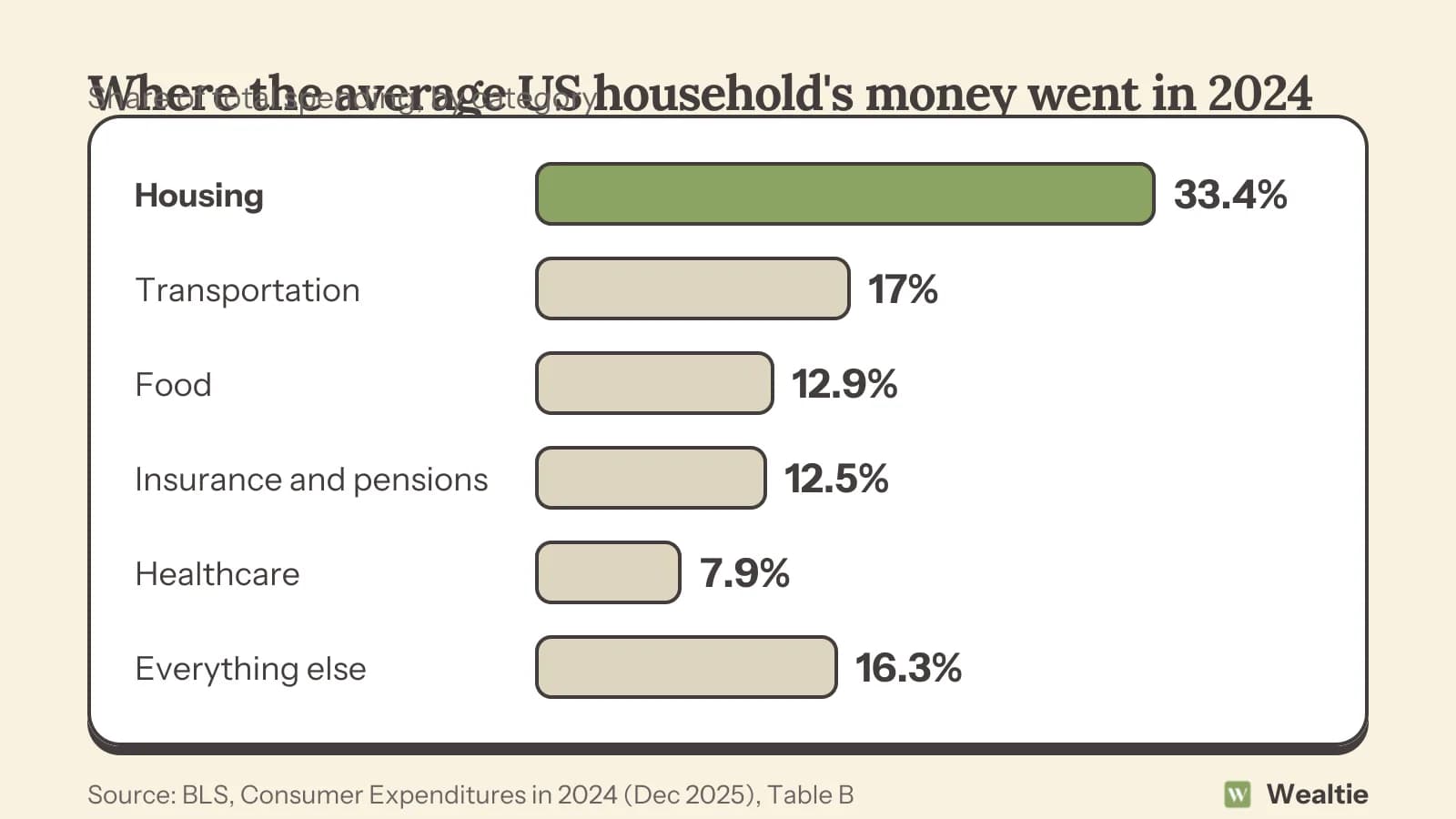
"Personal insurance and pensions" is mostly Social Security and retirement contributions taken from pay, so it often won't show up in a take-home budget.
Step 4: How do you set the spending limit?
Take your savings out first, and whatever's left after that is the spending limit.
Pay minus savings equals the limit. Saving what's left at the end of the month puts savings last in line, after every purchase that month.
Example: 3,000 take-home, 300 to savings, so the spending limit is 2,700. Fixed bills stay at 1,630, which leaves 1,070 for flexible spending. Last month that was 1,170, so 100 has to come out:
| Category | Last month | Budget |
|---|---|---|
| Groceries | 450 | 430 |
| Eating out | 250 | 180 |
| Fuel | 120 | 120 |
| Shopping | 200 | 170 |
| Other | 150 | 170 |
| Flexible total | 1,170 | 1,070 |
"Other" went up on purpose. It's where the things you forgot end up, and a limit that's too tight there breaks the whole budget by the third week.
Set limits only for the categories that change. Fixed bills don't need a limit, and twenty lines of limits is twenty chances to go over. One total and three to five category limits is enough for month one.
For a quick check on the overall split, the 50/30/20 rule suggests needs, wants and savings shares, and the budget calculator does that arithmetic for you.
Step 5: When should you check the budget?
Check it in the middle of the month, around day 15, while there's still time to change the second half.
At the halfway point, compare what you've spent with half the flexible budget. In the example that's 535. If you're at 700, the second half of the month has 370, not 535, and you know that with two weeks left instead of zero.
A budget tracker that forecasts the month does this sum for you. Wealtie's Budget Health warns you mid-month if your spending pace will take you over.
After month one, change the limits that were wrong. If groceries went 60 over, raise that limit by 60 and take it from a category that came in under.
Should you make a budget in a spreadsheet or an app?
Either works, because the five steps are the same. The difference is who does the typing and the sums.
A spreadsheet in Excel or Google Sheets needs four columns: category, budget, actual, difference. You enter every purchase yourself and build the totals. That suits people who like seeing the formulas.
An app does the totals and the mid-month check, and it's on your phone at the checkout. Wealtie is a free budget app that doesn't connect to your bank: the free plan includes a monthly budget, 10 categories and the Budget Health score.
Questions people ask
The easiest way is one total spending limit: take-home pay minus savings. Add limits for only the three to five categories that change month to month, like groceries and eating out, and check the total mid-month.
A simple monthly budget on 3,000 take-home looks like this: 300 to savings, 1,630 in fixed bills and 1,070 for flexible spending split across groceries, eating out, fuel, shopping and other. The numbers work in any currency.
Base the limits on what you spent last month, then check the budget around day 15 instead of at the end of the month. Change the limits that turned out wrong after month one rather than forcing them.
Make four columns: category, budget, actual and difference. Fill in budget from last month's spending, type each purchase into actual as it happens, and use a SUM formula for the totals.
Base the budget on your lowest normal month of income. Anything you earn above that goes to savings or to topping up a lean month later.
Sources
- Consumer Expenditures in 2024 (news release, December 19, 2025), Table B · U.S. Bureau of Labor Statistics · checked 12 October 2026
- Family spending in the UK: April 2024 to March 2025 · Office for National Statistics · checked 12 October 2026
This article is general information, not financial, tax or legal advice. Your situation is your own; check the numbers that apply to you before you act on them.