Money as a couple: How much should I spend on an engagement ring? Start from savings
How much should I spend on an engagement ring? What you can save without borrowing or touching your emergency fund, so saving 400 a month for nine months gives you a budget of 3,600.
 By Wealtie Team · 3 min read
Key takeaways
- Base the budget on what you can save, without borrowing or touching your emergency fund.
- Saving 400 a month for nine months gives you 3,600.
- Salary-based rules like "three months' pay" ignore your rent, debts and savings, so they aren't a useful guide.
- Compare the ring with what you're also saving for together, like a wedding or a home.
How much should I spend on an engagement ring?
What you can save for it without taking on debt or emptying your emergency fund. The right number has more to do with your own month than with anyone else's rule, and there's no figure that makes a ring the right size for a relationship.
Start with what you can put aside each month, multiply by how long you're willing to wait, and that's your budget.
| Saved each month | 6 months | 9 months | 12 months |
|---|---|---|---|
| 200 | 1,200 | 1,800 | 2,400 |
| 400 | 2,400 | 3,600 | 4,800 |
| 600 | 3,600 | 5,400 | 7,200 |
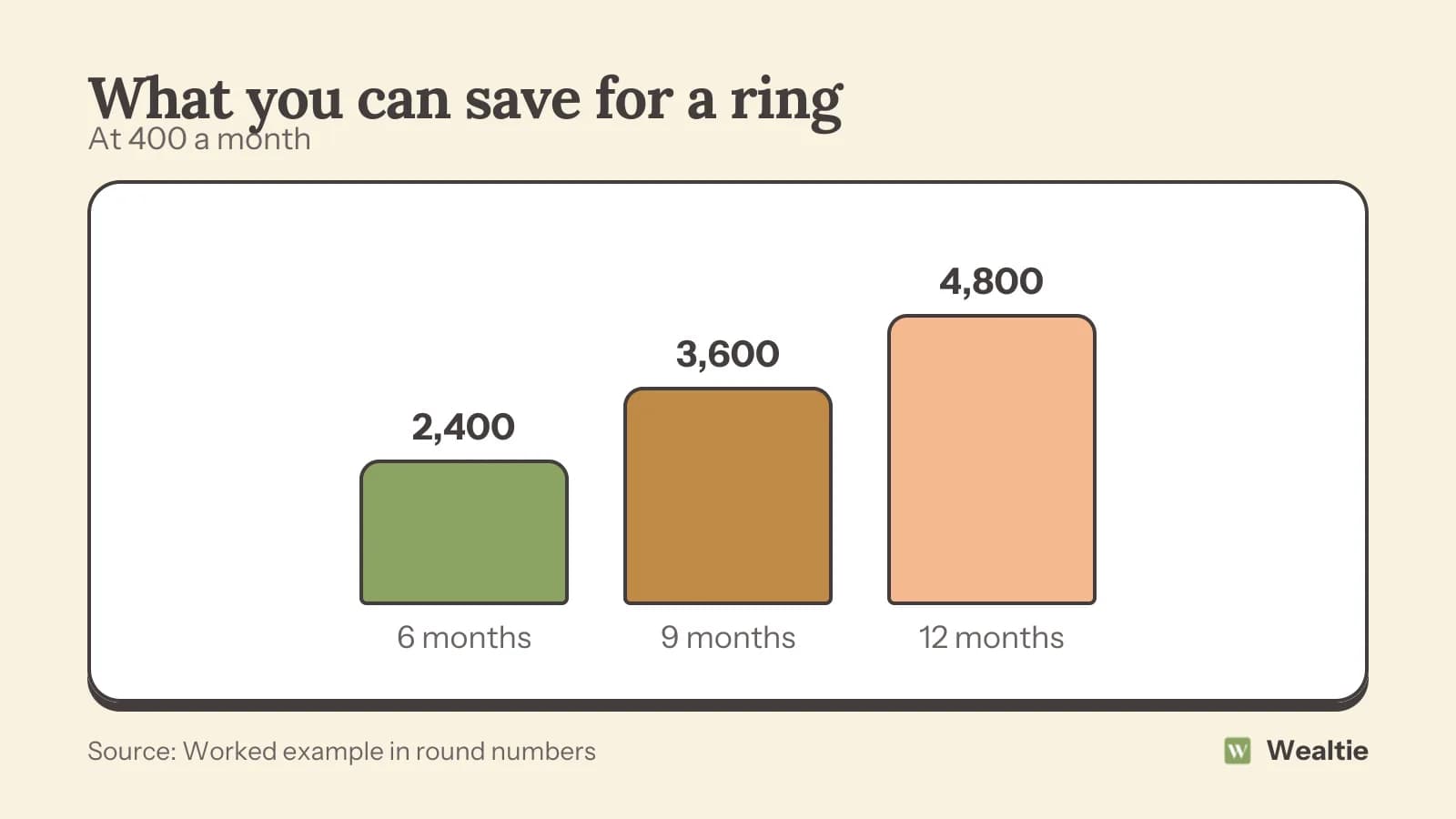
Those are round numbers that work in any currency.
Does the three months' salary rule mean anything?
Not for your budget. It's quoted a lot, but it ignores what matters: your rent, your debts, what you've saved and what else is coming. Two people on the same salary can have very different amounts to spare.
Three months' take-home is also a big sum. On take-home pay of 3,000, the rule points at 9,000. That's a serious deposit toward a home in many places, or most of a wedding. If you can afford it easily and want to, that's fine. It's just a poor test of whether you can.
Ignore the two-month and one-month versions too. Your own budget is a better guide than any of them.
What should you check before setting a budget?
Run through this list first:
- Do you have an emergency fund, even a small one?
- Are you carrying card debt? Clear it first if you can
- Are your bills paid with room to spare each month?
- What else are you saving for in the next two years?
If the fourth one includes a wedding or a home, it's worth looking at them together. The wedding budget and saving for a house can show you what's coming. Your total's the thing that matters, and the ring is one line in it.
Should you finance an engagement ring?
Try to avoid it. Store finance and credit cards can make a ring feel affordable by turning it into a monthly payment, but you'll be paying interest on something that doesn't earn anything.
Be careful with interest-free deals. They often end with a high charge if you haven't cleared the full amount by a set date. Read the terms if you go that way, and set up payments that finish before the deadline.
Waiting three or six months and saving costs you nothing. It also means you start your engagement without a debt to pay off together.
Should you talk about the budget with your partner?
It's worth thinking about, even if the proposal's a surprise. Many couples discuss rings ahead of time, and some choose one together. It means you're not guessing about what they'd like, and you get to see how you'll handle a big money decision as a couple.
If you want to keep it secret, ask a close friend or family member to find out what they'd like. Size, style and how they feel about the whole thing are all easier to learn before you've paid.
If money's something you've never talked about, how to talk about money with a partner is a useful place to start, and questions to ask before marriage will come in handy soon after.
How can you spend less and get a ring you like?
Decide what matters most to you, and spend on that. Stones slightly below a popular round number can cost noticeably less and look the same. Lab-grown stones usually cost much less than mined ones. A different gemstone, an antique ring or a family stone that's reset can each bring the price down, and some people prefer them.
Shop around. Compare the same specification across several jewellers, get the certificate if you're buying a diamond, and check the returns policy before you pay.
Remember the extras: resizing, engraving, and insurance. Add a little to the budget for these, and ask your home insurer what's covered, since a ring may need to be listed on your policy.
What if your partner expects more than you can afford?
Be honest about it. A conversation about what you can afford is a much better start than a debt they don't know about. Many people would be upset to learn that the ring put you in trouble.
If you'd like something bigger later, you could upgrade or reset the stone for an anniversary, once you're in a stronger position.
How do you save for a ring in Wealtie?
Add a separate savings account and name it something discreet if anyone else can see your phone. Move money into it as a transfer each payday, and it isn't counted as spending, so your budget tracker stays accurate. The account's balance shows up in your net worth tracker, and the Free plan includes two accounts.
Questions people ask
It's more than many people can comfortably afford, and the rule ignores your rent, debts and savings. Base the budget on what you can save instead.
Averages vary by country and survey, and they don't tell you what you can afford. Work out what you can save without borrowing, and use that as your budget.
Try to avoid it, since you'd be paying interest on something that earns nothing. Saving for a few more months costs nothing and means you won't start out with debt.
Six to twelve months is a realistic range. At 400 a month, that gives you between 2,400 and 4,800.
This article is general information, not financial, tax or legal advice. Your situation is your own; check the numbers that apply to you before you act on them.