Money as a couple: How to split utilities with roommates fairly, with the sums
To work out how to split utilities with roommates, start with equal shares, since most bills don't depend on room size. Adjust only when one person clearly uses more, and work out a mid-bill move-out by the day.
 By Wealtie Team · 3 min read
Key takeaways
- Split utilities equally unless someone clearly uses more, since most bills don't depend on who's in which room.
- A bill of 240 split three ways is 80 each.
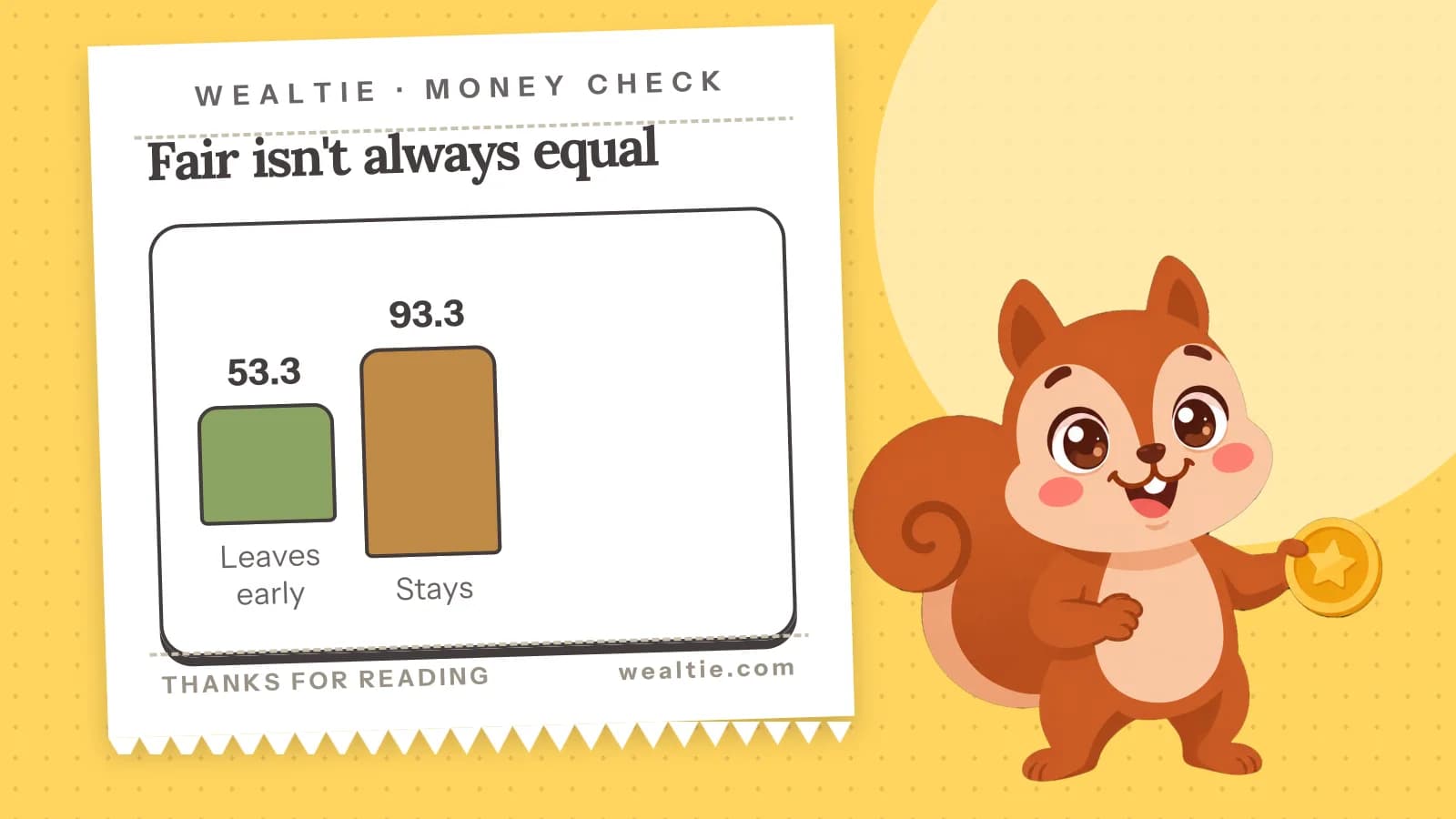
- When someone moves out mid-bill, charge by the day: on a 30-day bill of 240, someone leaving after day 20 pays 53.33 and the two who stay pay 93.33 each.
- Have everyone pay into one account or app before the due date, so one person isn't left chasing.
How do you split utilities with roommates?
Equally, unless there's a clear reason not to. Electricity, gas, water and internet mostly depend on how many people live there and don't care who's got the bigger bedroom. A bill of 240 split three ways is 80 each, in round numbers that work in any currency.
Rent's different, and splitting rent with roommates covers why a bigger room should cost more. Utilities aren't tied to floor space in the same way, so applying the same split usually overcharges someone.
When isn't an equal split fair?
When one person's use is clearly different and it's easy to agree on. A few cases that come up often:
| Situation | A fair approach |
|---|---|
| One person works from home all day | They pay a bit more for heating and electricity |
| One person has a space heater in their room | They pay a set extra amount in winter |
| Someone's away for a month or more | They pay internet in full and a reduced share of use-based bills |
| A partner stays over most of the week | Count them as an extra person, or add a fixed amount |
| One person wants the fastest internet | They pay the difference between plans |
Keep any adjustment simple. Use a fixed extra amount, since working it out to the kilowatt isn't worth the argument. If a change saves each person less than a coffee a month, leave it.
Who should have the account in their name?
Someone who's reliable and likely to be staying. The company deals with whoever's named on the account, and in most places that's the person who gets chased if it's not paid.
A common setup is for each person to take responsibility for one bill. One holds electricity, one holds internet, one holds water. Each person then only collects for their own bill, and nobody carries everything. Balance it up at the end if the amounts differ by much.
If only one person's named, they're taking on more risk than the others. It's reasonable for them to be paid before the bill's due, instead of chasing people after they've covered it.
How do you make sure everyone pays on time?
Have people pay before the bill's due, on a set date. A common way is a small shared account, where everyone pays in their monthly share and the bills come out of it. Then no one has to do the chasing.
To smooth out winter, agree an estimated monthly amount for energy. If the year's bills come to about 1,800 between three of you, that's 600 each for the year, or 50 a month each. Compare at the end of the year and settle the difference.
Check your first bills against the estimate. If they're well above what you expected, it's better to raise everyone's payment by a little now than to surprise them in February.
How do you split a bill when someone moves in or out?
By the day. Take a 30-day bill of 240, which is 8 a day. One of three roommates moves out after day 20:
| Period | Daily cost | Days | Who shares it | Each pays |
|---|---|---|---|---|
| Days 1 to 20 | 8 | 20 | Three people | 53.33 |
| Days 21 to 30 | 8 | 10 | Two people | 40.00 |
The person who left pays 53.33. The two who stayed pay 93.33 each. That adds up to a cent off the total, which someone rounds up.
Take a meter reading on the day someone moves out, and get a photo of it. It makes the sum accurate for that bill, and it means you'll avoid an argument later.
What about shared costs that aren't bills?
Agree on those too, because they add up. Toilet paper, cleaning products and the bin bags tend to be bought by the same person over and over, until they get fed up. Put them on a shared list, take turns, or put a small monthly amount into a shared pot.
Food's a separate conversation, and splitting groceries with roommates goes through the options. A TV subscription or streaming service should only be split among those who use it.
What should you agree before you move in?
Write down how each bill's split, who's named, when payment's due and how you'll handle a late one. A shared note will do. It's much easier to agree on this when everyone's getting on well than after the first argument.
How do you split utilities in Wealtie?
A shared account gives everyone the same record, with owner, editor and viewer roles. Split an expense using current shares or custom amounts, down to the cent, and choose pooled or per-person balances. The account owner needs Pro to invite people, and everyone else can be on any plan. There's more on the shared accounts page. A recurring bill in the bill tracker logs itself on its due date. Wealtie keeps the record, and you'll still pay each other yourselves.
Questions people ask
An equal split is fairest for most households, since utilities depend on how many people live there and not on room size. Add a fixed extra amount if one person clearly uses more.
Divide the bill by the number of days, then share each day's cost among the people living there that day. On a 30-day bill of 240, someone leaving after day 20 pays 53.33.
Usually not. Room size affects rent much more than it affects electricity, water or internet, so an equal split is normally fairer.
Someone who's reliable and likely to stay, since the company chases whoever's named. Sharing the load by giving each person one bill also works well.
This article is general information, not financial, tax or legal advice. Your situation is your own; check the numbers that apply to you before you act on them.