Money as a couple: Money questions to ask before marriage, and what to do with them
The money questions to ask before marriage cover six areas: what each of you earns, what you owe, how you spend, what you're saving for, how you'll share costs, and how you'll decide. The answers matter less than agreeing what to do with them, before the wedding rather than after the first argument.
 By Wealtie Team · 3 min read
Key takeaways
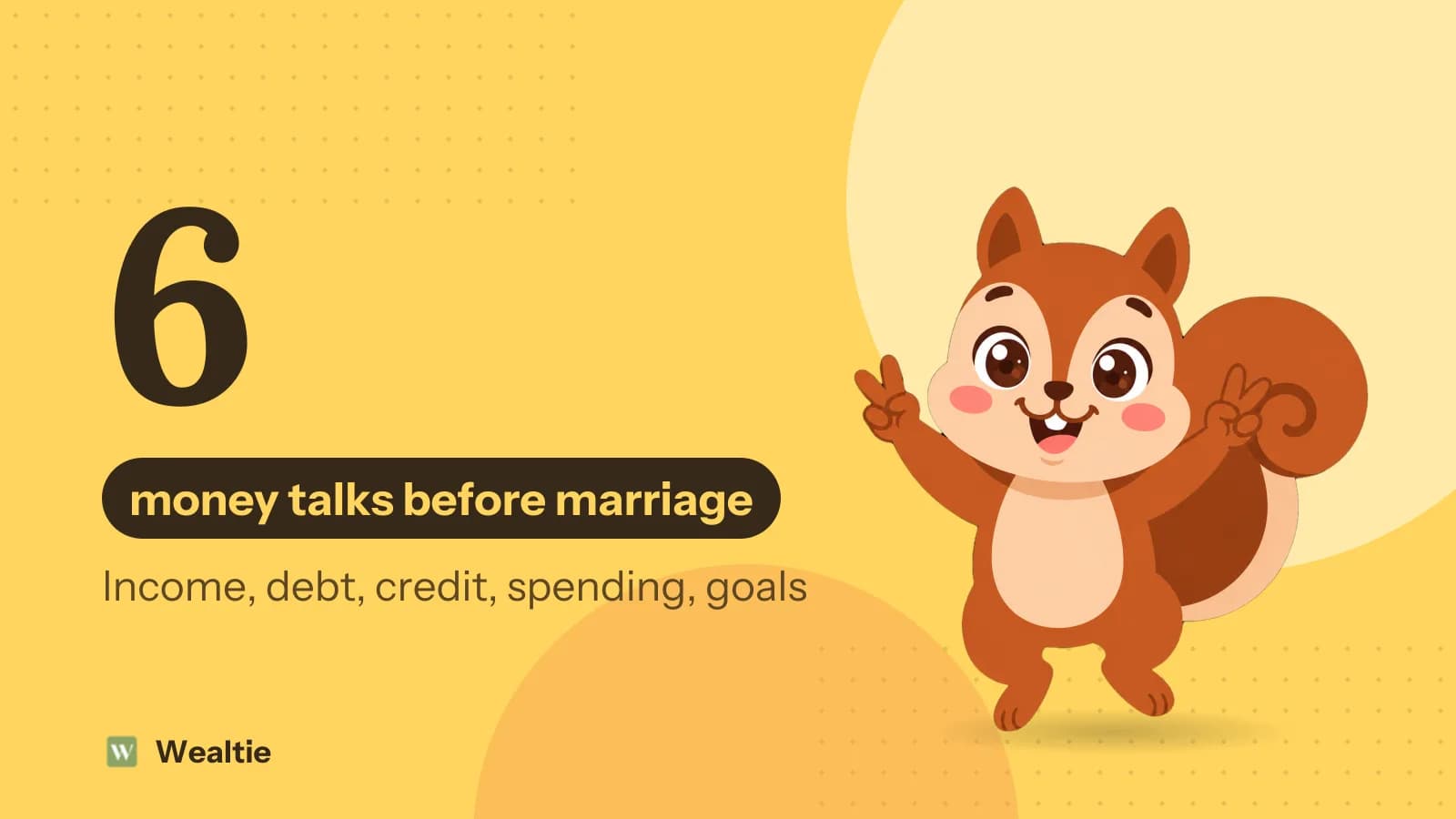
- Cover six areas before marriage: income, debt, credit, spending habits, goals, and how you'll share and decide.
- Share the actual numbers: take-home pay, every debt with its balance and rate, and savings.
- Debt doesn't need to be a dealbreaker; a plan to pay it off and an agreement on whose it is matters more.
- Decide how you'll split costs, joint, separate or both, and agree a spending limit above which you check with each other.
- Hold the conversation in parts over a few weeks, and repeat a short version every month after the wedding.
What money questions should you ask before marriage?
Six areas cover almost everything that causes trouble later:
| Area | The core question |
|---|---|
| Income | What does each of us take home, and how steady is it? |
| Debt | What do we each owe, at what rate, and what's the plan? |
| Credit | Is there anything in either credit history we should know about? |
| Spending | How do we each spend, and where do we differ? |
| Goals | What are we saving for in the next five years? |
| Sharing and deciding | How will we split costs and make big decisions? |
You don't need to agree on everything. You need to know the answers, and agree what you'll do about the differences.
What should you ask about income and debt?
The real numbers. Not ranges, not "I'm fine".
- Take-home pay, monthly, and whether it varies. Freelance or commission income needs a different plan from a salary.
- Every debt: student loans, credit cards, car loans, buy now, pay later, money owed to family. For each, the balance, the interest rate and the monthly payment.
- Savings and investments, including retirement accounts.
- Anything owed to you, or money you send regularly to family.
Debt doesn't need to be a dealbreaker. Hidden debt is what damages trust. A known balance with a plan, whether that's debt snowball or avalanche, is something you can solve together. Agree whether existing debts stay with the person who took them on, or become a shared project.
What should you ask about spending habits?
How each of you actually spends, and what money means to you.
- What do you spend on without thinking, and what do you hate spending on?
- Do you budget, track, or neither?
- How did your family handle money when you were growing up?
- What's a big purchase to you: 100, 500, 5,000?
- How do you feel about lending money to friends or family?
Differences here are normal. One saver and one spender is a common pairing. The goal is to understand each other's defaults, so a purchase that seems small to one of you isn't a shock to the other.
A useful exercise: each of you writes down last month's spending by category, then compare. Not to judge, but to see where the defaults differ. The 50/30/20 rule gives you a shared starting shape to compare both against.
What should you ask about goals?
What you each want in the next five years, and what it costs.
A home, children, a career change, travel, paying off debt, a business. Put rough numbers and dates next to each, and see whether they fit together. Two big goals with the same deadline usually need an order. How to set financial goals explains how to give each a monthly amount.
How will you share costs?
Decide the setup before the wedding: everything joint, everything separate, or a joint account for shared costs with personal money on the side.
Then decide how much each of you puts in. Equal amounts work when incomes are similar; contributions in proportion to income often feel fairer when they aren't. Should couples have joint bank accounts? compares the three setups, and how to split bills as a couple works through the numbers.
How will you make money decisions?
Agree two rules: a spending limit and a check-in.
A spending limit is the amount above which either of you checks with the other before buying. In round numbers, 200 is a common starting point; pick what fits your income. Below it, no discussion needed.
A monthly check-in is a short, regular look at the month: what came in, what went out, what's coming up. Fifteen minutes, on a calm day. How to talk about money with your partner has a format for it.
When should you have the conversation?
In parts, over a few weeks, well before the wedding. Start with goals, which are easier to talk about, and come back to numbers once you've both gathered them. And don't let the wedding itself become the first test: the wedding budget is a good, concrete place to practise.
How do you keep shared money visible after?
Use one record you can both see. In Wealtie, a shared account holds shared costs, with roles for each of you and balances that can be pooled or kept per person. The owner needs Pro to invite a partner, who can join on any plan, including Free. Your personal accounts stay your own.
Questions people ask
What each of you earns and owes, your credit history, how you each spend and save, your goals for the next five years, how you'll split costs, and how you'll make big money decisions together.
Yes, every one, with its balance, interest rate and monthly payment. Hidden debt is a common source of conflict; known debt with a payoff plan usually isn't.
There's no single right answer. Some pool everything, some keep everything separate, and many use a joint account for shared costs plus separate accounts for personal spending. Agree which before the wedding.
Pick a calm time, not during an argument or right after a big purchase, and start with goals rather than numbers. Then share figures in a second conversation once you've both gathered them.
Look for the rule both of you can live with, such as a spending limit before checking in, or personal money each month that's spent without discussion. Disagreements are normal; unspoken ones cause the trouble.
This article is general information, not financial, tax or legal advice. Your situation is your own; check the numbers that apply to you before you act on them.