Budgeting: How to budget for a wedding: set the total first, then the guest list
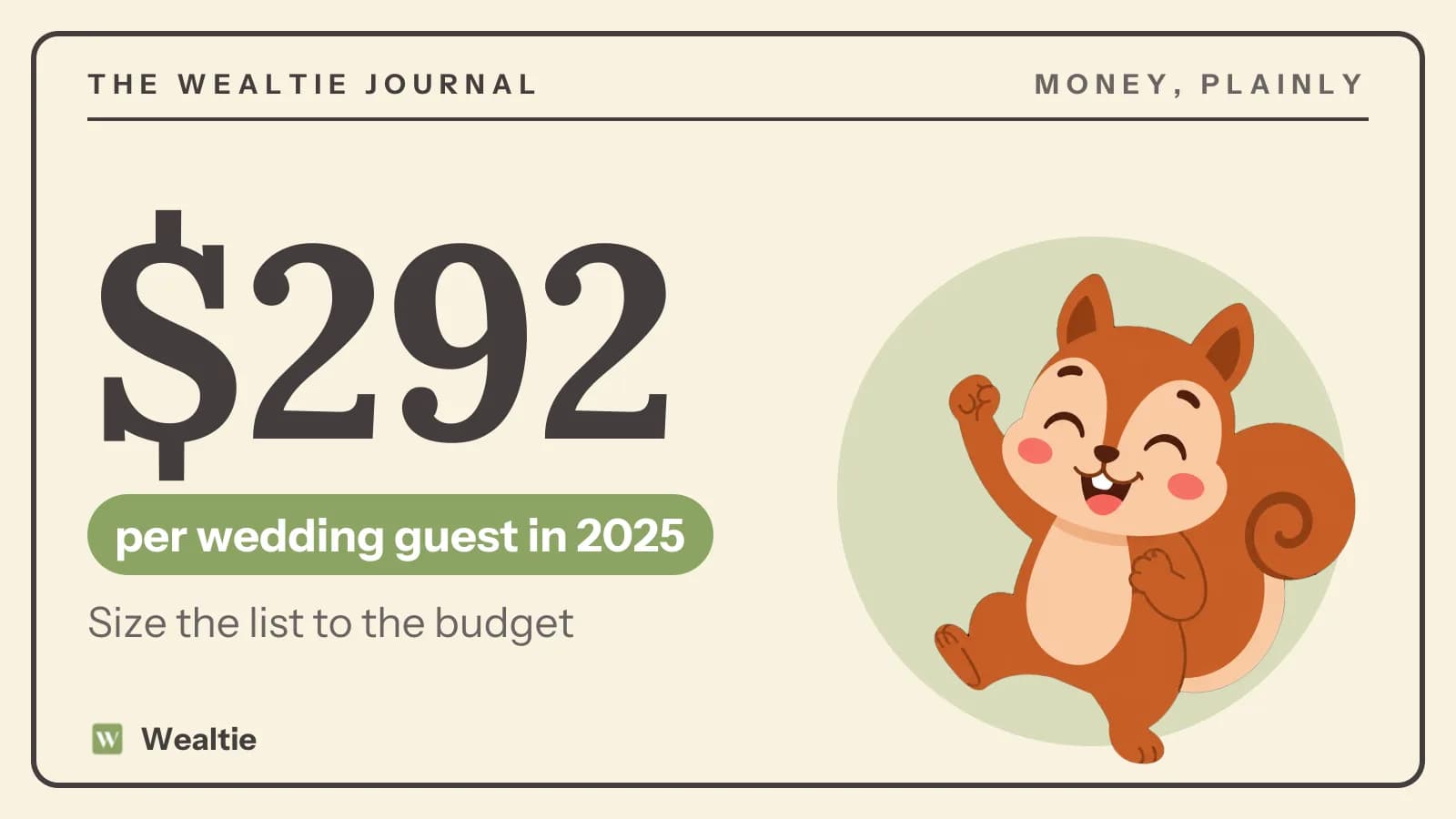
To budget for a wedding, set the total you can pay without borrowing first, then size the guest list to fit it, because guests drive most costs. US weddings in 2025 averaged $34,000 for 117 guests, about $292 a guest, in The Knot's 2026 Real Weddings Study.
 By Wealtie Team · 3 min read
Key takeaways
- The average US wedding in 2025 cost $34,000, with 117 guests, according to The Knot's 2026 Real Weddings Study of 10,474 couples.
- That works out to about $292 per guest, up $8 from 2024, which makes the guest list the biggest lever on the total.
- Set the total from money you'll actually have by the date: savings, monthly saving until then, and any family contributions you've confirmed.
- Keep 5% to 10% of the budget as a buffer for service charges, tips, alterations and the costs nobody quotes upfront.
- A wedding paid for with credit card debt costs more than its price, so cut the guest list or the date before you borrow.
How much does a wedding cost?
The average US wedding in 2025 cost $34,000, for an average of 117 guests, according to The Knot's 2026 Real Weddings Study of 10,474 couples. That's about $292 a guest, up $8 from 2024. Couples hired 13 vendors on average.
An average hides a wide range: a courthouse ceremony and a dinner for 20 costs a fraction of that, and a big wedding in an expensive city costs much more. The useful number isn't the average. It's the one you can pay without borrowing.
How do you set a wedding budget?
Start with the money, not the dream. Add up what you'll have by the date without taking on debt.
- What you've saved already for the wedding.
- What you can save each month between now and the date, times the number of months.
- Contributions you've confirmed from family. Not ones you hope for; ones someone has said yes to, with an amount.
Here's a worked example in round numbers, the same in any currency. A couple has 6,000 saved, can put aside 900 a month for the 14 months until the date, and parents have offered 5,000.
| Source | Amount |
|---|---|
| Savings now | 6,000 |
| 900 a month × 14 months | 12,600 |
| Family contribution | 5,000 |
| Total budget | 23,600 |
23,600 is the budget. Not 25,000 because it's a rounder number, and not 34,000 because that's the average.
How many guests can you afford?
Divide the budget by a rough cost per guest. At The Knot's 2025 average of $292 a guest, 23,600 covers about 80 people.
| Guests | At $292 a guest |
|---|---|
| 50 | $14,600 |
| 80 | $23,360 |
| 117 (the 2025 average) | $34,164 |
| 150 | $43,800 |
Cost per guest is a rough measure, since some costs, like the photographer or the dress, don't change with numbers. But venue, food, drink, chairs, favours and invitations all do, and together they're most of a wedding. Every 10 guests is roughly $2,900 at the average.
Decide the guest list after the budget, not before. It's the one decision that moves every other line. Write the list in three tiers: people you'd cancel the wedding without, people you'd be sad to leave out, and people you'd invite out of obligation. The budget decides how far down the list you go.
How should you split the wedding budget?
Give every category an amount before you book anything, and keep 5% to 10% back for what nobody quotes upfront.
Continuing the example, here's one way to split 23,600 for 80 guests. It's an illustration, not a rule; your priorities decide the shares.
| Category | Amount |
|---|---|
| Venue, food and drink | 11,000 |
| Photography and video | 2,800 |
| Attire and alterations | 2,000 |
| Flowers and decor | 1,600 |
| Music and entertainment | 1,500 |
| Wedding rings | 1,500 |
| Hair and makeup | 600 |
| Invitations and stationery | 400 |
| Transport | 400 |
| Officiant and licence | 400 |
| Buffer for hidden costs | 1,400 |
| Total | 23,600 |
Pick the two or three things you care about most and give them more. Cut the categories neither of you will remember a year later.
What costs do couples forget?
Service charges, tips, alterations, delivery and setup fees, and the small things that add up. That's what the buffer is for.
Ask every vendor what the quote doesn't include. Common extras are a service charge on catering, cake cutting or corkage fees, overtime for the band or photographer, postage for invitations, and accommodation or travel for the two of you. If the buffer isn't used, it's the start of your first joint savings.
How do you pay for a wedding without debt?
Save on a schedule, pay deposits from savings, and match payment dates to the money you'll have.
Most vendors take a deposit at booking and the rest close to the date. List every payment and its due date, then check that your savings will be there in time. Treat the wedding like a sinking fund: a fixed monthly amount into a separate account until the date.
If the numbers don't work, change the plan before you borrow. A smaller guest list, a Friday or Sunday date, an off-season month or a later date all cost less than interest on a loan.
How do you track wedding spending as a couple?
Keep every deposit, payment and quote in one place you can both see.
Wealtie's shared accounts let two people use the same account, with pooled or per-person balances and expenses split to the cent, so you both see what's been paid and what's left. The account owner needs Pro to invite; the person who accepts can be on any plan, Free included. Give each category its own line in the budget, and Budget Health warns you if spending is running ahead of plan. For the wider money conversation, how to split bills as a couple covers 50/50, by-income and pooled setups.
Questions people ask
$34,000 for weddings in 2025, with an average of 117 guests, according to The Knot's 2026 Real Weddings Study of 10,474 US couples. That's about $292 per guest.
Add up what you'll have by the date without borrowing, take off a 5% to 10% buffer, divide the rest by a rough cost per guest to size the guest list, then split it by category before booking anything.
Take your target, subtract what you've saved and any confirmed contributions, and divide by the months until the date. To find 12,600 in 14 months, you'd save 900 a month.
For most couples, the venue and catering, because both scale with the number of guests. Cutting the guest list lowers them together, which is why it's the biggest lever on the total.
It's usually better to cut the guest list, change the date or the day of the week, or save longer. A loan adds interest to every line of the budget and starts married life with a debt.
Sources
- The Knot Worldwide Unveils 2026 Real Weddings Study · The Knot Worldwide · checked 1 November 2026
This article is general information, not financial, tax or legal advice. Your situation is your own; check the numbers that apply to you before you act on them.