Money as a couple: Why couples should each have personal spending money
Personal spending money gives each partner an agreed amount to spend however they like, with no need to explain or justify it. In a worked example, a couple each get 120 a month after bills and savings, and small purchases stop being a source of arguments.
 By Wealtie Team · 3 min read

Key takeaways
- Personal spending money gives each partner an agreed amount to spend freely.
- In a worked example, each partner gets 120 a month after bills and savings.
- It reduces arguments about small purchases and gives each person independence.
- Couples on different incomes can choose equal amounts or amounts in proportion to income.
What is personal spending money?
Personal spending money is an agreed amount each partner gets every month to spend however they like, with no need to explain it. Some couples call it fun money or pocket money. Bills, savings and shared goals come first, then whatever's left is split into personal amounts. One partner might spend theirs on hobbies, another on clothes or coffee, another might save it. No one asks.
It's one of the simplest ways to reduce money arguments in a relationship. It works for married couples, partners who live together and anyone sharing household finances.
Why does it help?
Because small purchases cause big arguments. When every bit of spending comes from a shared pot, one partner may feel judged and the other may feel worried. Personal spending money draws a clear line, and the amount doesn't need to be large to work. Shared money is planned together, and personal money is each person's own. That gives both partners independence and removes the need to justify a new book or a night out.
It also helps couples with different spending styles. When one partner loves spending and the other prefers saving, personal money makes a particularly big difference, since each can follow their own style within an agreed limit.
How much should it be?
An amount that fits your budget after bills, savings and goals. Here's a worked example, in round numbers that work in any currency:
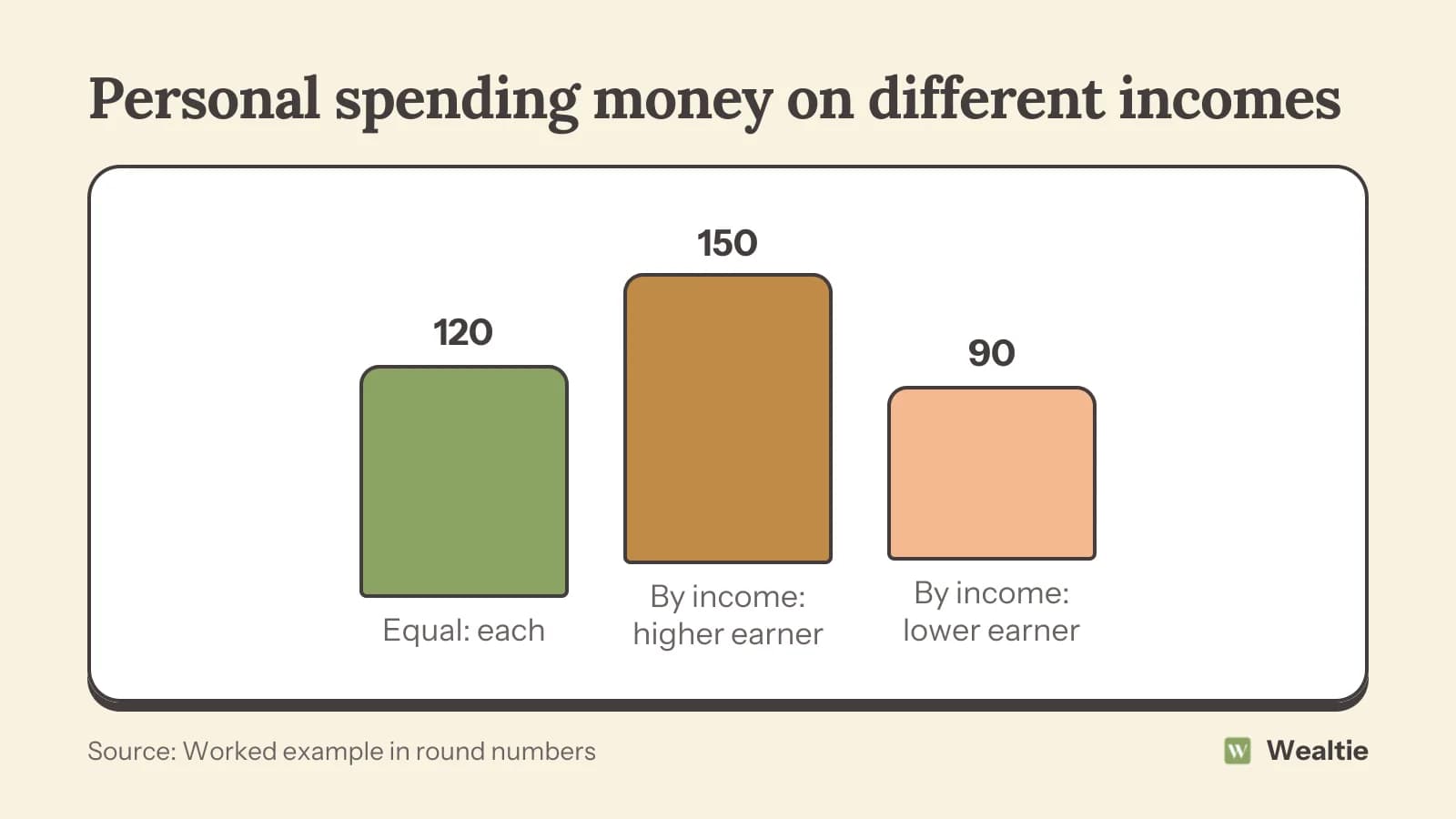
In this example, the couple have 240 left after everything else and split it equally, 120 each. If one earns much more, they might split it in proportion to income instead, like 150 and 90. Choose the option that feels fair to both of you. How much spending money per month helps you work out a realistic figure.
Equal or by income?
Equal amounts feel fair to many couples, especially if bills are already split by income. Others prefer amounts that reflect what each earns. There's no right answer, but talking it through openly matters more than the method. If one partner does more unpaid work at home, like childcare, many couples see equal personal money as fairer than splitting by income.
How do you set it up?
Many couples use separate personal accounts. On payday, money for shared bills and savings goes to a joint account, and each partner's personal amount goes to their own account. When it's gone, it's gone until next month. Joint or separate accounts covers the options. If you use one account, tracking each person's spending in their own category works too. Setting up the transfer to run automatically on payday means no one has to remember.
What counts as personal spending?
Agree the boundaries. Usually, personal money covers things one person wants, like hobbies, clothes beyond basics, treats, gifts for friends and solo outings. Shared costs, like groceries, bills, household items and joint holidays, come from shared money. Agreeing this once saves many small debates later. Writing down what goes where avoids grey areas. Things like a gym membership or a phone plan can go either way, so decide once and stick to it.
Gifts for each other
Many couples use personal money for gifts for each other, so a birthday present is a real gift rather than a shared purchase.
What if one partner always runs out?
That's okay, as long as they wait until next month. The point of personal money is that it's theirs to manage. If one partner regularly dips into shared money, talk about it calmly and check whether the amount is realistic. When your partner overspends has ideas if it becomes a pattern. Some couples let unspent personal money roll over, which rewards saving and gives each partner room for bigger purchases.
How do you review it?
Check the amount at your regular money conversation, every few months or when income changes. A pay rise might mean more personal money, or more for shared goals. The monthly money meeting is a good time to review it, and how to split bills as a couple covers the shared side.
How do you track personal spending money in Wealtie?
Give each partner their own personal line in your expense categories, with a monthly limit in the budget tracker, so you can each see what's left. Wealtie's sharing lets you share accounts with a partner; the person who shares needs Pro, and the person invited can be on any plan.
Questions people ask
An agreed amount each partner gets every month to spend however they like, without explaining it.
What fits after bills, savings and goals. In a worked example, 120 each a month.
Many couples choose equal amounts, while others split in proportion to income. Agree what feels fair.
Often with separate personal accounts that receive a set amount each payday, alongside a joint account for shared bills.
This article is general information, not financial, tax or legal advice. Your situation is your own; check the numbers that apply to you before you act on them.