Money as a couple: How to split bills as a couple: 50/50, by income, or pooled
How to split bills as a couple depends mostly on the gap in pay. If you earn about the same, 50/50 works. If one of you earns noticeably more, split by income so you each pay the same share of your pay. Or pool everything and stop keeping score. The numbers for each are below.
 By Wealtie Team · 5 min read
Key takeaways
- A 50/50 split is fair in pounds but not in effort when incomes differ: on 4,000 and 2,000 a month, 3,000 of shared costs takes 38% of one partner's pay and 75% of the other's.
- Splitting by income means each partner pays the same percentage of take-home pay; in the worked example, 2,000 and 1,000, or half of each income.
- In a 2024 YouGov survey, 48% of Britons said bills should be split by income, but 46% of working couples said they split them 50-50 in practice.
- Joint accounts are becoming less common in the US: 23% of married couples had none in 2023, up from 15% in 1996, according to the Census Bureau.
- Whatever the method, agree on what counts as a shared bill first and recalculate the split when either income changes.
What are the ways to split bills as a couple?
There are three common ways: split every shared bill 50/50, split it in proportion to what each of you earns, or pool all income and pay everything from one pot.
- 50/50. Each partner pays half of every shared cost. Easy to work out, easy to check.
- By income (proportional). Each partner pays the same percentage of their take-home pay. The higher earner pays more in money, the same in effort.
- Pooled. Both incomes go into one account, the bills come out of it, and what's left belongs to both of you.
Plenty of couples run a mix: a joint account for shared bills, topped up by income, and separate accounts for the rest. That hybrid is the most common setup among working couples in the UK, as the survey figures further down show.
How much does each method cost each partner?
With incomes of 4,000 and 2,000 a month and 3,000 of shared costs, the lower earner keeps 500 under 50/50, 1,000 when you split by income, and 1,500 when everything is pooled and the rest is shared equally. The numbers are round and work in any currency.
| Method | Partner A pays (earns 4,000) | Partner B pays (earns 2,000) | A keeps | B keeps |
|---|---|---|---|---|
| 50/50 | 1,500 (38% of pay) | 1,500 (75% of pay) | 2,500 | 500 |
| By income | 2,000 (50% of pay) | 1,000 (50% of pay) | 2,000 | 1,000 |
| Pooled | 6,000 goes in, 3,000 comes out | 1,500 | 1,500 |
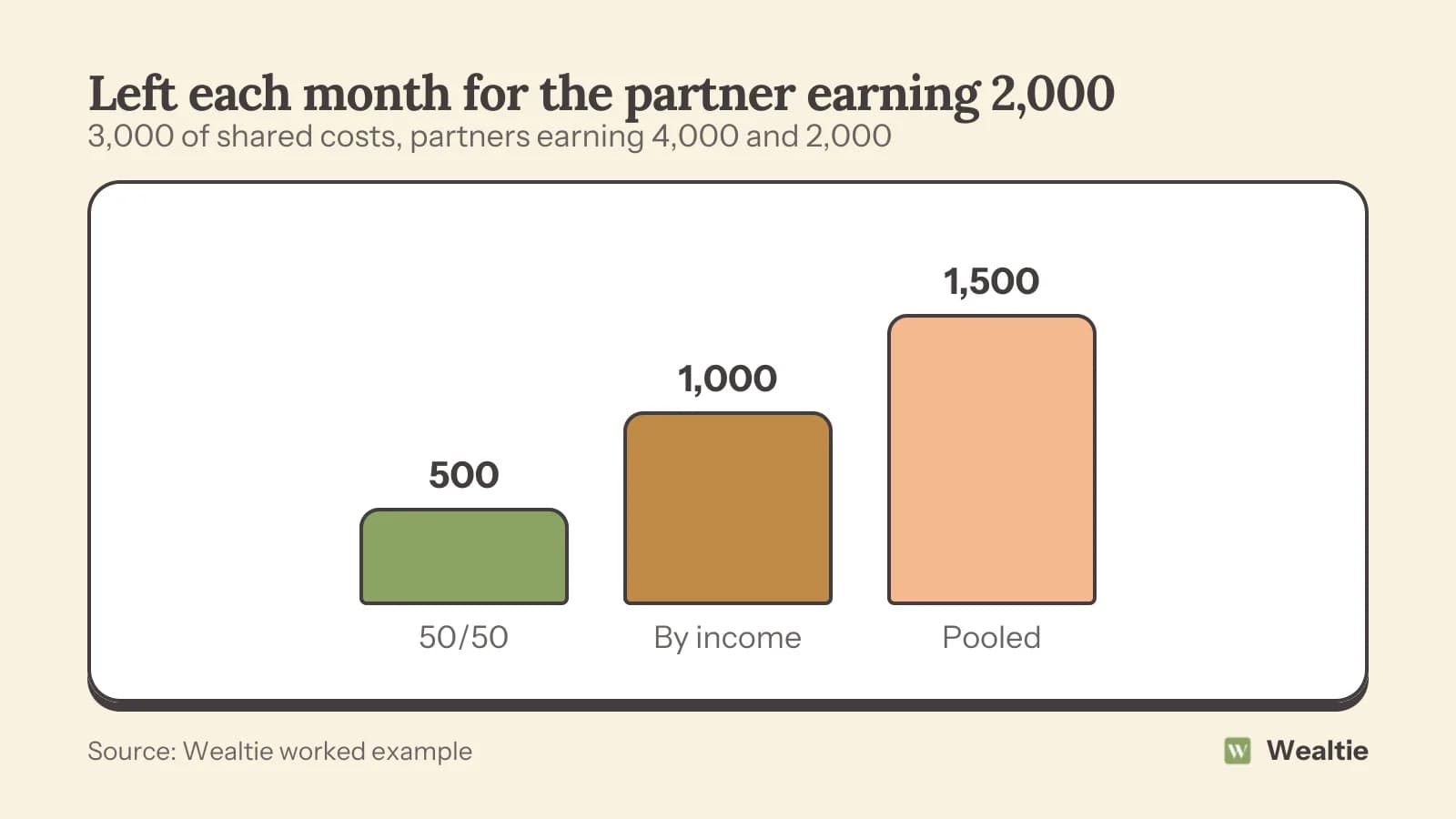
Under 50/50, Partner B has 500 a month for everything that isn't shared: their phone, clothes, savings, a birthday present for Partner A. Partner A has five times that. The split looks equal on the bill and very unequal on the bank statement.
The pooled row assumes the 3,000 left over is shared equally. Many pooling couples move most of it to joint savings instead and give each partner a fixed amount of personal spending money.
When is splitting 50/50 fair?
A 50/50 split is fair when your take-home pay is roughly the same, say within 10 to 20% of each other. Then the percentages come out close and nobody is quietly subsidising anybody.
That's how most similar-earning couples handle it. In YouGov's 2024 survey of British couples, 69% of couples who earn about the same, or where one earns only a little more, said they split bills 50-50.
It's a smaller group than it sounds. Pew Research Center found that 29% of US marriages in 2022 were egalitarian, with each spouse earning 40% to 60% of the couple's income. In 55%, the husband was the primary or sole earner, and in 10% the wife was.
50/50 also works while one of you is between jobs only if the other covers the gap without turning it into a debt. If that's the plan, say so out loud.
How do you split bills by income?
Add your take-home pay together, work out each person's share of the total, and pay that share of every shared bill.
- Add up take-home pay. 4,000 + 2,000 = 6,000.
- Find each share. 4,000 ÷ 6,000 = 67%. 2,000 ÷ 6,000 = 33%.
- Apply it to the shared costs. 3,000 × 67% = 2,000. 3,000 × 33% = 1,000.
Use take-home pay, not salary before tax, or the higher earner pays a share of money they never see. If one income moves a lot from month to month, work from the average of the last three to six months, the way you would in an irregular income budget.
Most couples think this is the fair way, and still don't do it. In the same YouGov survey, 48% of Britons said bills should be split by how much each partner earns, against 37% who said 50-50. Asked what they do in practice, 46% of couples where both work said 50-50 and 38% said in proportion to income. Even where one partner earns notably more, 33% still split 50-50.
The usual reason is that the proportional conversation is awkward and 50/50 isn't. Having the numbers in front of you, as in the table above, makes it a calculation instead of a negotiation.
Should you pool everything into a joint account?
Pooling suits couples who already think of their money as one budget, often married couples with children and long-term shared goals. It stops working when one partner wants spending nobody else checks.
Fewer couples pool completely than used to. The US Census Bureau reports that in 1996, 53% of married couples held all their bank accounts jointly; by 2023 it was 40%. The share with both joint and separate accounts rose from 9% to 17%, and 23% of married couples had no joint account at all, up from 15%.
If you pool, agree on a personal allowance for each of you, the same amount whoever earns more. It's the piece that keeps a joint account from turning into a running audit of each other's coffees.
What counts as a shared bill?
Shared bills are the costs you'd still have if you both lived there and neither of you bought anything for yourself: housing, utilities, groceries for the home, and anything bought for both of you.
Agree on the list before you agree on the split. The usual sticking points:
- Rent or mortgage. Shared, even if the home belongs to one of you. If you move into a partner's place, pay a share of the running costs or a fair rent, not their mortgage principal, unless you're agreeing to build equity together.
- Groceries. Shared for the household; one person's protein powder isn't.
- Subscriptions. Shared if you both use them. Tracking them as recurring costs, with a bill tracker, stops forgotten ones from slipping into the split.
- Cars, phones, debts brought into the relationship. Usually personal, unless you both rely on them.
- Holidays and eating out. Decide whether they come from the shared pot or are paid per trip.
Yearly bills, like insurance or a car service, are easier when you both put a little aside each month. A sinking fund for the household does that.
How do you keep the split fair month to month?
Write the split down, record every shared expense in one place, and look at it together once a month. Recalculate the percentages whenever either income changes.
The record is what stops the small resentments. Without it, one partner remembers paying for the big grocery shop and the other remembers the energy bill, and both are right.
A budget app for couples does the record-keeping for you. In Wealtie, one partner shares an account with the other as an editor or viewer, and you choose whether the balance is pooled or tracked per person. Shared expenses can be split to the cent, so a 67/33 split of a 94.20 grocery bill doesn't need a calculator. The account owner needs Pro to invite a partner, and the partner joins on any plan, including Free.
Once the shared bills are settled, each of you still needs a plan for your own money. If you've never set one up, start with how to make a budget, or try the 50/30/20 rule on what you keep.
Questions people ask
The fairest way is the one where each of you pays a similar share of your income. If you earn about the same, that's 50/50. If one earns noticeably more, split by income: each partner pays the same percentage of take-home pay.
Divide each person's take-home pay by your combined take-home pay, then pay that percentage of every shared bill. On 4,000 and 2,000 a month, that's 67% and 33%, so 2,000 and 1,000 of 3,000 in shared costs.
Yes, it's the most common approach among working couples in the UK. In a 2024 YouGov survey, 46% of couples where both partners work said they split bills 50-50, and 38% said they split them in proportion to income.
Start with the running costs of the home: rent or a fair share of it, utilities, council tax or local fees and groceries. If the home belongs to one of you, the other usually pays towards those costs rather than the mortgage principal, unless you agree to build equity together.
A joint account for shared bills helps most couples, whether or not they pool everything else. In 2023, 77% of US married couples with bank accounts held at least one account jointly, according to the Census Bureau.
Sources
- Almost a Quarter of Married Couples Didn't Have Joint Accounts in 2023, Up From 15% in 1996 · U.S. Census Bureau · checked 12 October 2026
- In a Growing Share of U.S. Marriages, Husbands and Wives Earn About the Same · Pew Research Center · checked 12 October 2026
- What is the fairest way for couples to split household bills? · YouGov · checked 12 October 2026
This article is general information, not financial, tax or legal advice. Your situation is your own; check the numbers that apply to you before you act on them.