Money as a couple: Should couples have joint bank accounts? Three setups compared
Couples don't need joint bank accounts, but most who share bills do best with one joint account for shared costs and separate accounts for the rest. In the US, 77% of married couples with bank accounts held at least one jointly in 2023, while 23% had none, up from 15% in 1996.
 By Wealtie Team · 4 min read
Key takeaways
- Couples use three setups: everything joint, everything separate, or a joint account for shared bills alongside separate personal accounts.
- In 2023, 23% of US married couples had no joint bank account, up from 15% in 1996, according to the Census Bureau.
- The right time to open a joint account is when you first share a regular bill, such as rent, not a particular relationship milestone.
- In most cases either owner of a joint account can withdraw all the money and close it, so open one only with someone you'd trust with the whole balance.
- Deposit insurance counts each owner separately: up to $250,000 per co-owner with the FDIC, and £120,000 per holder with the FSCS since 1 December 2025.
Should couples have joint bank accounts?
A joint account helps once you share bills, but it doesn't have to hold all your money. Couples tend to land on one of three setups:
| Setup | How it works | Suits couples who | Watch out for |
|---|---|---|---|
| All joint | Both incomes go into one account and everything is paid from it | Have similar spending habits and one shared budget | Every purchase is visible, and either of you can spend the whole balance |
| All separate | Each keeps their own account and you pay each other back | Don't live together yet, or keep finances apart on purpose | Settling up never stops, and shared bills need tracking |
| Joint plus separate | Each pays a set amount into a joint account for shared bills and keeps the rest | Share a home but spend differently | Deciding what counts as shared, and topping up when the joint account runs short |
The third setup is the common middle ground. Rent, utilities and groceries come out of one place, so nobody owes anybody at the end of the month, and personal spending stays personal.
How common are joint bank accounts?
Most married couples have at least one, but the share is falling. The Census Bureau found that 23% of US married couples had no joint bank account in 2023, up from 15% in 1996. Among married couples with any money in a financial institution, 77% held at least one account jointly, down from 85%.
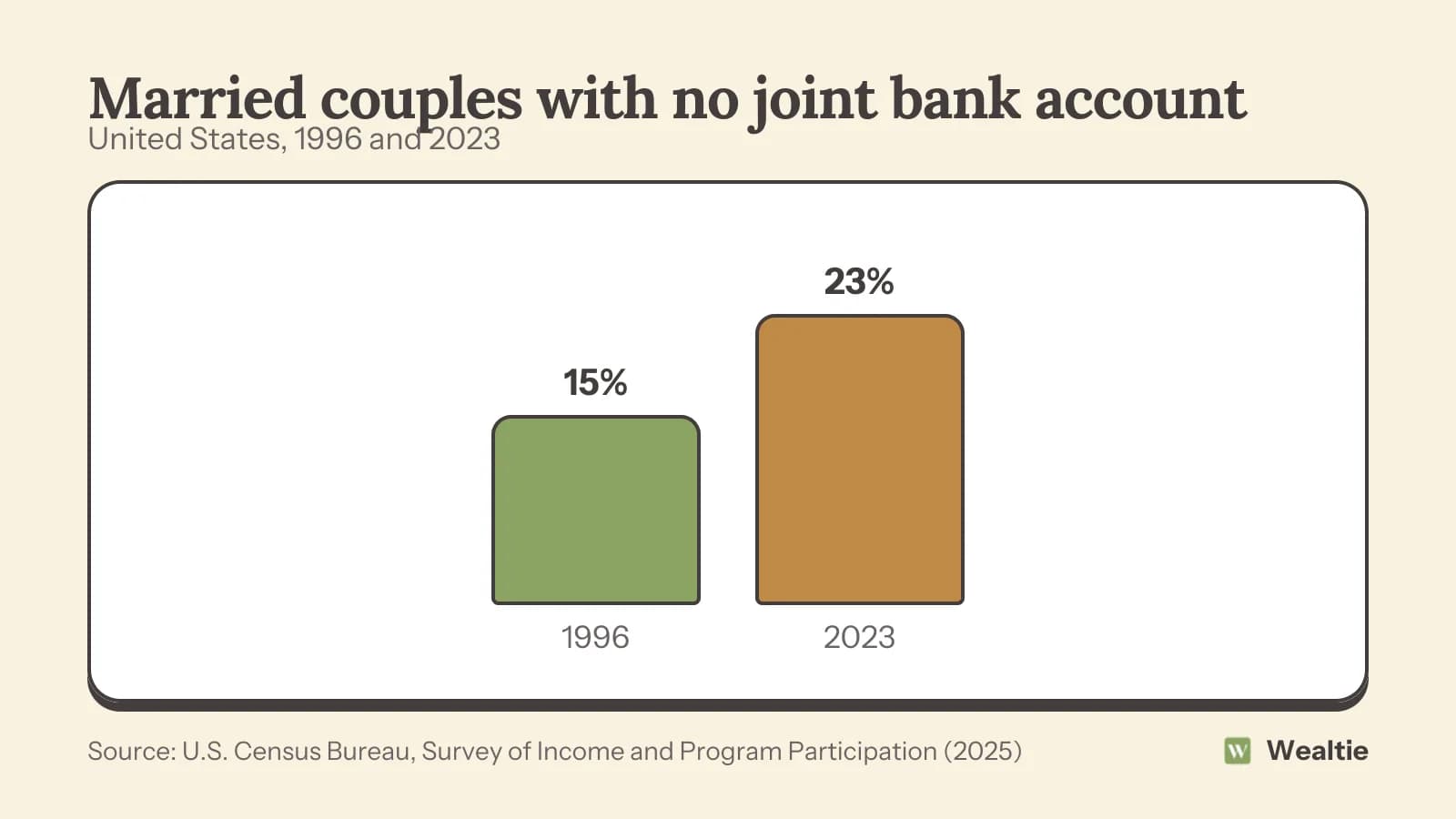
Those figures cover married couples only, so they say nothing about couples who live together without marrying.
When should a couple get a joint bank account?
When you first share a regular bill. Moving in together is the usual trigger: rent, energy and the internet are due every month whoever earns what, and paying them from one account is simpler than settling up.
You don't need to be married. The FDIC's rules for joint account insurance ask only that every co-owner is a living person with equal rights to withdraw and has signed for the account. Nothing in them refers to marriage.
If you're not sharing bills yet, there's little a joint account does that a quick transfer can't.
What changes when you open a joint account?
You each get full access to the money, and that's the part to think about before signing. The Consumer Financial Protection Bureau says that "in most circumstances, either person on a joint checking account can withdraw money from and close the account". Check your account agreement for the exact rules.
A few other things change:
- If one of you dies. On an account with rights of survivorship, the CFPB says "the money passes to the surviving owner". If the account is held as tenants in common, the deceased owner's share can go to their heirs instead. Your bank can tell you which one you have.
- Deposit insurance. In the US, each co-owner's shares of joint accounts at one bank are added together and insured up to $250,000. In the UK, the FSCS limit rose from £85,000 to £120,000 on 1 December 2025, and each holder of a joint account is protected up to that amount, so up to £240,000 for two.
- If you separate. Either of you can still move the money until the account is closed or changed. Agreeing how a joint account would be divided is easier while you still share a home than afterwards.
Keeping a personal account each limits how much is exposed to any of this to whatever sits in the joint one.
How much should each of you put into the joint account?
Enough to cover the shared bills, split either equally or in proportion to income. On round numbers that work in any currency, with 2,400 of shared costs a month and take-home pay of 3,000 and 2,000:
| Partner A | Partner B | Joint account | |
|---|---|---|---|
| Take-home pay | 3,000 | 2,000 | |
| Share of income | 60% | 40% | |
| Monthly transfer, split by income | 1,440 | 960 | 2,400 |
| Left for personal spending | 1,560 | 1,040 | |
| Monthly transfer, split 50/50 | 1,200 | 1,200 | 2,400 |
| Left for personal spending | 1,800 | 800 |
A 50/50 split leaves Partner B with 800, less than half of what Partner A keeps. Splitting by income leaves each of them 52% of their pay. How to split bills as a couple goes through both methods, and pooled money, in more detail.
Set the transfers for payday and add a small margin, around a tenth, so a higher energy bill doesn't leave the joint account short. A shared sinking fund can cover the yearly bills.
How to keep track of a joint account in Wealtie
Wealtie doesn't connect to any bank, so a joint account is an account you add and share inside the app. The owner invites the other person and gives them a role: owner, editor or viewer. Inviting needs Pro; the person who accepts can be on any plan, including Free.
The shared account can show a pooled balance or a balance per person, and an expense can be split between you to the cent. Your personal accounts stay alongside it as separate accounts. The budget app for couples page covers how sharing works, and the accounts and net worth page covers how the accounts add up.
Questions people ask
Most do: 77% of US married couples with bank accounts held at least one account jointly in 2023. A joint account for shared bills alongside separate personal accounts suits most couples who share a home.
Yes, you don't need to be married to open a joint bank account. The FDIC's joint account rules only require that each co-owner is a living person with equal rights to withdraw and has signed for the account.
About three in four US married couples: 77% of those with money at a financial institution held at least one account jointly in 2023. 23% of married couples had no joint account, up from 15% in 1996.
Yes, in most circumstances either owner of a joint checking account can withdraw the money and close the account. Check your account agreement, and keep money you need to protect in a personal account.
On an account with rights of survivorship, the money passes to the surviving owner. If the account is held as tenants in common, the deceased owner's share can pass to their heirs; your bank can tell you which applies.
Sources
- Almost a Quarter of Married Couples Didn't Have Joint Accounts in 2023, Up From 15% in 1996 · U.S. Census Bureau · checked 19 October 2026
- Trends in Joint Bank Account Ownership Within Couples: 1996-2023 · U.S. Census Bureau · checked 19 October 2026
- Your Insured Deposits · Federal Deposit Insurance Corporation · checked 19 October 2026
- A joint checking account owner took all the money out and then closed the account without my agreement. Can they do that? · Consumer Financial Protection Bureau · checked 19 October 2026
- What happens if I have a joint bank account with someone who died? · Consumer Financial Protection Bureau · checked 19 October 2026
- What is the FSCS and what is the new deposit protection limit? · Bank of England · checked 19 October 2026
- Deposit protection limit · Financial Services Compensation Scheme · checked 19 October 2026
This article is general information, not financial, tax or legal advice. Your situation is your own; check the numbers that apply to you before you act on them.