Income & freelancing: Fixed price vs hourly rate: how freelancers should charge
Choosing between a fixed price vs hourly rate depends on how clear the project is: fixed prices suit well-defined work, while hourly rates suit work that may change. In a worked example, the same website project earns 2,000 fixed or 1,600 hourly.
 By Wealtie Team · 3 min read

Key takeaways
- Fixed price vs hourly depends on how clear and stable the project is.
- Fixed prices reward working efficiently, but you carry the risk of overruns.
- Hourly rates protect you when work changes, but cap what you earn from speed.
- Define the scope clearly and charge for changes, whichever you choose.
Fixed price vs hourly: which should freelancers use?
Both work, and many freelancers use each for different jobs. With an hourly rate, you charge for the time you spend, so if the work takes longer, you earn more. With a fixed price, you agree one amount for the whole project, so if you work faster, you keep the benefit, but if it takes longer, you absorb the extra time. The right choice depends mostly on how clearly the work can be defined upfront.
Clients often prefer fixed prices because they know the cost in advance and can budget for it. That certainty has value, which is one reason fixed prices can earn you more for the same work. But a fixed price only works if both sides agree exactly what's included.
Hourly rates have their own downside: clients may watch the clock, question every hour on the invoice or ask for estimates anyway. Some freelancers find that moving to fixed prices for well-defined work leads to fewer awkward conversations and more trust, since the client knows the total and you can focus on doing the job well. Others prefer the simplicity of tracking time and billing for it. Trying both on different projects is the best way to find out what suits you and your clients.
Whichever you use, start from what you need to earn. How to set your freelance rate covers working out an hourly figure that covers your costs, time off and taxes. That figure is the foundation for both hourly and fixed pricing.
How do the two compare on a real project?
Here's a worked example of a small website project, in round numbers that work in any currency:
| Pricing | Total |
|---|---|
| Hourly, 40 hours at 40 | 1,600 |
| Fixed price | 2,000 |
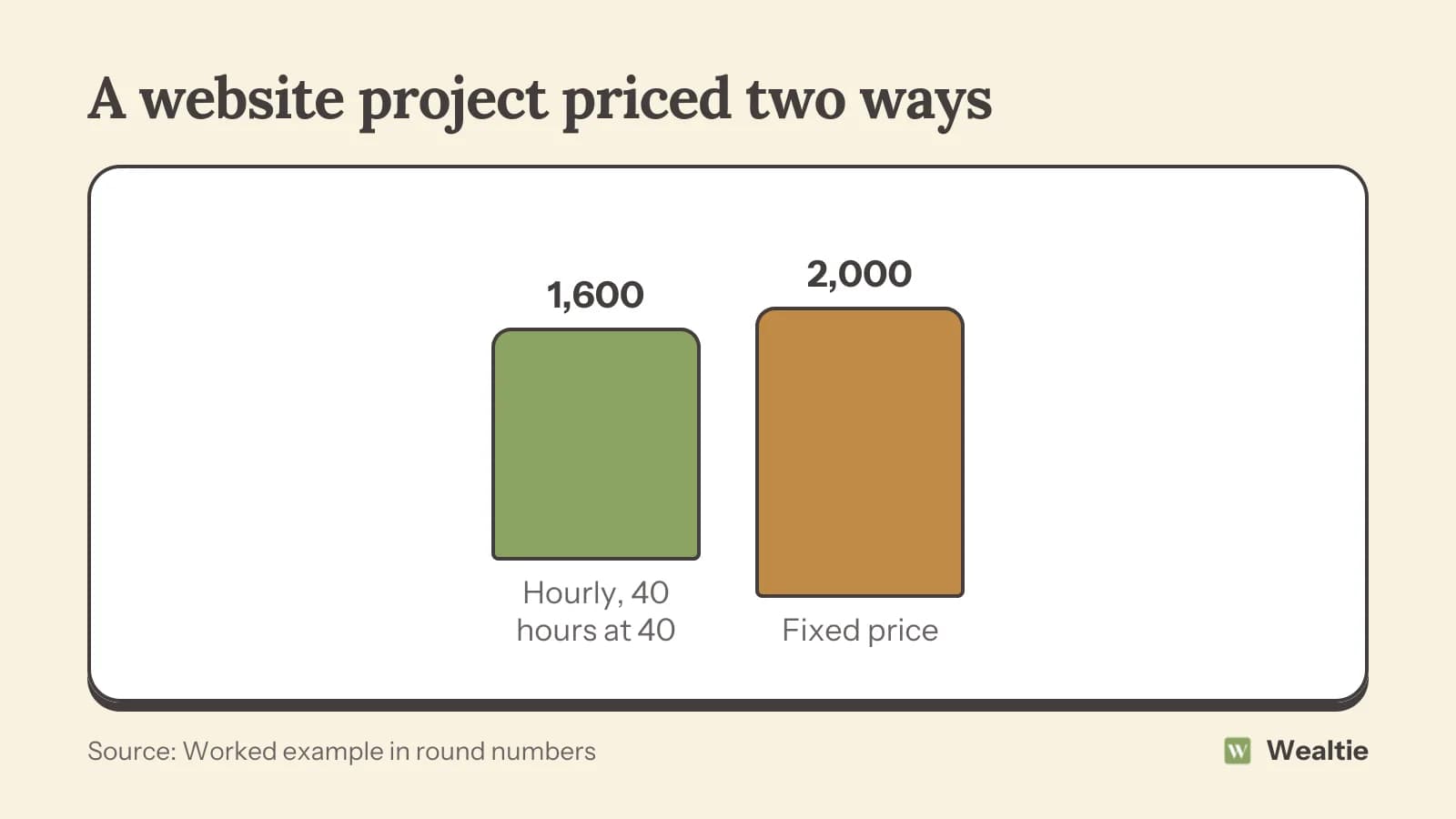
The fixed price is based on an estimate of 40 hours, plus a buffer for the unexpected and the value of a finished site to the client. If the work takes 40 hours, the fixed price earns 50 an hour. If it overruns to 55 hours, it still earns about 36 an hour, which is less than the hourly rate. That's the risk you take with fixed pricing.
When does a fixed price make sense?
The scope is clear
If you can list exactly what's included, like a five-page website or a set number of designs, a fixed price is easy to agree and easy to deliver.
You've done similar work before
Experience helps you estimate accurately, which reduces the risk of overruns.
You work efficiently
If you're fast, a fixed price rewards you for it, rather than earning less for finishing sooner.
The client values certainty
Many clients will pay more for a known total, so fixed prices can lift your earnings.
When does an hourly rate make sense?
The work is uncertain
Ongoing support, consulting, open-ended projects and work where the client keeps changing their mind suit hourly rates, since you're paid for all the time spent.
You're new to a type of work
If you can't yet estimate well, hourly rates protect you while you learn how long things take.
The client wants flexibility
Some clients prefer to add and change tasks as they go. An hourly rate handles that without endless renegotiating.
How do you avoid underpricing either way?
Define the scope in writing
List what's included and what isn't, how many rounds of changes, and the deadline. Anything beyond that is extra.
Charge for changes
Agree upfront how you'll price extra work, often at your hourly rate. It protects fixed prices from creeping scope.
Add a buffer
When estimating fixed prices, add time for meetings, emails, revisions and surprises. These are easy to forget.
Review after each project
Track how long fixed-price projects take. If they keep overrunning, raise your prices or tighten the scope. How to raise your freelance rates covers how.
Ask for a deposit
For larger fixed-price projects, asking for part of the fee upfront reduces your risk. How to write an invoice covers clear payment terms, and what to do when a client pays late covers chasing payment.
Can you combine the two?
Yes. Some freelancers quote a fixed price for a defined first stage, then switch to hourly or a monthly retainer for ongoing work. How to budget retainer income covers that model.
How do you track project income in Wealtie?
Log each payment in the income tracker, so you can see what each client and project brings in. Keep business costs in their own expense categories, and set a budget so your income covers your costs.
Questions people ask
Fixed prices suit clearly defined work you've done before. Hourly rates suit uncertain or changing work.
If the project takes longer than estimated, you absorb the extra time. In a worked example, an overrun drops the effective rate from 50 to about 36 an hour.
Define the scope in writing, charge for changes, add a buffer for meetings and revisions and track how long projects take.
Yes. Many freelancers quote a fixed price for a defined first stage, then charge hourly or a retainer for ongoing work.
This article is general information, not financial, tax or legal advice. Your situation is your own; check the numbers that apply to you before you act on them.