Income & freelancing: What to do when a client pays late, and how to budget around it
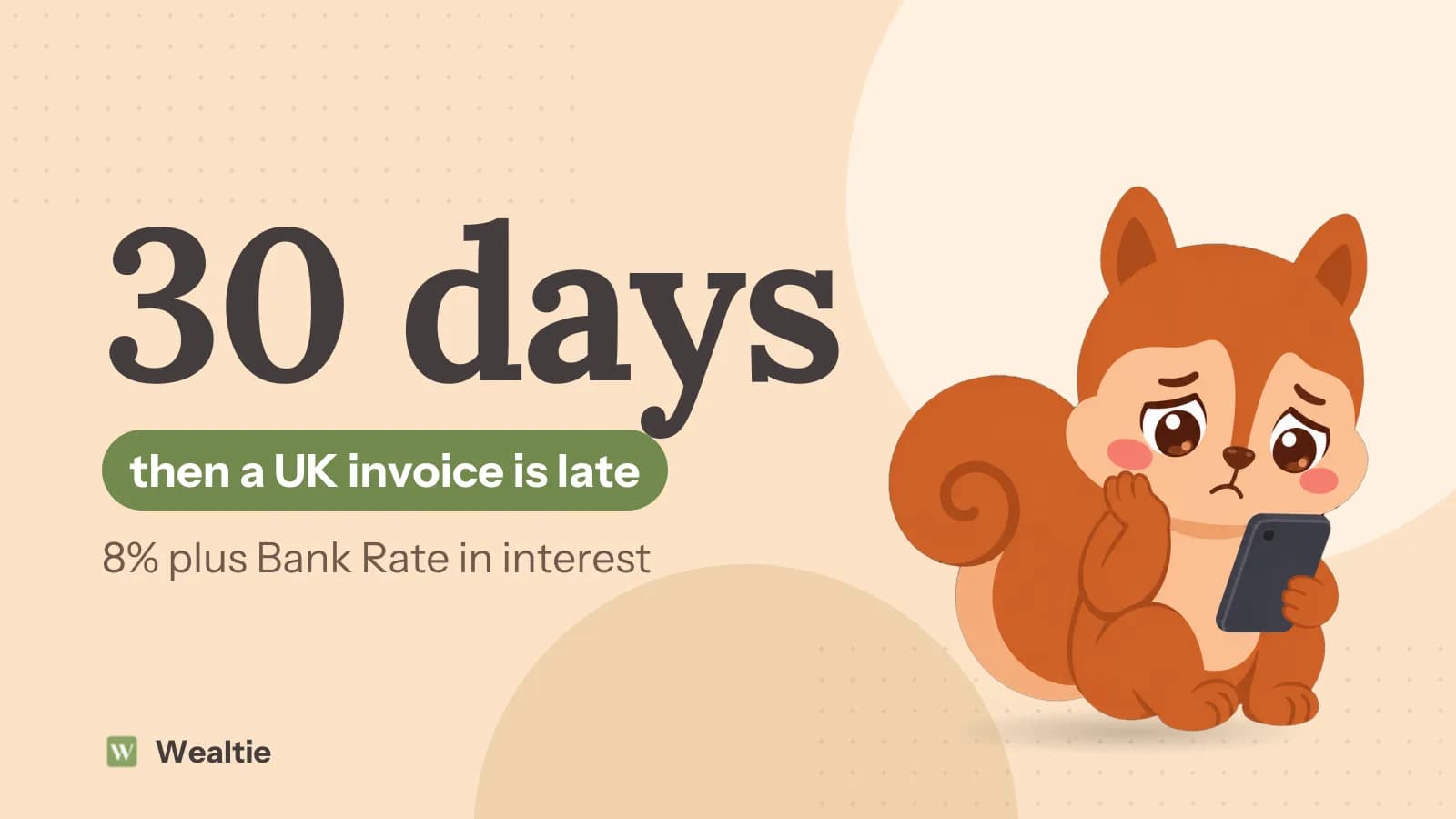
When a client pays late, send a polite reminder the day after the due date, follow up on a fixed schedule, and keep your own bills paid from a buffer, not the missing invoice. In the UK, business-to-business payments are late after 30 days by default, and you can charge 8% plus Bank Rate in interest.
 By Wealtie Team · 3 min read
Key takeaways
- Send a short, friendly reminder the day after an invoice is due; most late payments are forgotten, not refused.
- Follow up on a fixed schedule, getting firmer each time, and talk to the person who approves payments, not only your contact.
- In the UK, if no date is agreed, a business payment is late 30 days after the invoice or delivery, and you can claim 8% plus the Bank of England base rate in interest.
- UK law also lets you charge a fixed £40, £70 or £100 recovery fee, depending on the size of the debt.
- Budget on money that's arrived, not money that's owed, and keep a buffer so a late invoice is an annoyance, not a crisis.
What should you do when a client pays late?
Remind them the day after the due date, politely, with the invoice attached. Most late payments aren't refusals. The invoice went to the wrong inbox, the person who approves payments was away, or it simply slipped. A short, friendly note fixes most of them.
Something like: "Hi Sam, just a reminder that invoice 104 for 2,000 was due yesterday. I've attached it again. Could you let me know when it's scheduled? Thanks." No apology and no anger. State the invoice, the amount and the date, and ask for a payment date.
What reminder schedule works?
A fixed one, decided before any invoice is late, so you don't have to work out the tone each time.
| When | What to send |
|---|---|
| 1 day late | Friendly reminder, invoice attached |
| 7 days late | Second reminder, ask for a payment date |
| 14 days late | Call, and email whoever approves payments |
| 30 days late | Formal letter: amount, interest and fee, a final date |
| After that | Pause new work; consider a claim |
Two things help most. First, find out who actually pays invoices, often an accounts team rather than your contact, and copy them in. Second, stop new work once an invoice is well overdue. Carrying on makes the debt bigger and tells the client that paying late has no effect.
What does UK law let you charge?
Interest and a fixed recovery fee, for business-to-business payments. GOV.UK's late payment guidance sets it out.
If you haven't agreed a payment date, a payment is late 30 days after the customer gets the invoice, or after you deliver the work if that's later. Agreed terms between businesses are usually up to 60 days.
Once it's late, you can claim statutory interest of 8% plus the Bank of England base rate, unless your contract sets a different rate. The Bank of England raised Bank Rate to 4% on 5 November 2026.
You can also charge a fixed recovery fee, once per payment:
| Debt | Fixed fee |
|---|---|
| Up to £999.99 | £40 |
| £1,000 to £9,999.99 | £70 |
| £10,000 or more | £100 |
Here's how the interest works, using GOV.UK's own method and assuming a 4% base rate. On a £2,000 invoice, 12% a year is £240, or about 66p a day. After 45 days late, that's about £30, plus the £70 fee. Send a new invoice that adds them.
In practice, many freelancers mention interest in the 30-day letter and waive it if the client pays promptly. The right to charge it is often enough.
What about outside the UK?
Rules differ by country, so put your own terms in writing before you start: a payment date, a late-payment interest rate and what happens if an invoice goes unpaid. A contract term is far easier to enforce than an argument after the fact. Many countries, including those in the EU, have their own late-payment rules for business transactions; check the version where you work.
What if the client still won't pay?
Send a final letter with a clear deadline, then decide whether a claim is worth it.
The letter should state the invoice, the amount owed with any interest and fees, a date by which you expect payment, and that you'll take the matter further if it isn't paid. That's often the point where a payment arrives. If it doesn't, most countries have a small-claims process for modest debts that you can use without a lawyer. Weigh the time it takes against the amount owed, and keep every email, invoice and reminder as evidence.
How do you stop clients paying late?
Make paying easy and the terms clear from the start.
- Agree terms before the work, in writing, including the payment date.
- Ask for a deposit on new clients and large projects.
- Invoice on time, the day the work is delivered, with the due date and payment details on the invoice.
- Bill in stages on long projects, so you're never owed months of work.
- Keep a short list of late payers, and price their next job accordingly, or decline it.
How do you budget when clients pay late?
Budget only on money that's arrived, and keep a buffer between your invoices and your bills.
Freelancers who budget on what's owed get caught every time a client is late. Instead, pay income into a business or buffer account, and pay yourself a fixed monthly amount from it. How to pay yourself a salary when self-employed sets out the method, with a two-month buffer that absorbs a late invoice without touching your rent. How to measure income stability shows how big that buffer should be for your pattern of pay.
In Wealtie, log each invoice payment as income when it actually arrives, and move your monthly pay to your everyday account as a transfer between accounts. Set the salary transfer as a recurring transaction so it shows in your budget on the same day each month. An income goal then shows how close the month is to target, counting only money that has landed.
Questions people ask
Send a short, friendly reminder the day after the due date with the invoice attached, then follow up on a fixed schedule. Most late payments are oversights, so start polite and get firmer only if the reminders are ignored.
In the UK, yes: for business-to-business payments you can claim statutory interest of 8% plus the Bank of England base rate, unless your contract sets a different rate. Elsewhere, check local law and put a late-payment term in your contract.
If you haven't agreed a date, a business payment is late 30 days after the customer gets the invoice or you deliver the work, whichever is later. Agreed terms are usually up to 60 days between businesses.
On top of interest, a fixed recovery fee of £40 for debts up to £999.99, £70 for £1,000 to £9,999.99, and £100 for £10,000 or more, once per payment.
Budget only on money that's arrived, pay yourself a fixed amount from a buffer account, and keep one or two months of expenses in that buffer so a late invoice doesn't touch your bills.
Sources
- Late commercial payments: charging interest and debt recovery · GOV.UK · checked 6 November 2026
- Bank Rate increased to 4%, November 2026 · Bank of England · checked 6 November 2026
This article is general information, not financial, tax or legal advice. Your situation is your own; check the numbers that apply to you before you act on them.