Income & freelancing: How to write an invoice as a freelancer and get paid on time
To write an invoice as a freelancer, include your details, the client's, a unique number, the date, what you did, the amount, the due date and how to pay. Clear payment terms and sending it promptly do most of the work of getting paid on time.
 By Wealtie Team · 3 min read
Key takeaways
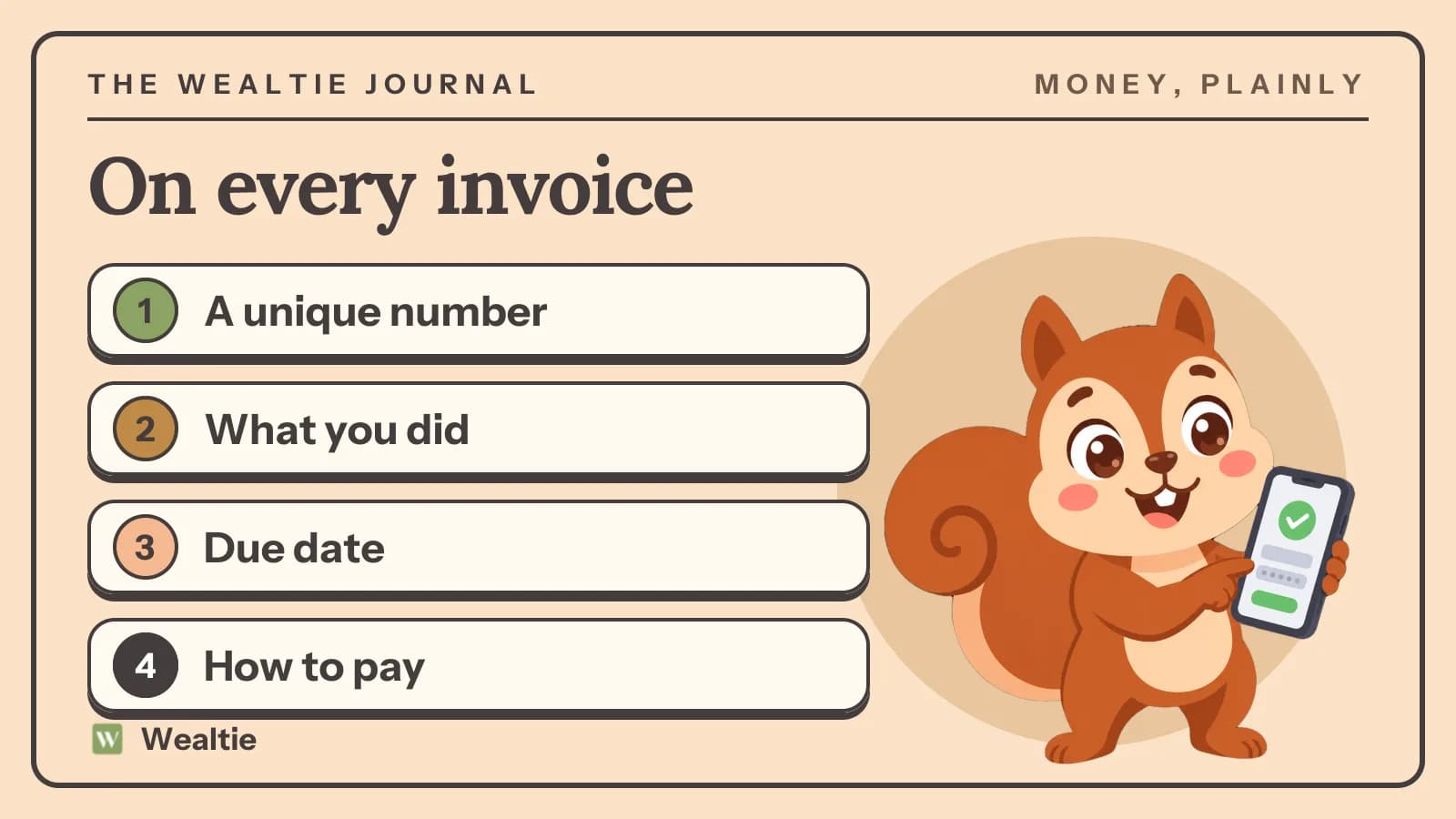
- Every invoice needs your details, the client's, a unique number, the date, the work, the amount, the due date and payment details.
- Send invoices as soon as work is delivered, since the payment clock starts when the client receives it.
- Agree payment terms before you start, and put them on the invoice.
- Tax registration rules, like VAT or sales tax, can add requirements, so check what applies to you.
How do you write an invoice as a freelancer?
Include everything the client needs to pay you without asking a question. A clear invoice gets paid faster, because nothing about it needs checking. You can use a template, accounting software or a simple document, as long as it has the right parts.
What should an invoice include?
These are the usual parts:
| Part | Example |
|---|---|
| Your name and contact details | Name, address, email |
| Client's name and address | Company name and billing address |
| A unique invoice number | 2026-014 |
| Invoice date | 10 November 2026 |
| What you did | Logo design, 12 hours at 50 |
| Amount for each line | 600 |
| Total due | 1,400 |
| Due date | 24 November 2026 |
| How to pay | Bank details or payment link |
Describe the work in the client's terms, matching the quote or contract, so whoever approves it recognises it straight away. Before work starts, confirm the client's legal name and billing address, since invoices sent to the wrong company often bounce around. Add a purchase order or project reference if the client gave you one. Big organisations often won't pay an invoice without it.
If you're registered for VAT, sales tax or a similar tax, there may be extra legal requirements, like your tax number and the tax shown separately. Check the rules in your country.
How should you number invoices?
In a simple sequence, with no gaps and no repeats. Many freelancers use the year and a number, like 2026-001, 2026-002. A clean sequence makes your records easy to follow and helps at tax time.
Keep a copy of every invoice you send, even ones that are cancelled. A note on a cancelled invoice is better than a missing number.
What payment terms should you use?
Short and clear, agreed before you start. Common terms are 14 or 30 days after the invoice date. Put the due date as a date, not just "30 days", so there's no doubt.
For a new client or a large project, ask for part of the fee upfront, like a deposit before starting, and the rest on delivery. For long projects, invoice in stages instead of waiting until the end.
Make paying easy by putting the bank details or payment link on the invoice itself, not in a separate email. Some countries have laws that let you charge interest on late payments from businesses. If you plan to use them, mention it in your terms.
When should you send it?
As soon as the work is delivered, or on an agreed date for ongoing work. The payment period usually starts when the client receives the invoice, so a week's delay in sending it is a week's delay in being paid.
Use a clear subject line, like the invoice number and your name, and attach a PDF instead of an editable file. Send it to the right person. Ask who handles invoices when you start working with a new client, since sending it to your contact rather than the accounts team can add weeks.
What if the invoice isn't paid on time?
Follow up the day after it's due, politely and with the invoice attached. Many late payments are oversights. Keep the tone friendly and factual, since most clients pay after a reminder and you'll want to work with many of them again. If there's still no payment, follow up again a week later and ask when it'll be paid. What to do when a client pays late has a step-by-step plan, including when to stop work.
How do invoices fit into your budget?
Count money when it arrives, not when you invoice. An invoice is a promise, and freelance budgets that treat invoices as income can come up short when payments run late. Track the average number of days each client takes to pay, since it tells you how much buffer you need. Set aside tax from each payment the day it lands. How much to set aside for taxes has the working, and the guide on how to budget on irregular income covers smoothing out the gaps.
How do you keep records?
A simple list of every invoice: number, client, date, amount, due date and date paid. It shows at a glance who owes you and for how long. Keep the invoices themselves for as long as your tax authority requires, and back them up somewhere other than your laptop.
How do you track freelance income in Wealtie?
Log each payment as income when it arrives, not when you invoice, and the income tracker shows the month's total against your goal. Wealtie doesn't create invoices, so use a template or invoicing tool for those. On Pro, income analytics show your sources, a stability score and a projection, and the budget tracker keeps your spending separate.
Questions people ask
Your details, the client's, a unique invoice number, the date, the work done with amounts, the total, the due date and how to pay.
Short, clear terms agreed before you start, often 14 or 30 days, with the due date written as a date. Ask for a deposit on new or large projects.
Use a simple sequence with no gaps, such as the year and a number, like 2026-001.
As soon as the work is delivered, since the payment period usually starts when the client receives it.
This article is general information, not financial, tax or legal advice. Your situation is your own; check the numbers that apply to you before you act on them.