Budgeting: What is disposable income, and how do you work out yours?
Disposable income is the money you have after tax and other deductions, and it's the starting point for any budget. In a worked example, a salary of 36,000 leaves about 2,400 a month of disposable income, and after essentials about 800 is left for saving and spending by choice.
 By Wealtie Team · 3 min read
Key takeaways
- Disposable income is what you have after tax and deductions; it's your real starting point for budgeting.
- In a worked example, 36,000 a year leaves about 2,400 a month of disposable income.
- Discretionary income is what's left after essentials, the part you choose how to use.
- Growing the gap between disposable income and essentials is how savings grow.
What is disposable income?
Disposable income is the money you have left after tax and other compulsory deductions from your pay. It's what reaches your bank account, ready to cover your bills, food, savings and everything else. When people talk about take-home pay, they usually mean much the same thing.
It matters because it's your real starting point. Budgeting from your salary before tax makes your income look bigger than it is, and leads to plans that don't add up. Many people who feel their money never stretches far enough are planning from the wrong number.
How is it different from discretionary income?
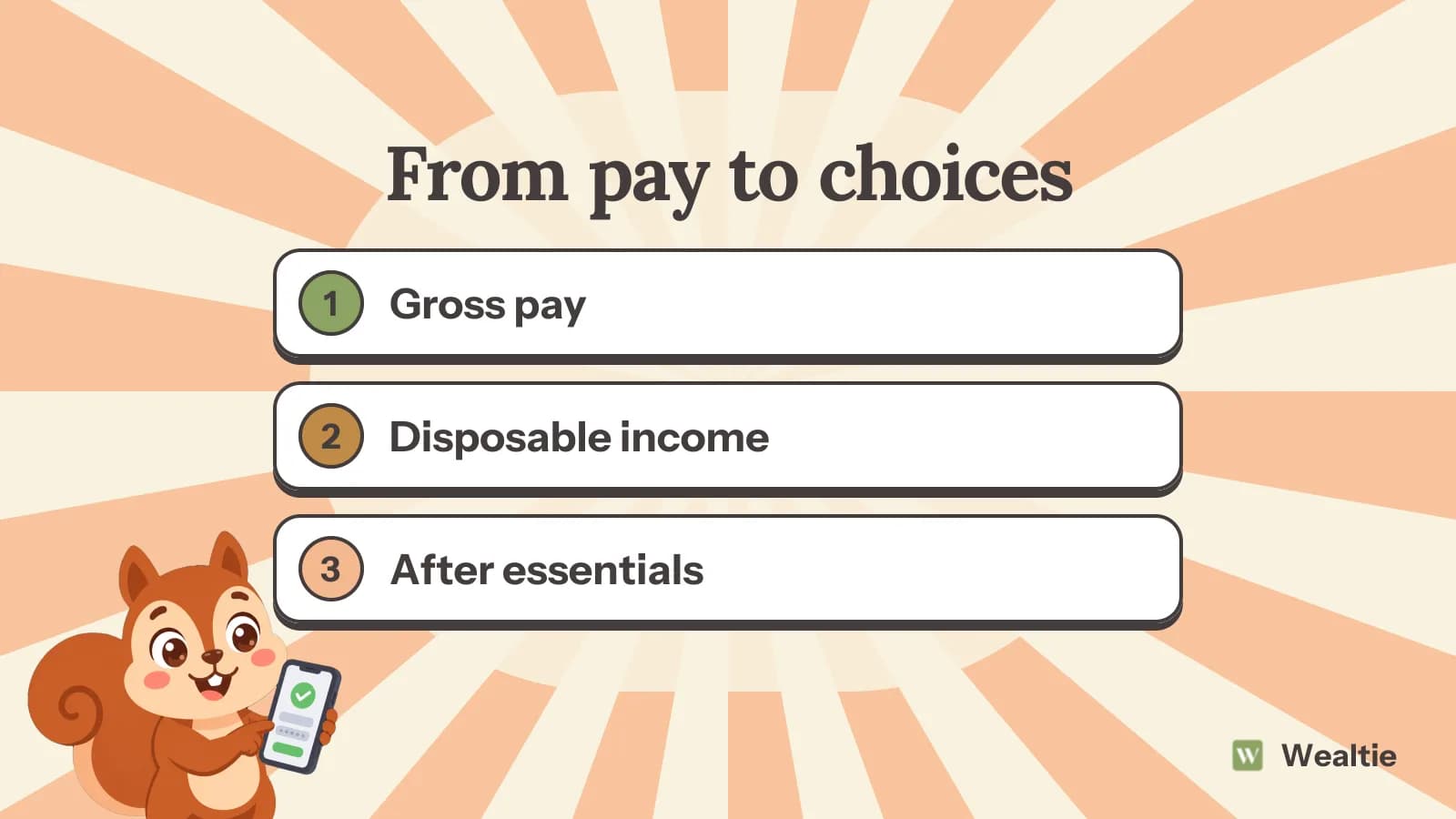
They're often confused. Disposable income is what you have after tax. Discretionary income is what's left after you've also paid for essentials, like housing, bills, food and transport. It's the part you get to choose how to use: savings, debt repayments beyond the minimum, eating out, hobbies and holidays.
Here's a worked example, in round numbers that work in any currency:
| Monthly amount | |
|---|---|
| Gross pay, from 36,000 a year | 3,000 |
| Disposable income, after tax and deductions | 2,400 |
| Essentials: housing, bills, food, transport | 1,600 |
| Discretionary income | 800 |
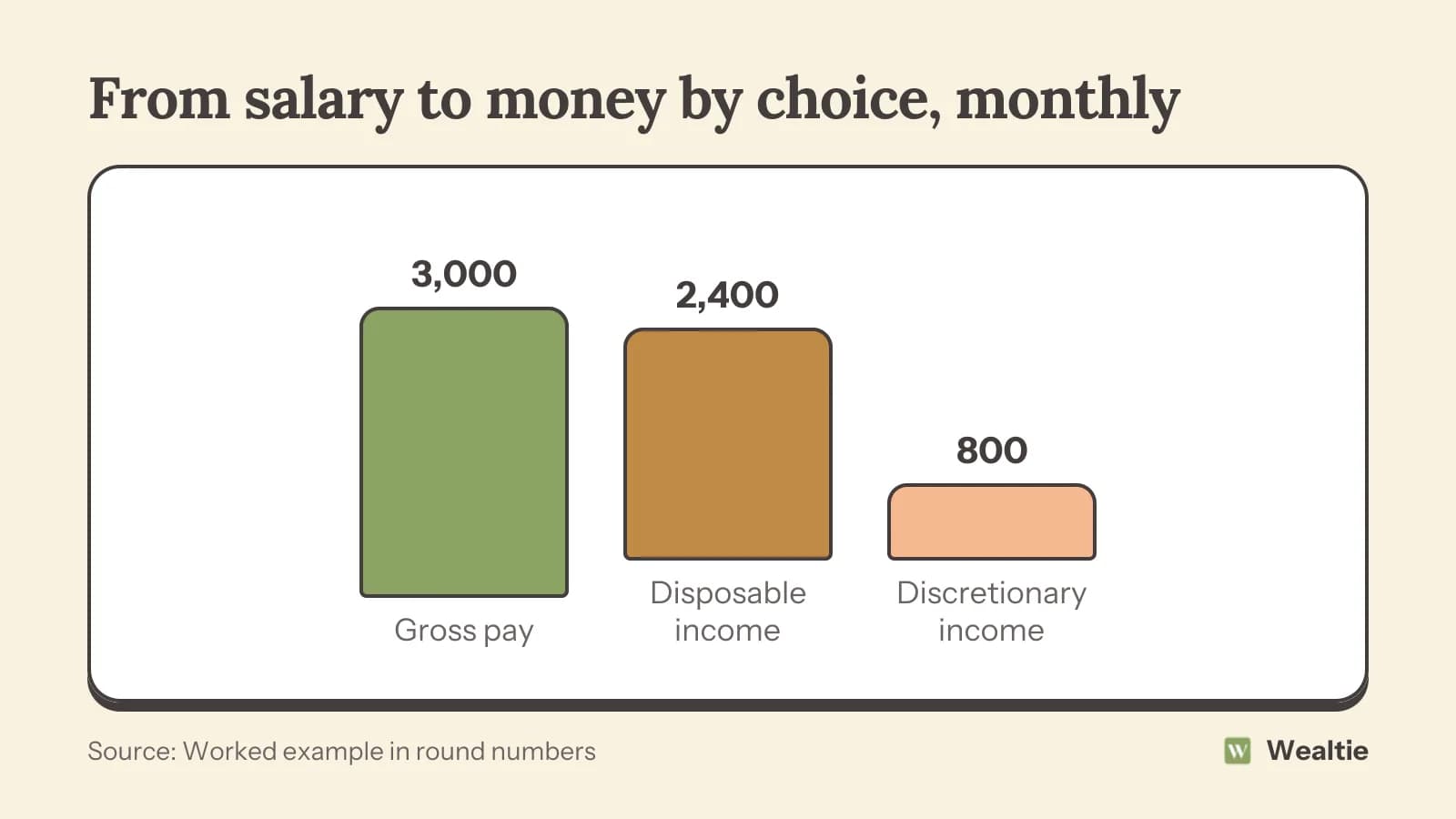
In this example, out of 3,000 of gross pay, 800 a month is flexible. Knowing that number changes how you plan. It shows how much room you have for saving and choices, and how much a change in essentials would free up.
How do you work out your disposable income?
Look at what reaches your account. If you're employed, your payslip shows net pay after tax and deductions. Add any other regular income, like benefits, child support or side income after tax. For irregular income, use an average of the last few months. Gross vs net income explains the deductions in more detail. If you share finances with a partner, work out your household disposable income by adding both take-home amounts.
If you're self-employed
Your disposable income is what's left after setting aside money for tax and business costs. Because income can vary, working from an average of the last six months, rather than your best month, gives a safer figure for budgeting. Treat the tax money as already gone, even if you pay it later, so your budget reflects what you can use.
How do you work out your discretionary income?
Subtract your essential costs from your disposable income. Go through a month of statements and add up housing, utilities, groceries, transport, insurance, childcare and minimum debt payments. What's left is your discretionary income. The bare-bones budget helps you find your essential costs. Yearly essentials, like insurance paid annually, should be divided by twelve and included.
How do you use these numbers?
They show where your choices are. Your disposable income sets the limit for everything. Your essentials are mostly fixed in the short term. Your discretionary income is where you decide what matters: how much to save, how fast to pay off debt and how much to enjoy now. How much of your income to save helps you decide how to split it.
Growing the gap
Savings grow when the gap between disposable income and essentials widens. That can happen by earning more, cutting essential costs, like a cheaper phone plan or insurance, or both. Even a small increase in that gap, saved every month, adds up. A cut of 50 a month in essential bills is 600 a year of extra discretionary money.
Why does disposable income change?
Pay rises, tax changes, new deductions, a change in hours or a new job all affect it. So can starting a workplace pension, which lowers take-home pay but builds savings for later. Checking each payslip helps you notice changes quickly. So do life events, like having a child or starting to repay a student loan. Checking your disposable income whenever something changes keeps your budget accurate. How to make a budget covers building a plan around it.
Watch for lifestyle creep
When disposable income rises, essentials often creep up too, like a bigger rent or a nicer car. Deciding in advance how much of any increase goes to savings keeps the gap growing rather than shrinking.
How do you track disposable income in Wealtie?
Log your take-home pay and other income in the income tracker, and set a monthly income goal to match. Track essentials and other spending in your expense categories. A limit in the budget tracker, with Budget Health, shows how much discretionary money is left as the month goes on.
Questions people ask
The money you have after tax and other compulsory deductions, usually the same as your take-home pay.
Disposable income is after tax. Discretionary income is what's left after essentials too.
Use the net pay on your payslip and add any other regular income after tax.
Earn more, cut essential costs, or both. In a worked example, 800 a month is left after essentials.
This article is general information, not financial, tax or legal advice. Your situation is your own; check the numbers that apply to you before you act on them.