Income & freelancing: How to compare two job offers beyond the salary
To compare job offers fairly, look at take-home pay plus pension, benefits and commuting costs, not just the headline salary. In a worked example, an offer paying 2,000 less a year comes out about 1,200 ahead once pension, travel and benefits are counted.
 By Wealtie Team · 3 min read
Key takeaways
- To compare job offers, look at take-home pay, pension, benefits and commuting costs together.
- In a worked example, the lower salary comes out about 1,200 ahead once everything is counted.
- Employer pension contributions are part of your pay, even though you don't see them monthly.
- Flexibility, growth and wellbeing matter too, even when they're hard to price.
How do you compare job offers fairly?
Put a value on everything each job gives you and costs you, not only the salary. Two offers with different salaries can be worth very different amounts once you count pension contributions, benefits, commuting costs and working patterns. It's easy to focus on the headline number because it's the one in the offer letter, but the rest of the package often matters just as much. A higher salary that comes with a long, expensive commute and a smaller pension can leave you worse off. Comparing job offers properly helps you choose with confidence. It also gives you facts to use if you decide to negotiate.
How do the numbers compare?
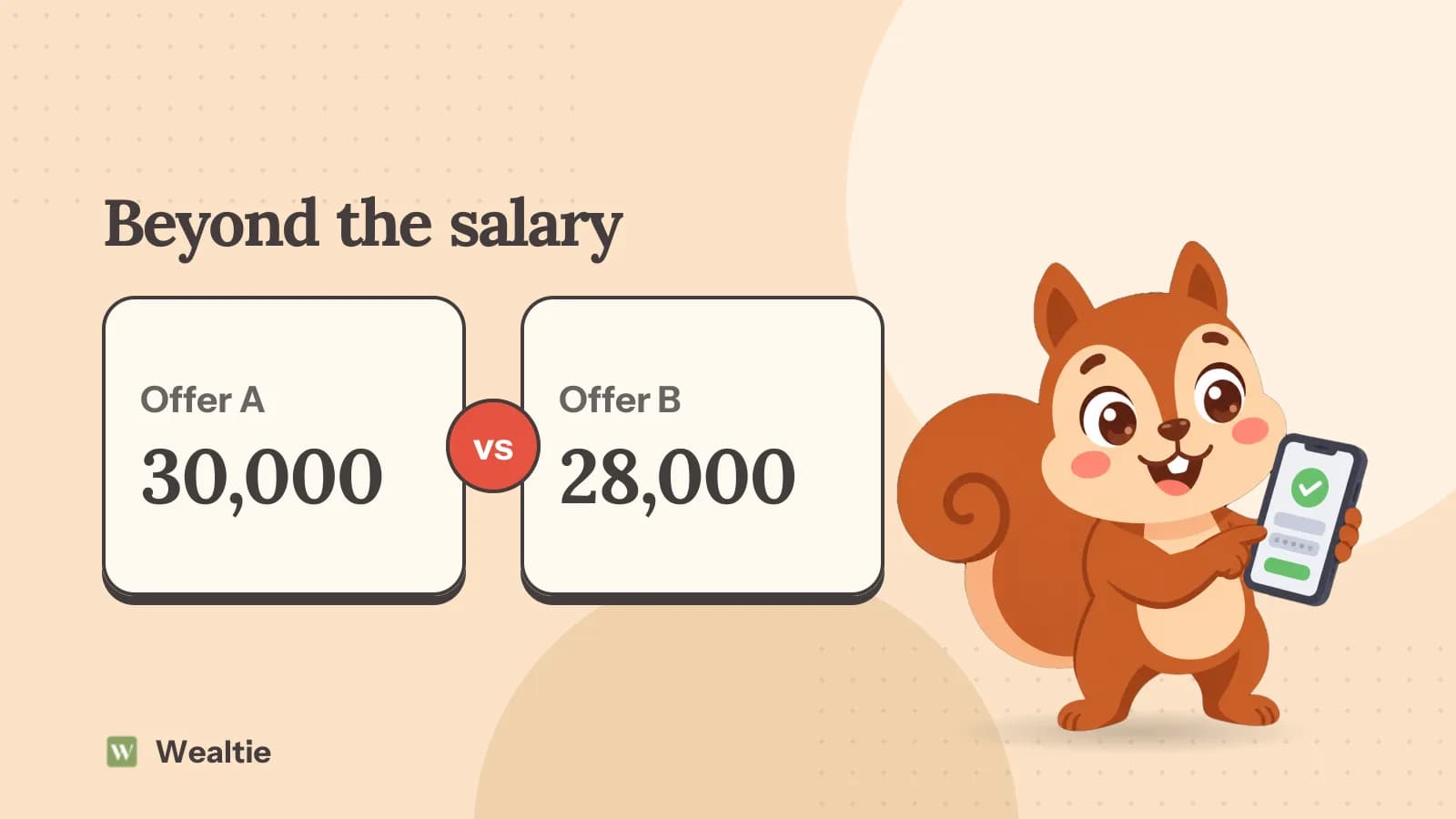
Here's a worked example of two offers, in round numbers that work in any currency:
| Offer A | Offer B | |
|---|---|---|
| Salary | 30,000 | 28,000 |
| Commuting cost a year | 2,400 | 600 |
| Employer pension contribution | 900 | 2,300 |
| Value after commute, with pension | 28,500 | 29,700 |
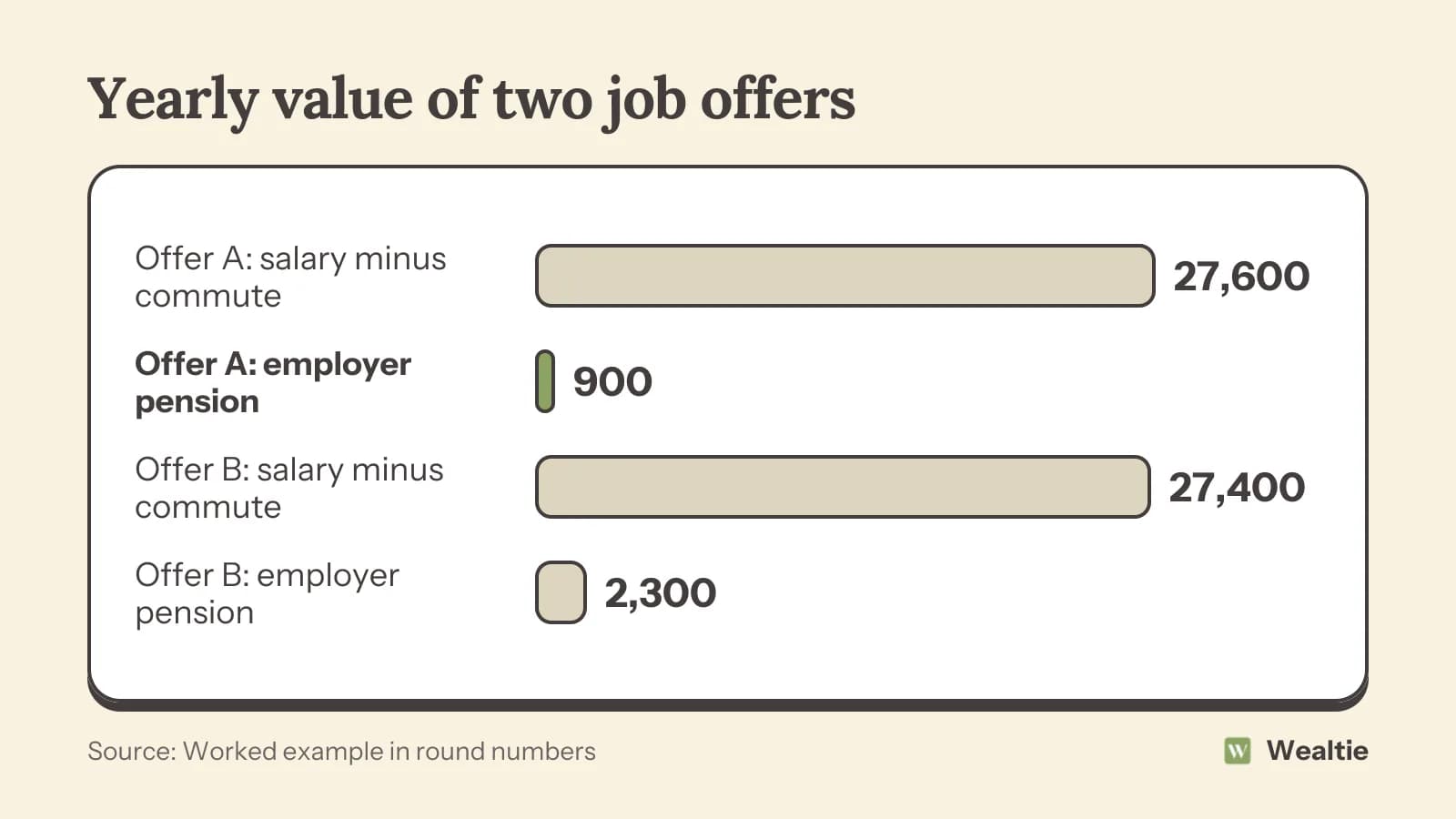
In this example, Offer B pays 2,000 less in salary but comes out about 1,200 ahead, thanks to a cheaper commute and a bigger employer pension. This is simplified, since tax applies to salary, so check take-home pay for each. Online take-home pay calculators for your country make this quick. Gross vs net income explains how deductions work.
What should you include?
List each of these for both offers:
- Take-home pay, after tax and deductions
- Employer pension contributions, which are part of your pay
- Bonuses or commission, and how likely they are
- Benefits, like health insurance, extra holiday, life cover or a company car
- Commuting costs and time, including fuel, fares and parking
- Working pattern, like hybrid or flexible hours
- Equipment or costs you'd pay yourself, like a uniform or home office
How to cut commuting costs can help you price the travel for each. Ask each employer for a written summary of the package, so you're comparing the same things.
Put a value on benefits
Ask what each benefit would cost you to buy yourself. Health insurance, extra holiday days or a free lunch all have a value. Only count benefits you'd use; a gym membership you'd never visit is worth nothing to you. Benefits that replace something you already pay for, like insurance, are worth the full amount you'd save.
What about things that are harder to price?
Some of the most important factors don't fit neatly in a table: how much you'd learn, chances for promotion, the team, job security and how the work would affect your health and family time. A job that pays a little less but offers training and progression can be worth more over a few years. Ask each employer how pay reviews work and how often people are promoted. A clear path to a higher salary can outweigh a small difference in starting pay. Write these down alongside the numbers, and weigh them honestly. Talking to people who work at each company, if you can, tells you more about the culture and workload than any interview.
Count your time
An hour less commuting each day adds up to many hours a month. Some people put a value on that time; others think about what they'd do with it. Either way, it belongs in the comparison.
Check the notice and probation terms
Notice periods, probation terms and any clauses about repaying training costs can affect your flexibility later. Read the contract for each offer before deciding, and ask about anything unclear.
Can you negotiate?
Often, yes. If you prefer one offer but the other pays more, it's reasonable to ask whether there's room to move on salary, pension or flexibility. Be polite and specific. Even if the salary can't change, an employer may offer extra holiday, a later review date or help with costs. How to negotiate a pay rise has tips that apply to offers too. Having a second offer can help, but be honest about it and don't invent one.
How do you budget for the switch?
Check what the change means for your monthly budget. A new job can change your pay date, which might leave a longer gap before your first pay, and bring new costs like travel or clothes. The first month in a new job budget covers getting through the switch smoothly. If the start date leaves a gap without pay, plan for it with savings before you resign from your current job.
How do you track a new income in Wealtie?
Log your new pay in the income tracker and update your monthly income goal to match. Track commuting and work costs in your expense categories, so you can see whether the job is delivering the value you expected.
Questions people ask
Compare take-home pay, employer pension, bonuses, benefits, commuting costs and working patterns, not just salary.
No. In a worked example, a salary 2,000 lower comes out about 1,200 ahead once commuting and pension are counted.
Yes. They're part of your pay, even though you don't see them monthly.
Often. It's reasonable to ask about salary, pension, holiday or flexibility, politely and specifically.
This article is general information, not financial, tax or legal advice. Your situation is your own; check the numbers that apply to you before you act on them.