Budgeting: How to budget in an expensive city when rent takes most of your pay
To budget in an expensive city, accept that rent may take a bigger share of your pay than the usual rules suggest, then make up for it on transport, food and fixed costs. In a worked example, rent of 1,500 on take-home of 3,200 still leaves room to save 250.
 By Wealtie Team · 3 min read
Key takeaways
- In an expensive city, rent can take a far bigger share of take-home pay than standard budgeting rules allow.
- In a worked example, take-home of 3,200 with rent of 1,500 still leaves 250 for savings and 550 for spending.
- Transport, food and sharing costs are where city dwellers can make up the most ground.
- Check whether the higher pay in the city is worth it after rent, compared with somewhere cheaper.
How do you budget in an expensive city?
Start with rent, because it decides everything else, then find savings in the areas where city life gives you options. Standard rules like keeping rent to a third of pay can be close to impossible in some cities. The goal is a budget that still leaves room to save, even if the shares look different.
What does a city budget look like?
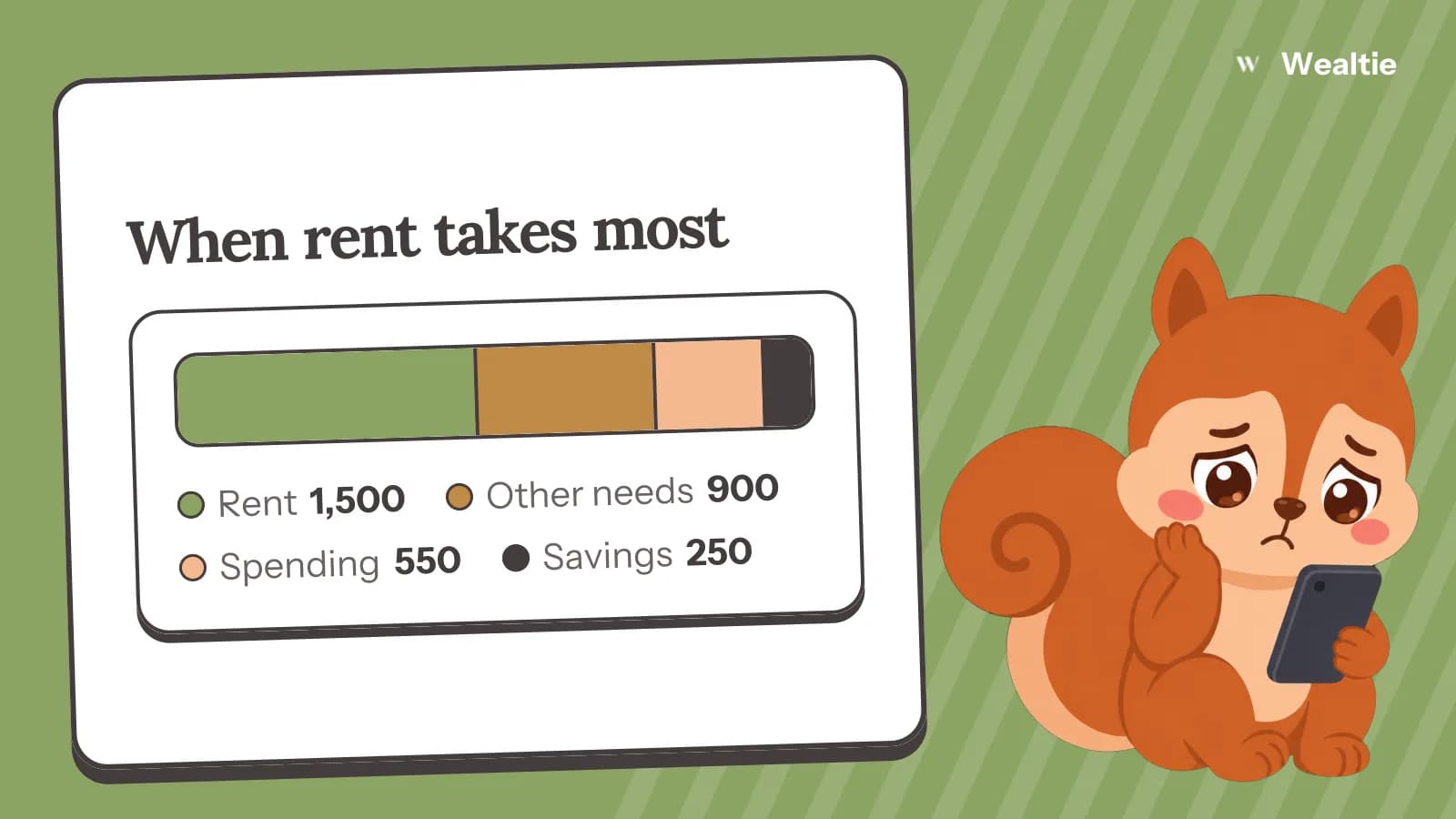
Here's a worked example on take-home of 3,200, in round numbers that work in any currency:
| Line | Amount |
|---|---|
| Rent | 1,500 |
| Bills, groceries, transport | 900 |
| Spending money | 550 |
| Savings | 250 |
| Total | 3,200 |
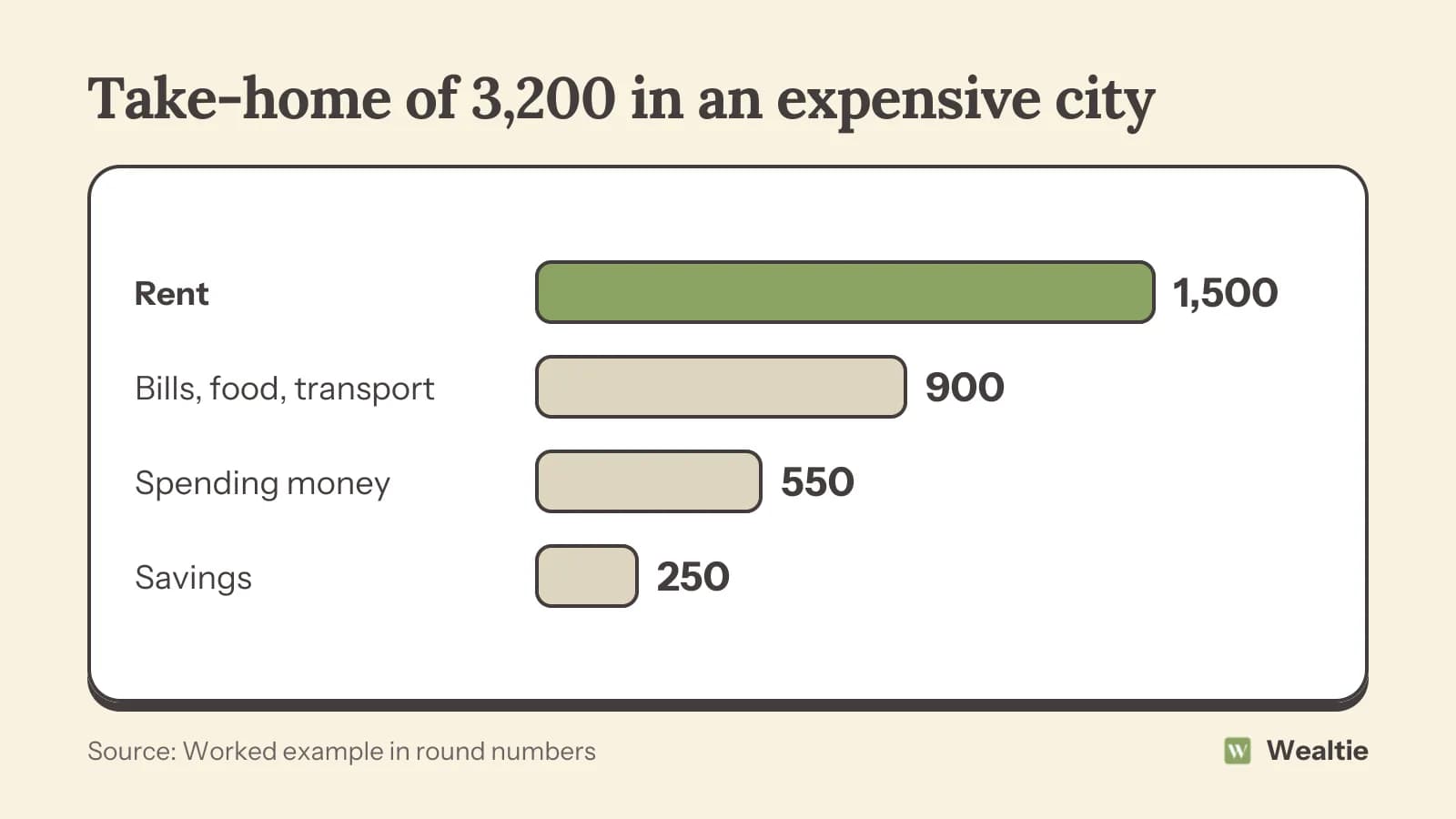
Rent takes almost half. That's above what the 50/30/20 rule suggests for all needs together. The budget still works because other costs are kept low and savings are set first.
Where can you make up ground?
In the places city life gives you choices:
- Transport: a monthly public transport pass or a bike is often far cheaper than a car. A pass at 90 a month against a car at 400, once you count insurance, fuel and parking, is a big difference.
- Sharing: a room in a shared flat at 950 instead of a studio at 1,500 saves 550 a month.
- Food: cities have more cheap places to buy food, like markets and discount supermarkets, as well as more temptation. Cooking most meals and keeping eating out to a set amount matters more here.
- Free things: parks, free museums and events can replace some paid nights out.
Living further out with a good transport link can cut rent by more than the extra travel costs, but count the time as well as the money. None of these is a must. Pick the ones that suit you and the trade-offs you're happy with.
How much rent is too much?
When it leaves no room to save or no buffer for a bad month. A useful check: after rent, bills, groceries, transport and minimum debt payments, is there anything left? If not, the rent's too high for the income, however normal it is in that city.
How much rent can I afford has a test using take-home pay. Before you sign, ask how rent increases work at renewal and whether any bills are included. If you're above it, a flatmate, a cheaper area with a longer commute or a smaller place are the usual options.
Is the higher city salary worth it?
Work it out. A job in a big city might pay more, but rent and other costs can take most of the difference. Compare what's left after rent and transport in each place, not the salary.
Say a city job pays 3,200 take-home with rent of 1,500, leaving 1,700. A job elsewhere pays 2,700 with rent of 800, leaving 1,900. The lower-paid job leaves more to live on. Career prospects, partners, friends and what you enjoy matter too, but the numbers are worth knowing. Remote or hybrid work changes the sum: if you only need to be in the city two days a week, living further out becomes much more realistic.
How do you save when rent's so high?
Set savings first, even a small amount. Move it on payday so it doesn't depend on what's left. 250 a month is 3,000 a year, which builds a real emergency fund. Pay yourself first covers the setup.
When you get a pay rise, put at least half of it toward savings before rent creeps up to meet it. Keep an emergency fund in particular. High fixed costs make you more exposed if income drops, because there's less to cut. How much should be in an emergency fund helps set the target.
What costs catch city dwellers out?
The small ones that add up. Delivery fees, taxis late at night, after-work drinks, coffee on the way to the station, and higher prices for convenience. Each one's small, but in a city they're constant.
Moving costs are another. Deposits and agency fees in expensive cities can be large, so start saving for the next move before you need to make it. Give the small costs a share of your spending money and watch it. How to save money on eating out has ideas for the biggest one.
How do you track a city budget in Wealtie?
Set your monthly limit in the budget tracker and give the categories that tend to run over their own share, like eating out and taxis. Budget Health warns you mid-month if your pace would take you over. Log rent and bills as recurring transactions, so they're counted on the day they leave.
Questions people ask
Set savings first, keep transport and food costs low, and consider sharing. Check that something's left after rent, bills, food, transport and debt payments.
Standard rules often can't be met in expensive cities. A better test is whether you can still save something and keep a buffer after all essential costs.
Compare what's left after rent and transport in each place, not the salary. A lower-paid job somewhere cheaper can leave more to live on.
Use public transport or a bike instead of a car, share housing, cook most meals and set a fixed amount for eating out and taxis.
This article is general information, not financial, tax or legal advice. Your situation is your own; check the numbers that apply to you before you act on them.