Multi-currency & travel: Which exchange rate to use: the right one for each job
Which exchange rate to use comes down to the job: record a purchase at the amount your bank took, and convert totals at one published daily rate. Tax returns follow your tax authority's rule.
 By Wealtie Team · 4 min read
Key takeaways
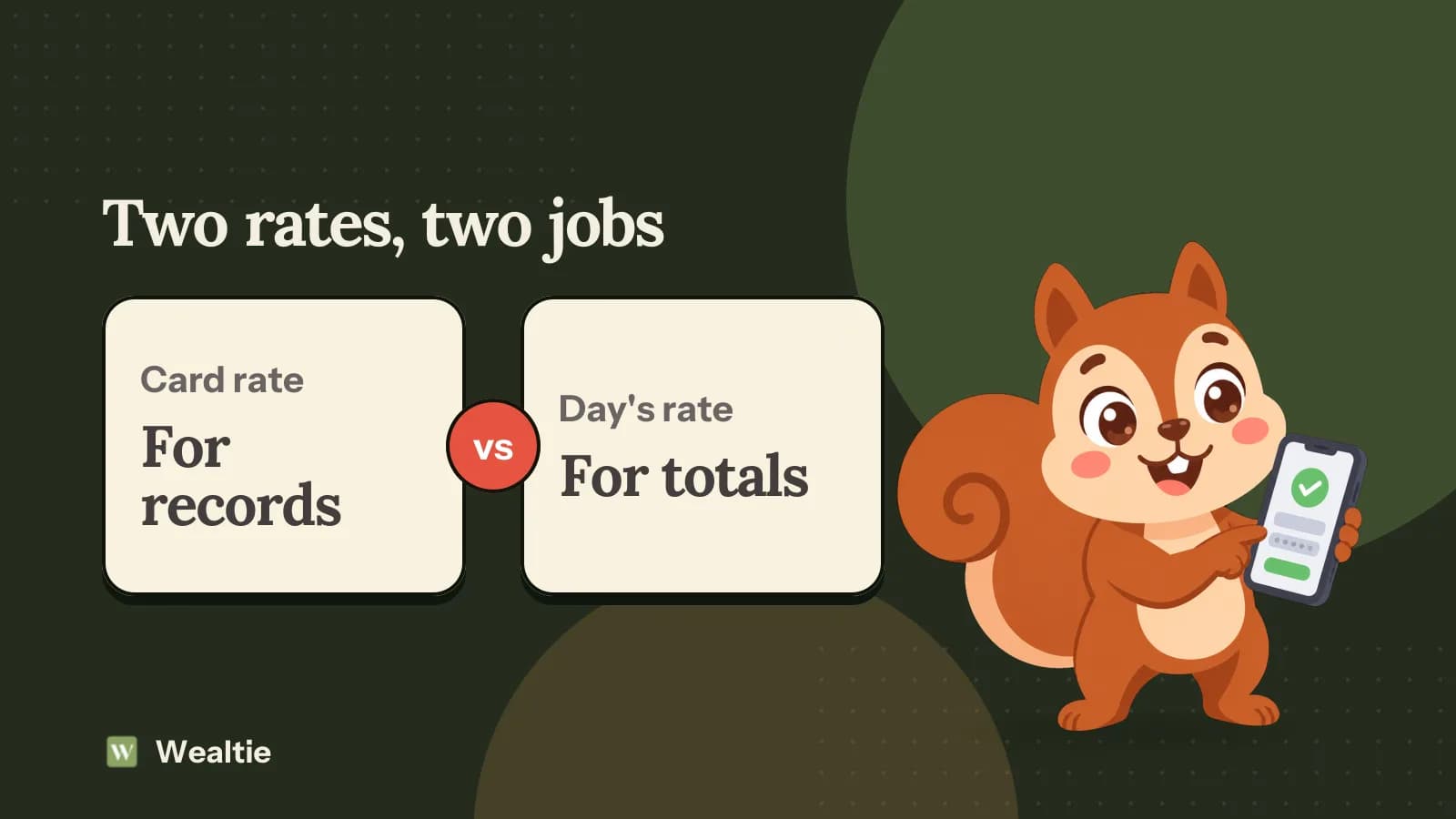
- Record a card purchase at the amount your bank took, because that figure already includes the card's conversion cost.
- Use one published daily rate, such as the ECB's euro reference rates, for totals and for checking what a card cost you.
- At the ECB's 9 November 2026 rate of 1.1193 dollars to the euro, $100 was €89.34; a 3% card mark-up would make it €92.02.
- When a terminal offers to charge you in your home currency, pay in the local currency instead, since the terminal's operator sets that conversion.
- Tax follows its own rule: the IRS tells US taxpayers to use the rate prevailing when an item is received, paid or accrued.
Which exchange rate should you use for each job?
Use the amount your bank took for anything that's already been paid, and a published rate for anything you're working out yourself.
| Job | Rate to use | Where to find it |
|---|---|---|
| Recording a card purchase | The one your bank applied, already inside the amount charged | Banking app or statement |
| Recording a payment from a foreign client | The amount that arrived in your account | Banking app or statement |
| Adding accounts into one total | One published daily rate | ECB, Federal Reserve H.10 or Bank of England |
| Checking what a card cost you | The published rate for the day of the purchase | ECB, Federal Reserve H.10 or Bank of England |
| Paying at a terminal that offers your home currency | Decline it and pay in the local currency | On the terminal's screen |
| Filling in a tax return | The one your tax authority asks for | Your tax authority's guidance |
How to track spending in two currencies covers the setup: which currency to budget in and how to lay out the records. This post is about the rates themselves.
What does one purchase cost at each rate?
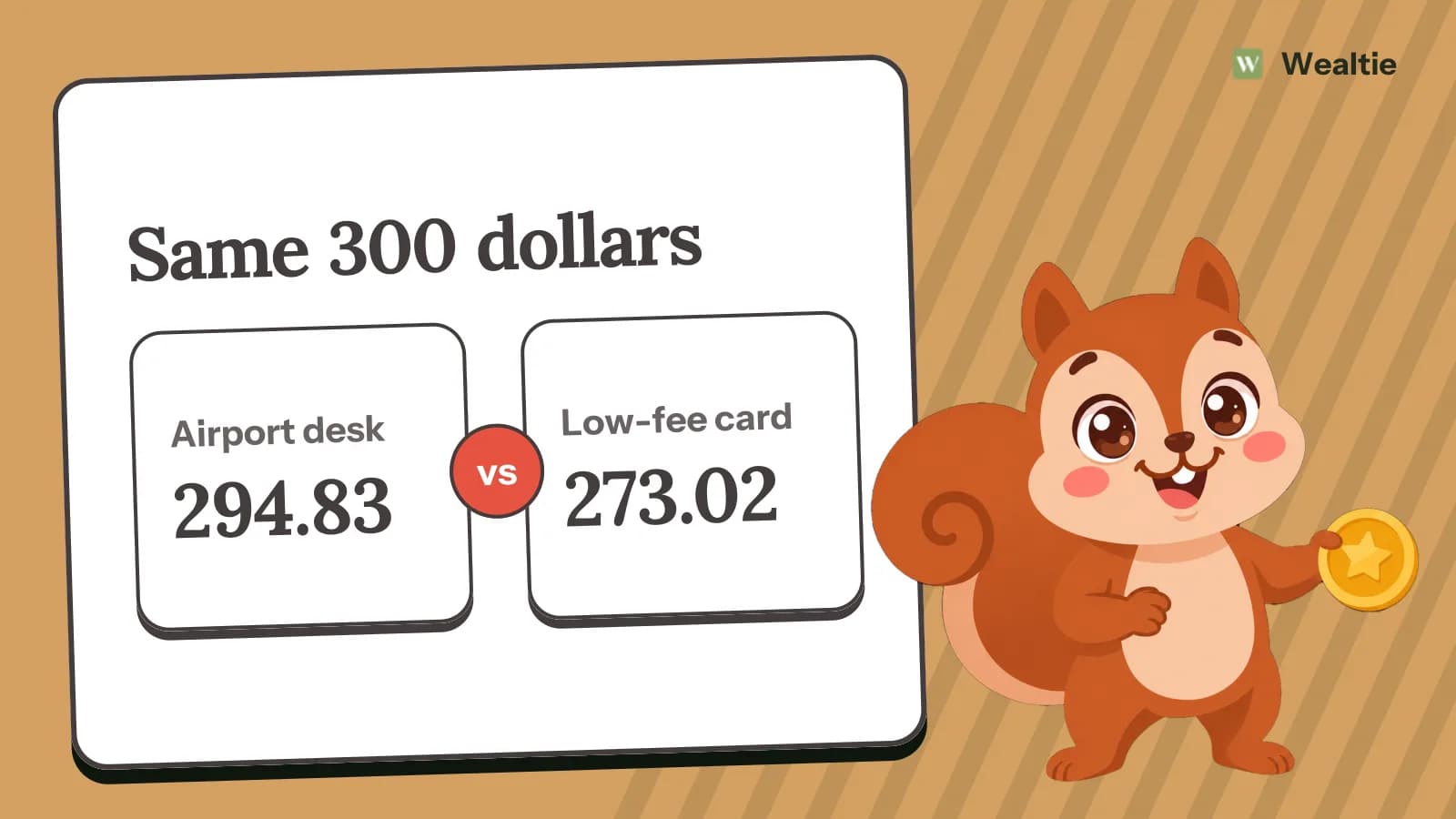
The same $100 dinner can cost three different amounts from a euro account, depending on who does the conversion. On 9 November 2026 the ECB reference rate was 1.1193 dollars to the euro, so $100 was €89.34.
| Rate | $100 costs | Above the reference rate |
|---|---|---|
| ECB reference rate, 9 November 2026 | €89.34 | n/a |
| Card with a 3% mark-up (example) | €92.02 | €2.68 |
| Terminal conversion with a 5% mark-up (example) | €93.81 | €4.47 |

Only the first row is a published figure. The two mark-ups are round examples, and yours will depend on the card and the terminal.
Say your banking app shows €92.02. That's the expense. The €89.34 goes nowhere in your records. It's only there to show you that paying in dollars on that card cost €2.68.
Why is your card's rate different from the published one?
Because a published rate is a reference, and your card's rate is a price with a charge built in. The card network converts the amount, and your bank may add its own foreign transaction fee on top.
In the EU you can compare that charge across cards. Regulation 2021/1230 requires card providers to express their total conversion charges as a percentage mark-up over the latest ECB reference rates, and to show it before you pay. Elsewhere, the card's terms are the place to look.
When should you use a published daily rate?
For sums you work out yourself, like a net worth total or a check on what a card charged you.
The ECB publishes euro reference rates against 29 currencies (as of 9 November 2026), usually around 16:00 CET on working days. It says they're "published for information purposes only" and that "using the rates for transaction purposes is strongly discouraged". Nobody will sell you euros at that rate. For a total, that's fine.
In the US, the Federal Reserve's H.10 release comes out weekly with a rate for each day. Its figures are "noon buying rates in New York for cable transfers".
Pick one source and stay with it. The ECB's rates come from a concertation around 14:10 CET and the Fed's from noon in New York, so the two can differ for the same day. Mixing them moves your total for no reason.
The ECB doesn't publish at weekends or on TARGET closing days. For a purchase on one of those days, use the last rate published before it.
What should you press when a terminal offers your home currency?
The local currency. If you accept the offer, whoever runs the terminal does the conversion and sets the rate, as in the 5% row above.
In the EU the terminal has to show that mark-up and tell you that you can pay in the seller's currency instead, under Article 4 of the same regulation. So the percentage on the screen is the number to read before you press anything. Your card may still add its foreign transaction fee, whichever you pick.
Which exchange rate do you use for tax?
The one your tax authority names, which may not be the one in your budget. For a US return, the IRS says to "use the exchange rate prevailing when you receive, pay, or accrue the item" and, where there's more than one, "the one that most properly reflects your income".
Other countries set their own rules, so check before you file. Don't copy a figure from a budget total onto a return: it was converted for a different purpose and may be on a different date's rate. If you're self-employed, how much to set aside for taxes covers the saving side.
How does Wealtie handle exchange rates?
Wealtie keeps each account in its own currency and converts your totals into a display currency at each day's rate. It's a multi-currency budget app with all 68 currencies on the Free plan.
That splits the work the way the table at the top does. Log a card purchase in the account's own currency at the amount your banking app shows, and the balance keeps matching your statement. Wealtie's daily rate then does the converting for the total across accounts, which the net worth tracker adds up in one place. Moving money between your own accounts is recorded as a transfer, so it isn't counted as spending.
Wealtie's rates are for your totals. The app doesn't move or exchange money.
Questions people ask
Usually the card network's rate on the day the payment is processed, plus any fee or mark-up your bank adds. The amount in your banking app already includes both, so that's the figure to record.
Your statement includes your card's conversion charge, and the ECB rate is a reference that nobody trades at. On a $100 purchase on 9 November 2026, the ECB rate gave €89.34, so a 3% mark-up would show €92.02.
Use the last rate published before that day. The ECB publishes on working days only, so Friday's rate covers Saturday and Sunday when you're converting totals.
Only if your tax authority accepts them, so check its guidance first. The IRS tells US taxpayers to use the rate prevailing when an item is received, paid or accrued, and to use the one that most properly reflects their income if there's more than one.
No, pay in the local currency and let your card do the conversion. If you pay in your home currency, whoever runs the terminal or ATM sets the rate, and it often includes a mark-up.
Sources
- Euro foreign exchange reference rates · European Central Bank · checked 9 November 2026
- Foreign Exchange Rates, H.10: About · Board of Governors of the Federal Reserve System · checked 9 November 2026
- Further details about spot exchange rates data · Bank of England · checked 9 November 2026
- Regulation (EU) 2021/1230 on cross-border payments in the Union, Article 4 · European Union (EUR-Lex) · checked 9 November 2026
- Foreign currency and currency exchange rates · Internal Revenue Service · checked 9 November 2026
This article is general information, not financial, tax or legal advice. Your situation is your own; check the numbers that apply to you before you act on them.