Multi-currency & travel: Foreign transaction fees: what they cost and how to avoid them
A foreign transaction fee is a charge, usually 1% to 3% of the purchase, that your card issuer adds when you pay in a foreign currency or buy from a merchant abroad. Half of US credit card plans charged none in the CFPB's late-2025 survey; most of the rest charged 1% or 3%.
 By Wealtie Team · 3 min read
Key takeaways
- A foreign transaction fee is a percentage of each purchase, usually 1% to 3%, added by your card issuer when you pay in a foreign currency or with a foreign merchant.
- In the CFPB's survey of 663 US credit card plans in the second half of 2025, 330 (49.8%) charged no foreign transaction fee; of those that did, 139 charged 1% and 136 charged 3%.
- Among plans from the 25 largest issuers, 63% had no foreign transaction fee, but 89% of those that charged one set it at 3%.
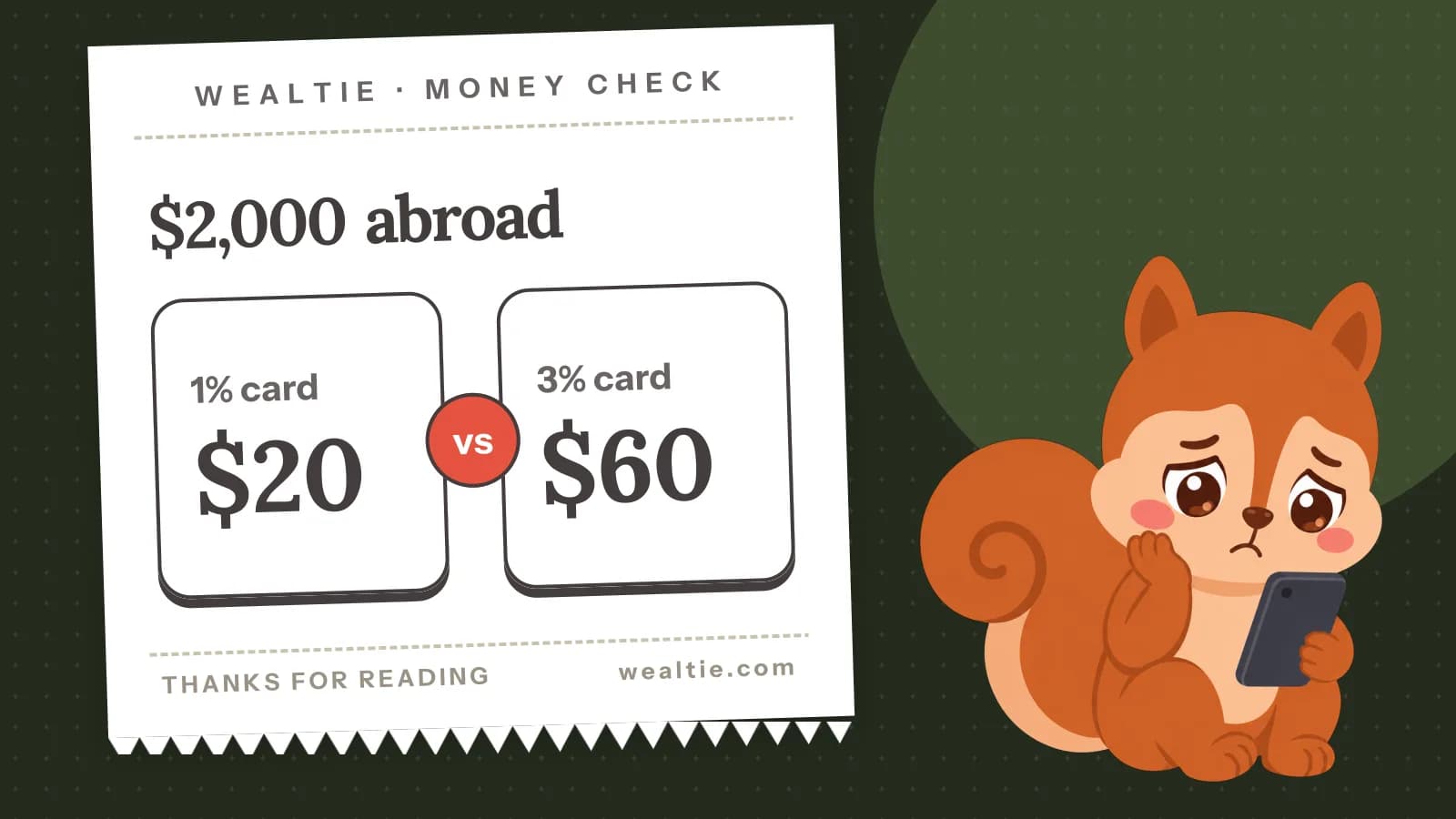
- On $2,000 of spending abroad, a 3% fee costs $60 and a 1% fee costs $20.
- When a card terminal or website offers to charge you in your home currency, choose the local currency: the conversion rate is set by whoever offers it.
What is a foreign transaction fee?
A charge your card issuer adds when you pay in a foreign currency or buy from a merchant based abroad. It's usually a percentage of the purchase, between 1% and 3%.
The CFPB's credit card survey describes it as a fee on transactions that take place overseas or with a foreign merchant. That second part catches people out: an online order from a shop based in another country can carry the fee even if you never left home, and sometimes even if the price was shown in dollars.
The fee is separate from the exchange rate. You pay the card network's conversion rate on the purchase, and then the fee on top.
How much are foreign transaction fees?
Usually 1% or 3%, and about half of US credit card plans don't charge one at all.
In the CFPB's Terms of Credit Card Plans survey for the second half of 2025, 663 plans from 195 issuers reported their foreign transaction fee:
| Foreign transaction fee | Number of plans | Share of plans |
|---|---|---|
| None | 330 | 49.8% |
| 1% | 139 | 21.0% |
| 3% | 136 | 20.5% |
| 2% | 30 | 4.5% |
| Other rate or not stated | 28 | 4.2% |
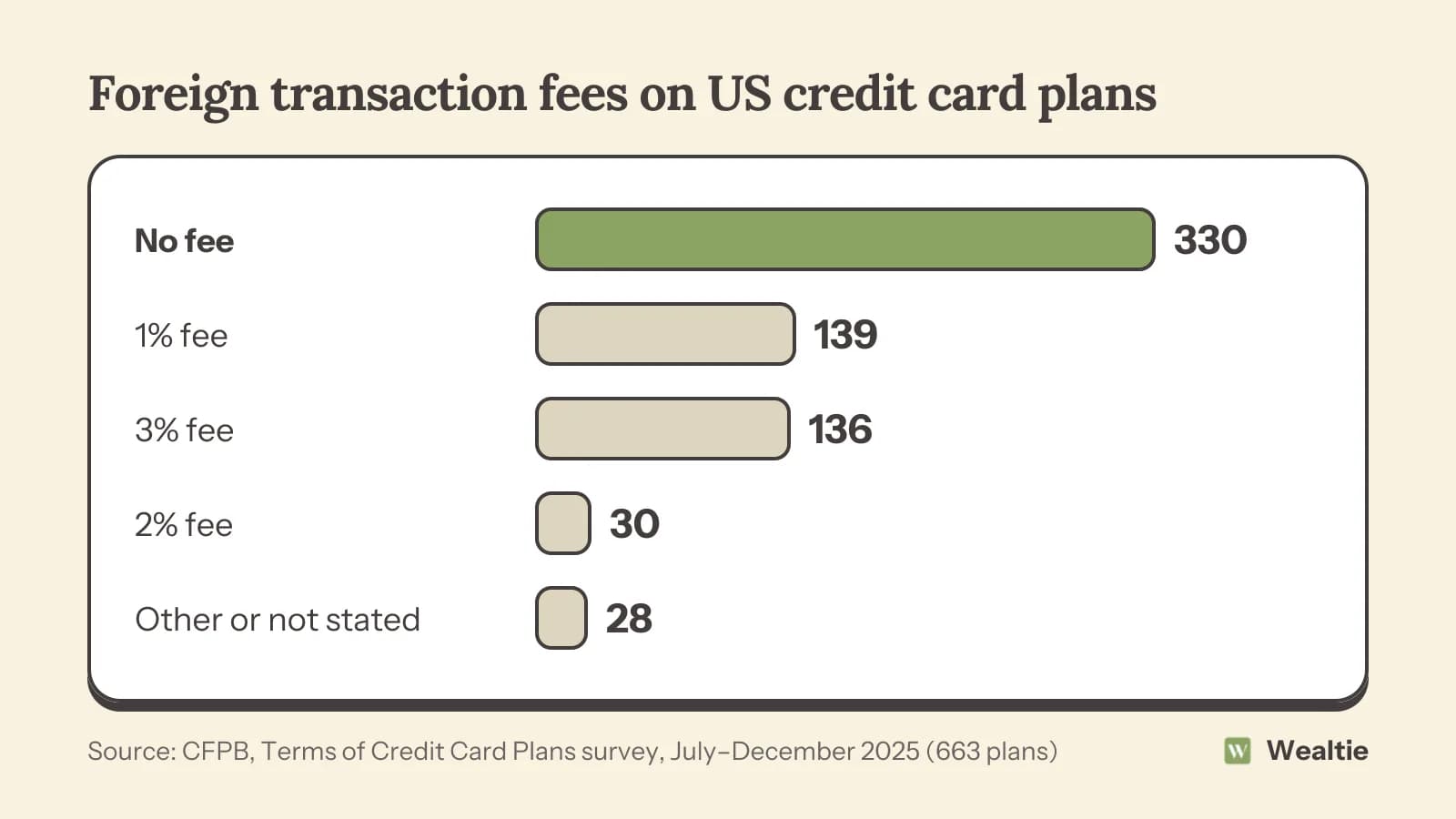
The big issuers are split further apart. Among plans from the 25 largest card issuers, 63% charged no foreign transaction fee. But of the ones that did, 89% charged 3%. The 1% fees mostly come from smaller banks and credit unions.
These are counts of card plans, not of cards in people's wallets, so they don't tell you what share of cardholders pay the fee. They do tell you that a card without one isn't hard to find.
What does a foreign transaction fee cost on a trip?
The fee times everything you spend abroad on that card. On a trip with $2,000 of card spending, a 3% fee costs $60 and a 1% fee costs $20.
| Spent abroad on the card | 1% fee | 3% fee |
|---|---|---|
| $500 | $5 | $15 |
| $2,000 | $20 | $60 |
| $5,000 | $50 | $150 |
Hotels, car hire and flights booked with foreign companies count too, so the total is often bigger than the spending money you take. How to budget for a trip abroad has a line for card fees in its worked example.
Should you pay in local currency or your home currency?
Local currency, almost always. When a card terminal, ATM or website offers to charge you in dollars, that's called dynamic currency conversion, and the exchange rate is set by whoever is offering it, not by your card network.
The screen usually makes paying in your home currency look like the safe choice. It isn't. The rate often includes a mark-up, and your card may still add its own foreign transaction fee because the merchant is abroad. Choose the local currency and let your card do the conversion.
Do debit cards and ATMs charge foreign transaction fees?
Many do. A debit card can carry the same percentage fee as a credit card, and a cash withdrawal abroad can add a fee from your bank and another from the ATM's owner.
Check your bank's fee schedule before you go. If you'll need cash, withdraw larger amounts less often, so fixed per-withdrawal fees hit fewer times, and decline the ATM's offer to convert the amount for you.
How do you avoid foreign transaction fees?
Use a card that doesn't charge them, pay in the local currency, and check the card's terms before you travel.
- Check your current cards. The foreign transaction fee is listed in the card's terms and on the issuer's website. You may already have one without it.
- Use the no-fee card for everything abroad, including foreign websites and bookings.
- Decline conversion to your home currency at terminals, ATMs and checkouts.
- Keep cash for where it's needed, and take it out in fewer, larger withdrawals.
How do you track spending in another currency?
Log each purchase in the currency you paid, and record any fee as its own line so you can see what the card cost you.
In Wealtie, each account keeps its own currency, and your totals are converted into your display currency at each day's rate across all 68 currencies. A card fee logged as its own expense shows up in your category totals, so the trip's true cost is one number. Cash abroad goes in the same way: Wealtie is an expense tracker that never connects to your bank, so a market stall counts like a card payment. How to track spending in two currencies goes through which exchange rate to use and why your total moves when you haven't spent anything.
Questions people ask
A fee your card issuer charges on purchases made in a foreign currency or with a merchant based abroad, usually 1% to 3% of the amount. It appears on your statement as a separate line or is added to the purchase.
Usually 1% or 3% of the purchase. In the CFPB's survey of US credit card plans in late 2025, 139 plans charged 1%, 136 charged 3% and 330 of 663 charged nothing.
Use a card with no foreign transaction fee, which half of US credit card plans offered in late 2025, and pay in the local currency rather than accepting a conversion to dollars at the till or ATM.
Many do, and ATM withdrawals abroad can add a fee from your bank and one from the ATM owner. Check your bank's fee schedule before you travel, and withdraw larger amounts less often.
They can. Issuers may charge the fee on purchases processed by a merchant abroad even when the price is in dollars. Check the card's terms, or use a card with no foreign transaction fee for foreign sites.
Sources
- Terms of Credit Card Plans survey data, reporting period ending 31 December 2025 · Consumer Financial Protection Bureau · checked 1 November 2026
- Terms of Credit Card Plans (TCCP) data dictionary · Consumer Financial Protection Bureau · checked 1 November 2026
- Payments, transfers and cheques in the EU · European Union, Your Europe · checked 1 November 2026
This article is general information, not financial, tax or legal advice. Your situation is your own; check the numbers that apply to you before you act on them.