Multi-currency & travel: How much money can you travel abroad with? The legal limits
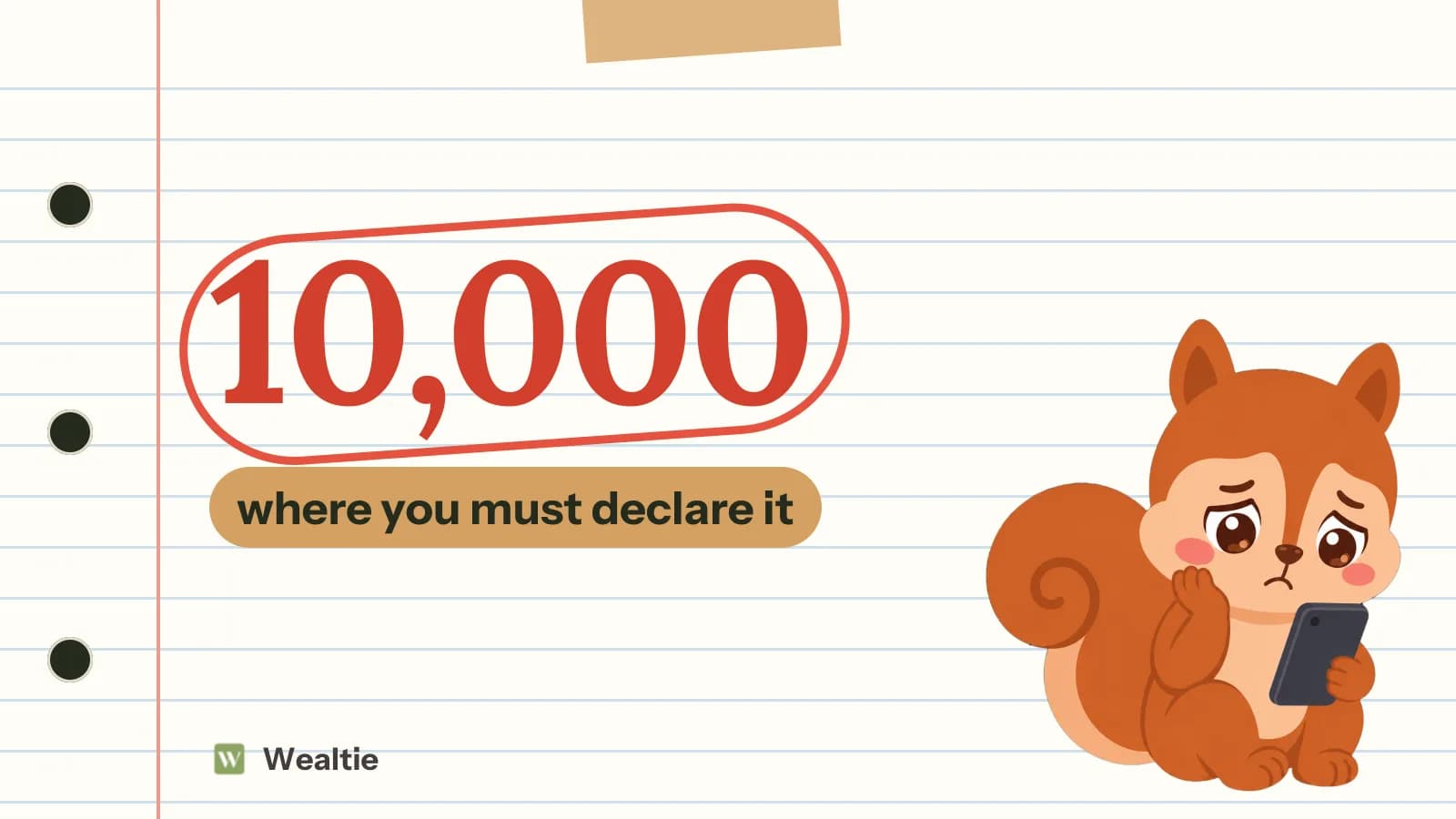
How much money can you travel abroad with? There's no general limit leaving the US, UK or EU, but you must declare cash at the 10,000 line: above $10,000 for the US, and £10,000 or €10,000 or more for the UK and EU.
 By Wealtie Team · 3 min read
Key takeaways
- In the US, you must report more than $10,000 when entering or leaving, and the amount applies to a family or group's combined total.
- In the UK, you must declare £10,000 or more when carrying cash between Great Britain and a country outside the UK.
- EU rules require a declaration of €10,000 or more when entering or leaving the EU, and cash includes prepaid cards.
- Failing to declare can lead to seizure of the money and, in the UK, a penalty of up to £5,000.
How much money can you travel abroad with?
As much as you like leaving the US, UK or EU, but above a certain amount you have to declare it. Those lines are reporting rules, and they don't cap what you can carry. Here's where each one sits:
| Leaving or entering | Line | Rule |
|---|---|---|
| US | More than $10,000 | Report to CBP |
| Great Britain, to or from outside the UK | £10,000 or more | Declare to UK customs |
| EU, to or from outside the EU | €10,000 or more | Declare to customs |
The wording differs slightly. In the US you report "amounts exceeding $10,000". In the UK and the EU, you declare 10,000 or more.
Your destination may have its own rules, and some countries limit how much of their currency can come in or go out. Check the official customs site for the country you're going to before you pack the money.
Does the limit apply per person or per family?
Often to the group. CBP says that when families or groups are involved, "the $10,000 threshold applies to the total amount they are carrying or sending collectively, not per individual". GOV.UK says the same: a family or group with £10,000 or more in total still needs to declare, even if each person's carrying less.
Splitting the money between four people to stay under the line doesn't work.
What counts as cash?
More than banknotes. The EU's regulation defines cash as currency, bearer-negotiable instruments like traveller's cheques, commodities used as highly liquid stores of value, and prepaid cards. So a stack of notes and a loaded prepaid card can add up toward the same line. Check how your own route treats gold or other valuables.
Money in your bank account that you reach with a normal debit or credit card isn't something you carry in this sense.
How do you declare it?
Each country has its own form. In the US, it's FinCEN Form 105, which CBP says can be filed electronically. In the UK, GOV.UK has a declaration service and says the earliest you can declare is 72 hours before you travel. In the EU, you declare to customs in the member state where you enter or leave.
There's no tax on declaring, and declaring doesn't mean you've done anything wrong. It's a report.
Northern Ireland has its own rule in euros for cash carried between it and countries outside the UK, and GOV.UK explains how it applies.
What happens if you don't declare?
You can lose the money. CBP says people who fail to file risk having their currency forfeited and seized, and that in some cases they may face civil or criminal penalties, including fines or imprisonment.
In the UK, GOV.UK says all the cash you're carrying can be seized by a Border Force officer, and you may have to pay a penalty of up to £5,000 to get it back.
Separately, in the UK any cash can be seized if customs have reasonable grounds to suspect a crime, so being under the line isn't the only thing that matters. Keep paperwork showing where a large sum came from.
Why would you carry that much anyway?
Usually you wouldn't, and there are better ways. A large sum is most often going toward a property deposit, a car, a family gift, or moving abroad. A bank transfer or a money-transfer service leaves a record and doesn't sit in a suitcase. Cash can't be replaced if it's lost or stolen, and travel insurance often limits how much of it's covered.
For an ordinary trip, you'll need far less. How to budget for a trip abroad covers what you'll spend, and foreign transaction fees covers what cards and ATMs charge.
How much cash should you take on a normal trip?
Only enough for your first day or two and places that won't take cards. Some countries still run heavily on cash, so look up the destination before you go. The rest of your spending money can stay on a card and in your account, and you can take out more as you need it.
Split it up while you travel, so that one lost wallet doesn't take everything. Keep a card and a small amount of cash in a different bag.
How do you keep track of travel cash in Wealtie?
Add your wallet as an account in the currency you're carrying and log what you spend from it. Each account keeps its own currency, and your total's converted into a display currency at each day's rate. The multi-currency budget app covers 68 currencies on the Free plan, and your net worth tracker shows cash alongside your other accounts.
Questions people ask
As much as you like, in most cases, but you must report more than $10,000 entering or leaving the US, and declare £10,000 or €10,000 or more in the UK and EU. Your destination may have its own rules.
Yes, if you're at or over the line for your route. That's more than $10,000 for the US, and £10,000 or more or €10,000 or more for the UK and EU.
Not always. CBP applies the $10,000 to the total a family or group carries, and GOV.UK says a family or group with £10,000 or more in total needs to declare.
The money can be seized. CBP warns of forfeiture and possible penalties, while in the UK you may have to pay a penalty of up to £5,000 to get it back.
Sources
- Money and Other Monetary Instruments · U.S. Customs and Border Protection · checked 9 November 2026
- Take cash in and out of the UK · GOV.UK · checked 9 November 2026
- Regulation (EU) 2018/1672 on controls on cash entering or leaving the Union · European Union (EUR-Lex) · checked 9 November 2026
This article is general information, not financial, tax or legal advice. Your situation is your own; check the numbers that apply to you before you act on them.