Income & freelancing: How much to set aside for taxes when you're self-employed
How much to set aside for taxes when you're self-employed in the US: about 20% to 25% of your profit for federal tax, plus your state's income tax. A single filer with $60,000 of profit in 2026 owes about $12,000, or 20%. Move it out every time a client pays, not in April.
 By Wealtie Team · 4 min read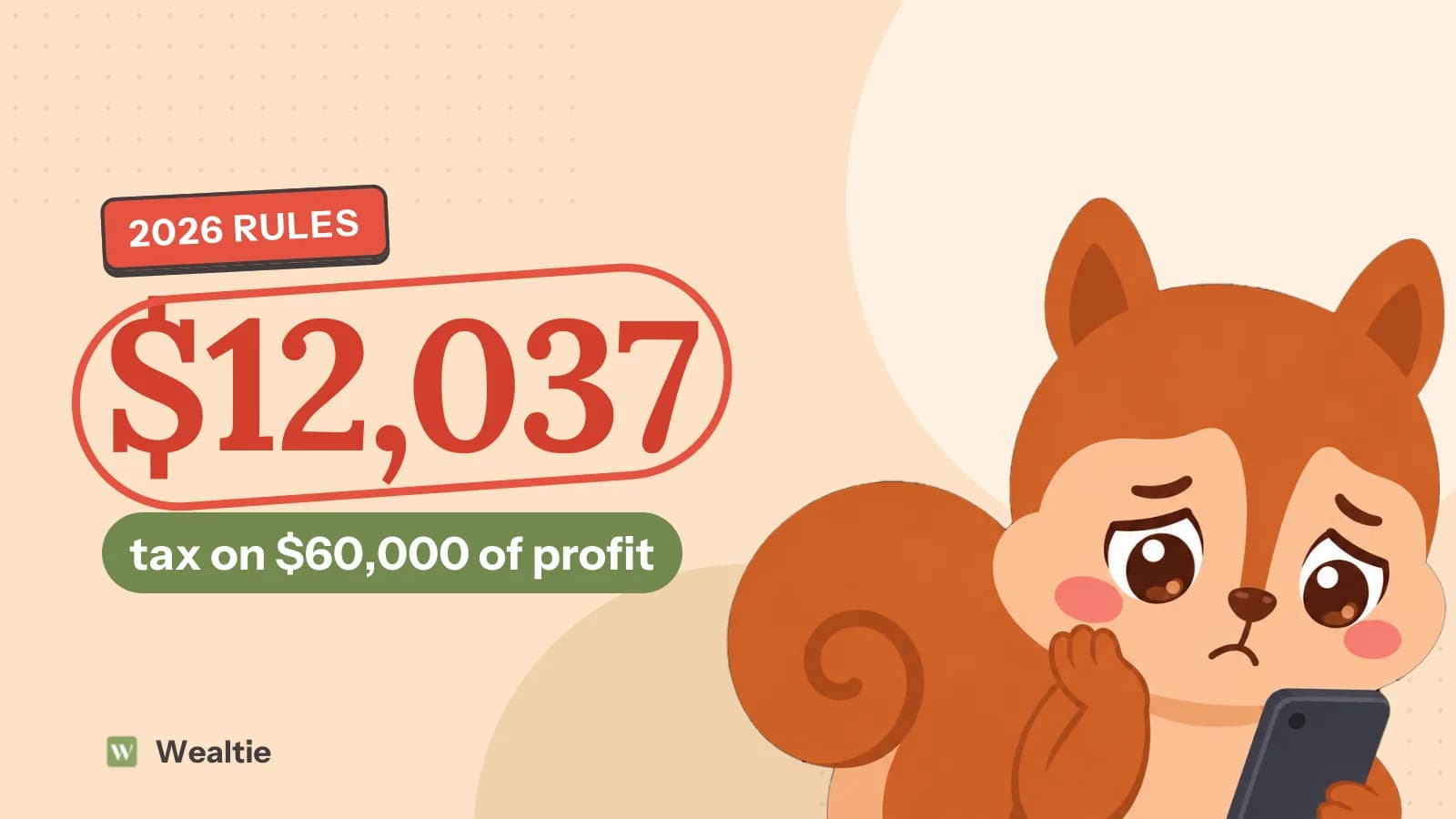
Key takeaways
- A single self-employed filer in the US pays about 17% of a $30,000 profit, 20% of $60,000 and 22% of $100,000 in federal tax for 2026, before any state income tax.
- Self-employment tax is 15.3% (12.4% Social Security plus 2.9% Medicare) on 92.35% of net earnings, and it starts at $400 of profit, long before income tax does.
- The IRS expects estimated tax four times a year, on April 15, June 15, September 15 and January 15; you can also pay monthly as long as each quarter is covered.
- In the UK for 2026/27, a sole trader pays about 15% of a £30,000 profit and 23% of £60,000 in Income Tax and Class 4 National Insurance.
- UK sole traders in their first year can owe 150% of the year's tax in one January, because the first payment on account for the next year falls due at the same time.
How much should you set aside for taxes if you're self-employed?
Set aside 20% to 25% of your profit for US federal tax, then add your state's income tax rate on top. Profit means what clients paid you minus your business expenses, not the total that hit your account.
Here is what a single filer with no other income, taking the standard deduction, owes in federal tax for 2026 at three profit levels:
| Profit in 2026 | Self-employment tax | Federal income tax | Total federal tax | Share of profit | Set aside a month |
|---|---|---|---|---|---|
| $30,000 | $4,239 | $942 | $5,181 | 17% | $432 |
| $60,000 | $8,478 | $3,559 | $12,037 | 20% | $1,003 |
| $100,000 | $14,130 | $8,235 | $22,365 | 22% | $1,864 |
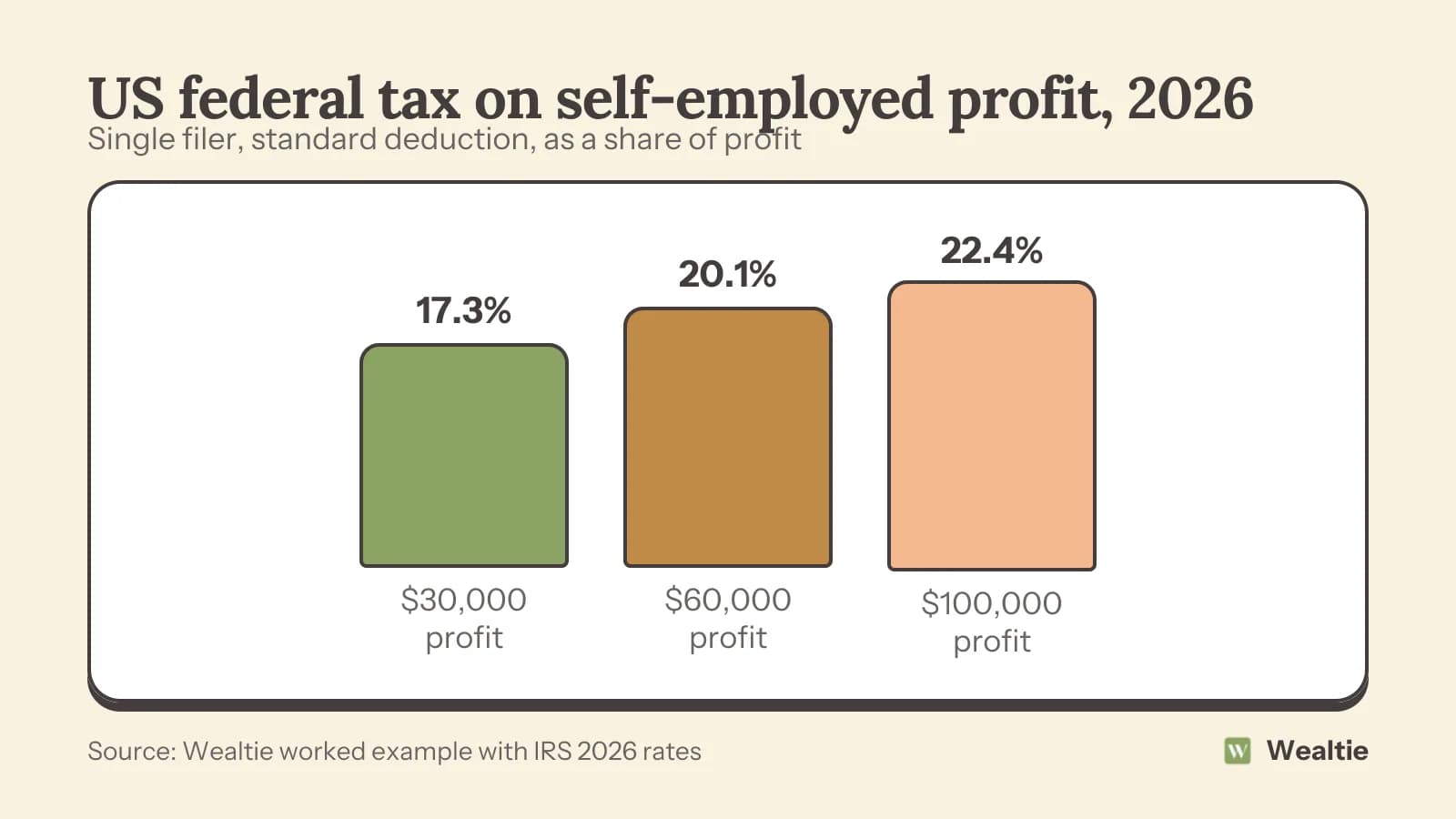
The share climbs with profit because income tax is progressive. Self-employment tax stays at roughly 14% of profit all the way up to the Social Security cap.
These are estimates for one simple case. A spouse's income, children, retirement contributions or a large deduction will move the number, so treat the table as a starting point and check it against the worksheet in Form 1040-ES once a year.
State income tax goes on top. Some states don't tax income at all; in others, add your state's rate for your income level to the percentage above. Rounding up to 25% or 30% in total covers most people in most states and leaves a small refund rather than a bill.
Why is the tax higher than on a salary?
Because you pay both halves of Social Security and Medicare. An employer pays half for its staff; when you're the business, you pay the employer's share as well.
The IRS sets the self-employment tax rate at 12.4% for Social Security and 2.9% for Medicare, 15.3% in total. A few details soften it:
- It applies to 92.35% of your net earnings, not all of them.
- You can deduct half of it when working out your adjusted gross income.
- The Social Security part stops at a yearly cap, $184,500 of earnings in 2026. Medicare has no cap.
It also starts early. You usually owe self-employment tax once your net earnings from self-employment reach $400, even if your income is too low for any income tax. That's why the $30,000 row above is mostly self-employment tax.
How does the $60,000 example add up?
Self-employment tax of $8,478 plus income tax of $3,559 makes $12,037, about 20% of the profit. The steps, using the IRS's 2026 figures:
- Self-employment tax. $60,000 × 92.35% × 15.3% = $8,478.
- Adjusted gross income. Subtract half the self-employment tax: $60,000 − $4,239 = $55,761.
- Standard deduction. The 2026 standard deduction for a single filer is $16,100, leaving $39,661.
- Qualified business income deduction. Sole proprietors can deduct up to 20% of qualified business income, limited to 20% of taxable income. Here that's 20% × $39,661 = $7,932, leaving $31,729 of taxable income.
- Income tax. 10% on the first $12,400, then 12% on the rest up to $50,400: $1,240 + $2,319 = $3,559.
Step 4 is the one people leave out, and it's worth about $950 here. Without it the estimate comes out too high, which isn't a disaster, just money you could have used sooner.
When do you pay it?
Four times a year. The IRS expects estimated tax by April 15 for January to March, June 15 for April and May, September 15 for June to August, and January 15 of the next year for September to December.
You generally have to pay estimated tax if you expect to owe $1,000 or more when you file. Miss it and you may owe a penalty, even if you end up with a refund. Most people avoid the penalty if they've paid at least 90% of this year's tax, or 100% of last year's, whichever is smaller.
The quarters aren't all three months long, which catches people out in June. If that's awkward, the IRS says you can pay weekly, every two weeks or monthly, as long as you've paid enough by the end of each quarter. Monthly payments from the money you've set aside keep the June one from arriving two months after April's with nothing put by.
How much should you set aside in the UK?
About 15% of a £30,000 profit and 23% of £60,000 for the 2026/27 tax year, counting Income Tax and Class 4 National Insurance.
- Income Tax: nothing on the first £12,570, 20% up to £50,270 and 40% above that.
- Class 4 National Insurance: 6% on profits between £12,570 and £50,270, and 2% above. With profits of £7,105 or more, Class 2 is treated as paid, so there's nothing extra to pay for it.
| Profit, 2026/27 | Income Tax | Class 4 NI | Total | Share of profit | Set aside a month |
|---|---|---|---|---|---|
| £30,000 | £3,486 | £1,046 | £4,532 | 15% | £378 |
| £40,000 | £5,486 | £1,646 | £7,132 | 18% | £594 |
| £60,000 | £11,432 | £2,457 | £13,889 | 23% | £1,157 |
How do you keep the tax money from getting spent?
Move your tax percentage into a separate savings account the day each payment arrives, and treat whatever's left as your income.
A percentage per payment works better than a monthly amount when income jumps around. A 4,000 month puts 1,000 aside at 25%; a 1,000 month puts 250 aside. You never have to remember what you owe for the year so far, because the account already holds it.
Then pay the quarterly bills from that account and nothing else. If it ends the year with money left, that's a cushion for next year's first quarter, or the start of a sinking fund for the costs of running the business.
To see it in one place, use an income tracker that keeps the tax account next to your spending money. In Wealtie you can keep the tax pot as its own account (the Free plan includes 2 accounts), and moving money into it is a transfer, so it doesn't show up as spending. Set a monthly income goal after tax, and your budget only ever works with money that's yours.
If your income varies a lot from month to month, the rest of the plan is in the irregular income budget guide: a baseline month, a buffer, and what to do with the good months.
Questions people ask
Set aside 20% to 25% of your profit for federal tax, plus your state's income tax. For a single filer in 2026, federal tax comes to about 17% of a $30,000 profit, 20% of $60,000 and 22% of $100,000.
For most single filers with profits under about $100,000, yes. Federal tax in 2026 comes to 17% to 22% of profit at those levels, which leaves room for state income tax inside 30%.
Yes. The IRS says you can pay estimated tax weekly, every two weeks or monthly, as long as you've paid enough by the end of each quarter's due date.
No, you usually only pay self-employment tax once your net earnings from self-employment are $400 or more. You may still need to file a return for other reasons.
You may owe a penalty for underpayment, even if you're due a refund when you file. Most people avoid it by owing less than $1,000, or by paying at least 90% of this year's tax or 100% of last year's during the year.
Sources
- Topic no. 554, Self-employment tax · Internal Revenue Service · checked 13 October 2026
- IRS releases tax inflation adjustments for tax year 2026, including amendments from the One, Big, Beautiful Bill (IR-2025-103) · Internal Revenue Service · checked 13 October 2026
- Qualified business income deduction · Internal Revenue Service · checked 13 October 2026
- Estimated taxes · Internal Revenue Service · checked 13 October 2026
- Estimated tax: Individuals 2 (when to pay estimated tax) · Internal Revenue Service · checked 13 October 2026
- Contribution and benefit base · Social Security Administration · checked 13 October 2026
- Income Tax rates and Personal Allowances · HM Revenue & Customs (GOV.UK) · checked 13 October 2026
- Self-employed National Insurance rates · HM Revenue & Customs (GOV.UK) · checked 13 October 2026
- Understand your Self Assessment tax bill: payments on account · HM Revenue & Customs (GOV.UK) · checked 13 October 2026
This article is general information, not financial, tax or legal advice. Your situation is your own; check the numbers that apply to you before you act on them.