Money as a couple: Saving for a goal together when you earn different amounts
Saving for a goal together starts with a target, a date and a monthly amount you both agree on. When you earn different amounts, contributing the same share of each income, rather than the same sum, keeps the goal fair. Keep the money in its own account and agree upfront what happens to it if plans change.
 By Wealtie Team · 3 min read
Key takeaways
- Agree three things before saving: the target, the date, and the monthly amount that gets you there.
- Equal contributions are simplest; contributions by income take the same share of each person's pay, which is fairer when incomes differ.
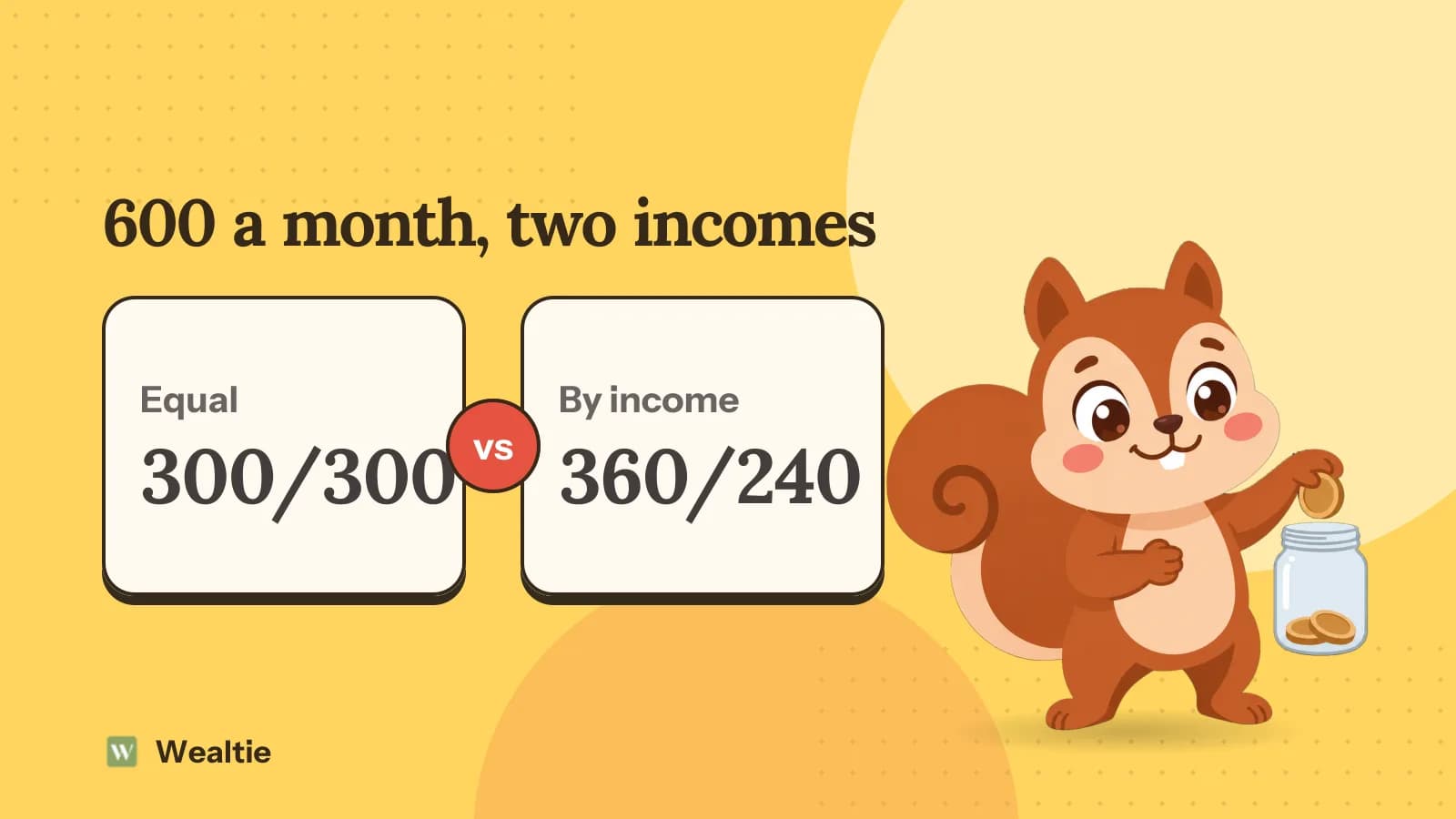
- On 3,600 and 2,400 of take-home pay, a 600 monthly goal split by income is 360 and 240, 10% of each income.
- Keep shared savings in a separate account, joint or in one name with a written agreement, so it's not mixed with everyday money.
- Agree in advance what happens to the money if the plan changes or the relationship ends: usually each person takes back what they put in.
Saving for a goal together: where do you start?
Agree the target, the date and the monthly amount first. Then decide how to split the monthly amount, where the money lives, and what happens if the plan changes.
Shared goals fail in the details. One person thought the holiday was 3,000, the other 5,000. One moved their share on payday, the other "when there's something left". Ten minutes agreeing the numbers at the start saves a year of quiet resentment.
What should you agree before you start saving?
Three numbers, written down: the target, the date, and the monthly amount.
Here's a worked example in round numbers, the same in any currency. A couple wants 7,200 for a deposit top-up in 12 months. That's 600 a month. (Interest would help a little; it's left out to keep the numbers simple.)
If 600 a month doesn't fit, change the target or the date before you start, not three months in. 7,200 in 18 months is 400 a month. Both are valid plans; only one of them fits your budget.
It also helps to agree what the goal is for, in a sentence. "A deposit for a two-bedroom flat by next spring" settles arguments later that "saving for a house" doesn't, because you both know what you're giving up the takeaway for.
Should you split savings equally or by income?
Equally if you earn about the same. By income if you don't, so the goal takes the same share of each person's pay.
Continuing the example, one partner takes home 3,600 a month and the other 2,400.
| Split | Partner A (3,600) | Partner B (2,400) | Share of A's pay | Share of B's pay |
|---|---|---|---|---|
| Equal | 300 | 300 | 8.3% | 12.5% |
| By income (60/40) | 360 | 240 | 10% | 10% |
On equal shares, the lower earner gives up half again as much of their pay. By income, both give 10%. The by-income split is usually the fairer one, but the right answer is the one you both think is fair, said out loud. The same choice comes up with shared bills; how to split bills as a couple compares the options with a worked example.
Where should shared savings be kept?
In a separate savings account that both of you can see, funded by both contributions on payday.
A joint savings account is the simplest version: both pay in, both can see the balance. If you'd rather not open a joint account, one person can hold the savings in their own name, with a written note of who has paid in what. Either way, keep it separate from everyday accounts, so the deposit money doesn't quietly pay for groceries. Should couples have joint bank accounts covers the setups and what changes legally when an account is in both names.
What if one of you can't pay in one month?
Agree in advance: either the other covers it and it's evened out later, or the goal's date moves back a month. Both are fine; deciding on the day is not.
Keep a personal emergency fund each, so one person's car repair doesn't come out of the shared goal. How much should be in an emergency fund explains the first target.
What happens to shared savings if plans change?
Whatever you wrote down at the start. The usual rule is that each person takes back what they put in, plus their share of any interest.
It feels unromantic to agree on this when you're planning a holiday or a home. That's exactly why it's easy then and hard later. Two sentences on a note is enough: who's paid in what, and how it's split if the goal is dropped or the relationship ends.
How do you keep both of you on track?
Check the balance together once a month, in the same few minutes you'd spend on any money check-in. Celebrate the halfway point; it's the part that keeps a 12-month goal alive.
Wealtie's shared accounts let you both see the same balance, with pooled or per-person balances, so each contribution is visible and the "who's paid in what" note keeps itself. The account owner needs Pro to invite; the person who accepts can be on any plan, Free included. Each of you keeps your own accounts private, and a monthly budget on each side makes sure the contribution comes out first.
Questions people ask
Agree the target, the date and the monthly amount, then decide how to split it: equally or by income. Keep the money in a separate account and move both contributions on payday.
Equal works when incomes are close. When one earns noticeably more, contributing the same percentage of each income is fairer: on 3,600 and 2,400, a 600 goal is 360 and 240.
A joint account makes shared savings visible to both of you and easy to fund. If you'd rather not, one person can hold it with a written note of who has paid in what.
Whatever you agreed in advance. A common rule is that each person takes back what they contributed, plus their share of interest. Write it down when you start, while it's easy to talk about.
Fund the shared goal first with an agreed amount, then each person saves for personal goals from what's left. Keeping personal goals separate avoids arguments about whose priority comes first.
This article is general information, not financial, tax or legal advice. Your situation is your own; check the numbers that apply to you before you act on them.