Money as a couple: Moving in together budget: the money conversation, in order
A moving in together budget has two parts: the one-off cost of the move, and the monthly costs you'll share once you're in. Agree both before you sign the lease, in that order, and decide how you'll split them and what each of you keeps separate.
 By Wealtie Team · 3 min read

Key takeaways
- Budget the move itself separately from the monthly costs: deposit, van, furniture and setup fees can add up to more than a month's rent.
- List every shared monthly cost before you agree on a rent you can both afford, not after.
- Splitting by income keeps the shared bills the same share of each person's pay; 50/50 is simpler but can squeeze the lower earner.
- Agree what stays separate, such as personal spending, old debts and savings goals, so a shared budget doesn't mean shared everything.
- Review the split after three months, when you know what the shared bills actually come to.
What should a moving in together budget cover?
Two things: what the move costs once, and what living together costs every month. Budget them separately, because they come out of different money.
The one-off costs usually come from savings. The monthly costs come from pay. Mixing them is how a couple ends up paying for a new sofa out of the grocery money in month two.
Have the conversation before you sign a lease. The rent you can afford depends on the other shared bills and on how you split them, and you can't change the rent after signing.
What does the move itself cost?
The deposit, the first month's rent, moving, furniture and setup fees. Together they can come to more than two months' rent.
Here's a worked example in round numbers, the same in any currency, for a flat at 1,800 a month:
| One-off cost | Amount |
|---|---|
| First month's rent | 1,800 |
| Deposit | 1,800 |
| Van or movers | 500 |
| Furniture and household basics | 1,000 |
| Connection and setup fees (internet, utilities) | 250 |
| Total | 5,350 |
Deposits are often a month's rent or more, and the law sets a maximum in many places, so check yours. If you're both leaving a flat, your old deposits come back, but often weeks after you've moved, so don't count on them for the new one.
Decide how you'll split the one-off costs before anyone pays. Furniture is the awkward line: if one of you buys the sofa, whose is it if you split up? Either split furniture the same way as the rent, or agree that whoever pays for an item keeps it.
Which monthly costs will you share?
Everything you both use: rent, utilities, internet, council tax or local taxes, insurance on the home, groceries and household items. List them all before agreeing on a rent.
Continuing the example:
| Shared monthly cost | Amount |
|---|---|
| Rent | 1,800 |
| Energy and water | 200 |
| Internet | 50 |
| Contents insurance | 30 |
| Groceries | 600 |
| Household items | 70 |
| Shared subscriptions | 50 |
| Total | 2,800 |
Groceries for two vary a lot. How much to spend on groceries has USDA's monthly figures for a couple if you want a starting number. To see whether 2,800 fits next to everything else you pay, put your combined take-home pay into the budget calculator.
Leave out costs that belong to one person: your own phone, your car, your gym, your old student loan. Those are what the "what stays separate" part of the conversation is for.
How should you split shared costs?
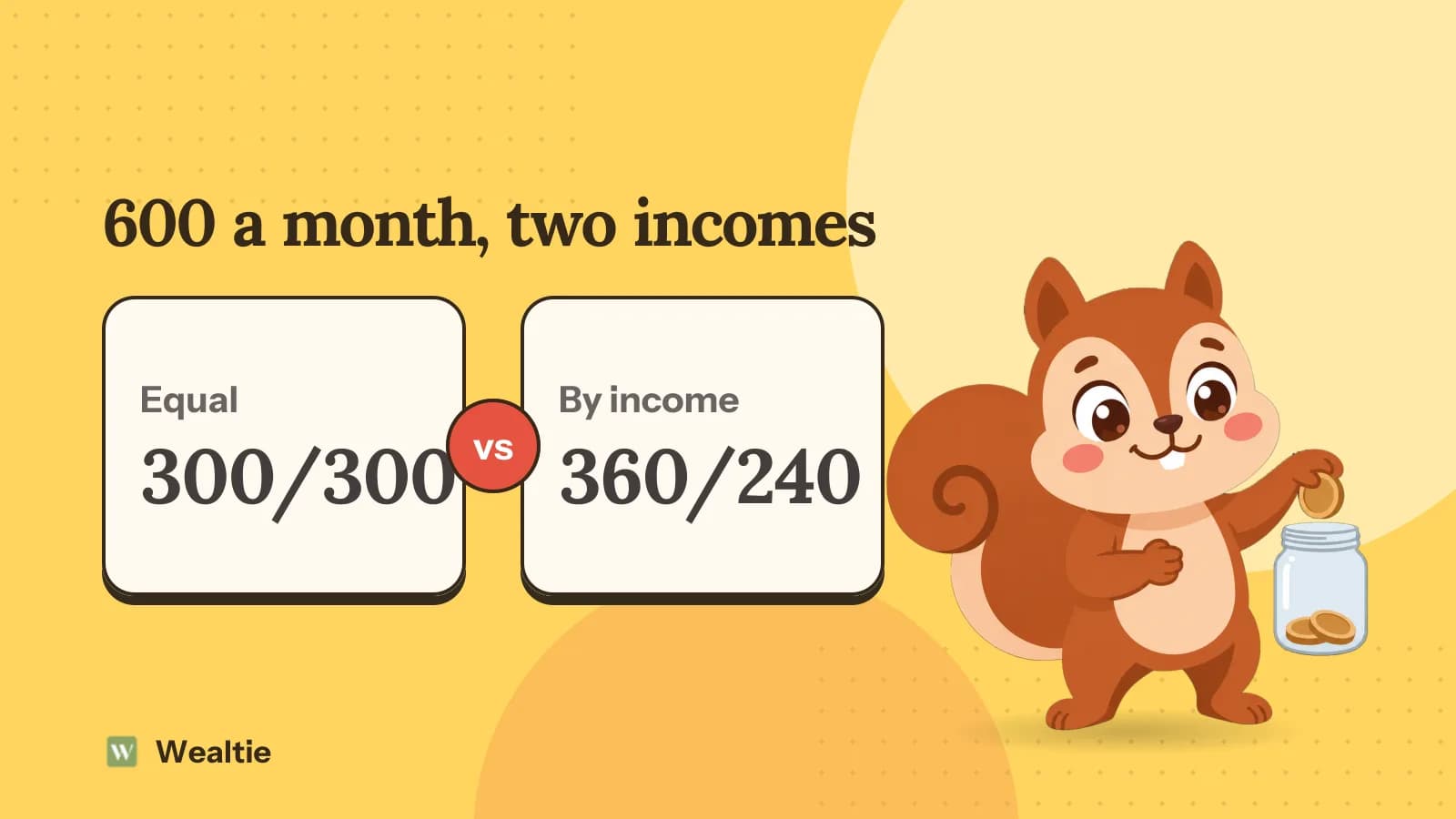
50/50 if you earn about the same; by income if you don't. Both are fair; they're fair in different ways.
Say one of you takes home 3,200 a month and the other 2,400, 5,600 between you. The shared costs are 2,800.
| Split | Earns 3,200 pays | Earns 2,400 pays | Left for the first | Left for the second |
|---|---|---|---|---|
| 50/50 | 1,400 | 1,400 | 1,800 | 1,000 |
| By income (57% / 43%) | 1,600 | 1,200 | 1,600 | 1,200 |
On 50/50, the shared bills take 44% of one person's pay and 58% of the other's. By income, both pay half of what they earn. Neither is wrong, but if one of you would be left with 1,000 a month for everything else, 50/50 will feel tight within weeks.
The full comparison, including pooling all your income, is in how to split bills as a couple.
Do you need a joint account?
No, not to start. One person can pay the shared bills and the other can transfer their share on payday. A joint account helps once there are several bills and you're tired of the transfers.
If you do open one, a common setup is that both pay their agreed share into it each month, and the shared bills come out of it. Personal spending stays in your own accounts. Should couples have joint bank accounts goes through the setups, and what changes legally when an account is in both names.
What should stay separate?
Personal spending, debts from before you met and your own savings goals. A shared budget doesn't mean a shared everything.
Agree a rough amount each of you spends without checking with the other. It removes the arguments about the second coffee and the new trainers. Talk about debts openly, including the amounts, but they stay with the person who took them on unless you both decide otherwise.
Savings can be both: a shared goal like a holiday or a deposit, and personal savings that are nobody else's business.
When should you review the budget?
After three months. By then you'll know what the energy bill comes to, what groceries for two cost, and whether the split feels fair.
Look at the shared total against what you planned, and at what each person has left. If one of you keeps running short, change the split before it turns into resentment. Then review again whenever either income changes.
Wealtie's shared accounts are built for this. One account holds the shared bills, with pooled or per-person balances and expenses split to the cent, and each person keeps their own accounts private. The account owner needs Pro to invite; the person who accepts can be on any plan, Free included. Each of you can keep a personal monthly budget alongside it, and Budget Health warns you mid-month if your spending pace will take you over.
Questions people ask
Add up the one-off cost of the move, then list every monthly cost you'll share and agree how to split it. Do both before you sign a lease, so the rent fits what you can both pay.
50/50 works when you earn about the same. When one earns noticeably more, splitting by income keeps the rent the same share of each person's pay. On 3,200 and 2,400, that's 57% and 43%.
Enough for the deposit, the move and anything you'll need to buy, plus the first month's rent. In the example in this post, that comes to 5,350, split between two people.
You don't need one to start. A joint account helps once you have several shared bills; until then, one person paying and the other transferring their share works. Agree on the split first.
Personal spending, debts taken on before you met and individual savings goals usually stay separate. Shared costs are the ones you both use: rent, utilities, internet, groceries and household items.
This article is general information, not financial, tax or legal advice. Your situation is your own; check the numbers that apply to you before you act on them.