Income & freelancing: Quarterly estimated taxes: the 2027 due dates and how to budget them
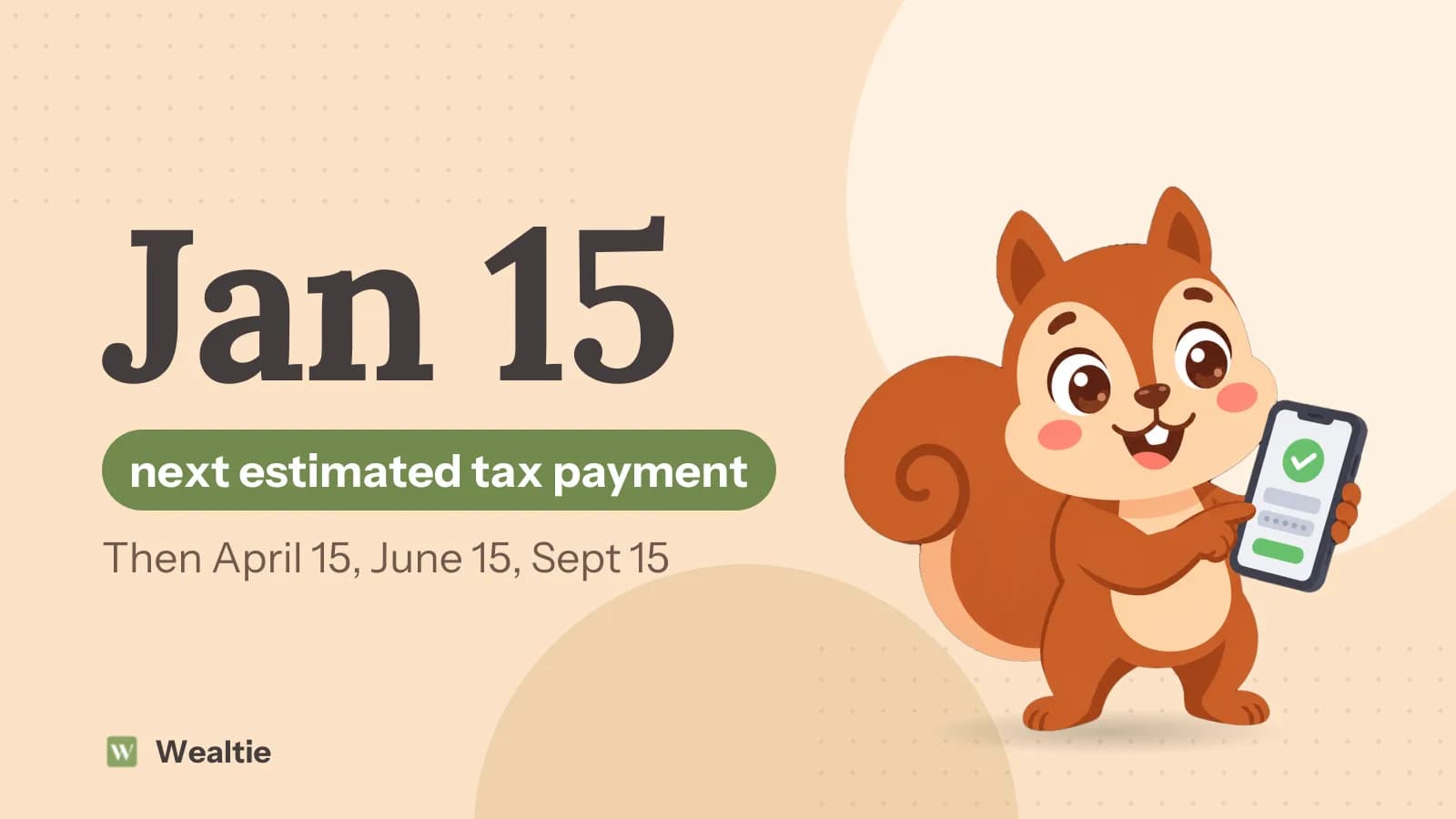
Quarterly estimated taxes are what freelancers and others without enough withholding pay the IRS during the year. You generally have to pay if you expect to owe $1,000 or more. The next due date is January 15, 2027, for income earned from September to December 2026.
 By Wealtie Team · 3 min read
Key takeaways
- You generally have to pay quarterly estimated taxes if you expect to owe $1,000 or more when you file, for example from self-employment income.
- The due dates are April 15, June 15, September 15 and January 15 of the following year; the next one is January 15, 2027.
- Most people avoid the underpayment penalty by paying at least 90% of this year's tax or 100% of last year's, whichever is smaller; higher earners have a stricter rule.
- The IRS lets you pay weekly or monthly instead, as long as enough is paid by the end of each quarter.
- Setting the money aside from every payment you receive, in a separate account, means each due date is a transfer, not a scramble.
What are quarterly estimated taxes?
Tax you pay the IRS during the year on income that has no tax taken out of it. Employers withhold tax from wages; nobody does that for freelance invoices, side-business profits or large investment income. The IRS expects that tax as you earn it, not in one go the following April.
The IRS's estimated taxes guidance says estimated tax covers income tax and other taxes, including self-employment tax, which is Social Security and Medicare for people who work for themselves.
Who has to pay quarterly estimated taxes?
Generally, anyone who expects to owe $1,000 or more when they file, after withholding and credits. That's most self-employed people and freelancers with a steady client base, and people with large side income, interest, dividends or capital gains.
If you also have a job, there's another route: ask your employer to withhold more by filing a new Form W-4. Extra withholding from your pay counts towards the same tax, and it can replace estimated payments entirely.
If you owed no tax at all last year, were a US citizen or resident for the whole year and the year covered 12 months, you don't have to pay estimated tax this year.
When are quarterly estimated taxes due?
Four times a year, though the periods aren't equal quarters. From the IRS's due-date FAQ:
| Income earned | Payment due |
|---|---|
| January 1 to March 31 | April 15 |
| April 1 to May 31 | June 15 |
| June 1 to August 31 | September 15 |
| September 1 to December 31 | January 15 of the next year |
The next payment is due on January 15, 2027, for income earned from September to December 2026. If a due date falls on a weekend or a public holiday, the payment is on time on the next business day.
The second payment covers only two months and comes two months after the first, so June is often the tightest. Plan for it.
How do you avoid the underpayment penalty?
Pay enough, on time, each quarter. The IRS says most people avoid the penalty if they:
- owe less than $1,000 after withholding and credits, or
- paid at least 90% of this year's tax, or
- paid 100% of last year's tax,
whichever of the last two is smaller. Higher earners have a stricter version of the last test; Publication 505 explains it.
Here's a worked example. Your tax last year was $6,000. This year you expect $8,000. Paying $1,500 a quarter, a quarter of last year's tax, meets the 100% test, so there's no penalty even though you'll still owe $2,000 when you file. Paying $2,000 a quarter covers this year in full.
A penalty can apply to a late payment even if you end up due a refund. If you miss a date, pay as soon as you can.
Can you pay estimated taxes monthly?
Yes. The IRS says you can pay weekly, every two weeks or monthly, as long as enough is paid by the end of each quarter. For freelancers, monthly payments often fit better: $8,000 a year is about $667 a month instead of $2,000 four times a year.
You can pay online, by phone, through the IRS app or your IRS online account, or by mail with Form 1040-ES.
How do you budget for quarterly taxes?
Set the tax aside from every payment you receive, the day it arrives, in a separate account.
If you set aside 25% of each invoice, a $3,000 payment puts $750 in the tax account straight away. The money for January 15 is then already there in January. How much to set aside for taxes when you're self-employed works out the right percentage at different profit levels.
Treat the tax account as off-limits. It isn't savings, and it isn't a buffer for a slow month; that's what a separate buffer is for.
What's the UK equivalent?
Payments on account. If you're in Self Assessment and owed £1,000 or more last year, you usually make two advance payments, by 31 January and 31 July, each half of last year's tax, with any balance due the following 31 January. GOV.UK's payments on account guide explains the exemptions.
How do you keep track of tax payments?
In Wealtie, add a tax savings account to your accounts, and log the set-aside after each invoice as a transfer, so it doesn't count as spending. Set each due date as a recurring transaction so the payment shows in your monthly budget before it lands.
Questions people ask
April 15, June 15, September 15 and January 15 of the following year. If a date falls on a weekend or holiday, the payment is on time on the next business day. The next one is January 15, 2027.
Generally, individuals who expect to owe $1,000 or more in tax when they file, after withholding and credits. That usually means self-employed people, freelancers and people with large investment or side income.
Pay at least 90% of this year's tax or 100% of last year's tax, whichever is smaller, through withholding and estimated payments, on time each quarter. Higher earners have a stricter rule, explained in IRS Publication 505.
Yes. The IRS says you can pay weekly, every two weeks or monthly, as long as you've paid enough by the end of each quarter.
Pay as soon as you can. The penalty is worked out on the amount that was late and for how long, so paying sooner keeps it smaller.
Sources
- Estimated taxes · Internal Revenue Service · checked 6 November 2026
- When are quarterly estimated tax payments due? · Internal Revenue Service · checked 6 November 2026
- Understand your Self Assessment tax bill: payments on account · GOV.UK · checked 6 November 2026
This article is general information, not financial, tax or legal advice. Your situation is your own; check the numbers that apply to you before you act on them.