Income & freelancing: How to measure income stability: put a number on uneven pay
To measure income stability, take your last 12 months of income and work out three numbers: the lowest normal month, the average, and how far a typical month strays from the average. The smaller that spread, the steadier your income, and the less you need in a buffer to budget on it.
 By Wealtie Team · 3 min read
Key takeaways
- Income stability is how much your monthly income changes from one month to the next, measured over at least 12 months.
- Three numbers describe it: the lowest normal month, the average month, and the typical distance from the average.
- Dividing the typical distance by the average gives a percentage you can compare over time: under 10% is steady, over 30% is very uneven.
- Budget on the lowest normal month, not the average, and use the spread to size your buffer.
- Re-measure every quarter; one new client or one lost one can change the picture quickly.
How do you measure income stability?
Take your last 12 months of income and work out three numbers: the lowest normal month, the average month, and how far a typical month strays from the average.
Income stability is how much your pay changes from month to month. A salary barely moves. Freelance, commission, gig and seasonal work can swing by half or more. Knowing how much yours swings tells you what to budget on and how big a buffer you need, which "it varies" doesn't.
Use take-home income: what reached your account after tax, or after setting tax aside if you're self-employed. Twelve months is the minimum, so a seasonal pattern shows up.
What does it look like with real numbers?
Here's a worked example in round numbers, the same in any currency. A freelancer's last 12 months:
| Month | Income | Distance from average |
|---|---|---|
| 1 | 3,200 | 200 |
| 2 | 2,100 | 900 |
| 3 | 4,000 | 1,000 |
| 4 | 2,900 | 100 |
| 5 | 3,600 | 600 |
| 6 | 1,500 | 1,500 |
| 7 | 3,100 | 100 |
| 8 | 2,700 | 300 |
| 9 | 4,400 | 1,400 |
| 10 | 2,800 | 200 |
| 11 | 3,300 | 300 |
| 12 | 2,400 | 600 |
| Total | 36,000 | 7,200 |
The three numbers:
- Average month: 36,000 ÷ 12 = 3,000.
- Typical distance from the average: 7,200 ÷ 12 = 600. Ignore whether a month was above or below; just how far it was.
- Lowest normal month: 2,100. Month 6, at 1,500, was a one-off (an illness, say), so it's noted but not used as the base. If low months like that happen every year, it becomes the base.
How do you turn that into a stability score?
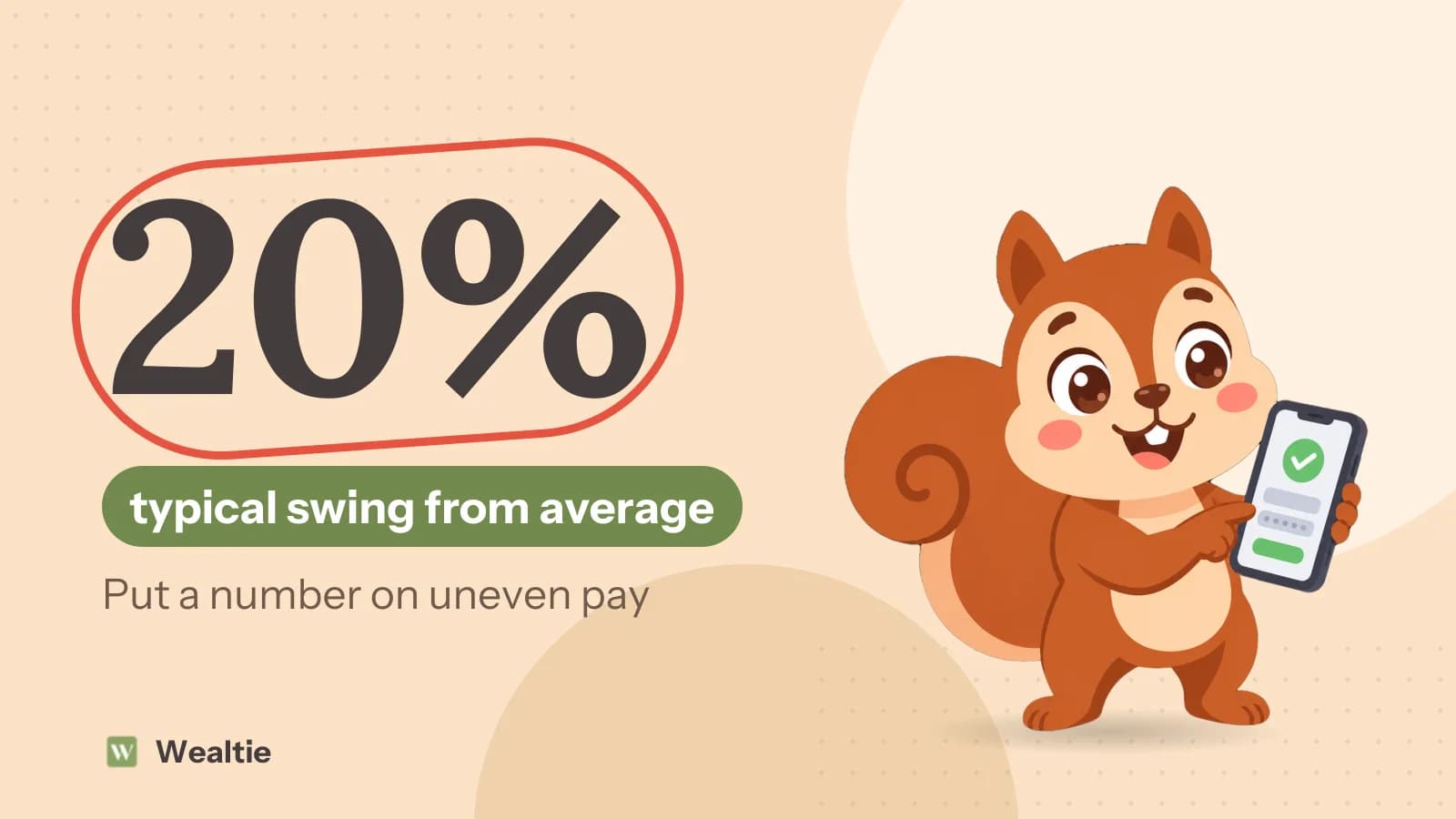
Divide the typical distance by the average: 600 ÷ 3,000 = 20%. That's the number to track over time.
| Typical distance from average | What it means |
|---|---|
| Under 10% | Steady: close to a salary with some overtime |
| 10% to 30% | Uneven: budget on the low month, keep a buffer |
| Over 30% | Very uneven: bigger buffer, pay yourself a fixed amount |
These bands are a rule of thumb, not an official scale. What matters is your own number moving over time. If it drops from 20% to 12% over a year, your income is getting steadier, even if the average hasn't changed.
Statisticians would use the standard deviation instead of the simple average distance. It gives a similar picture and takes a spreadsheet. The simple version can be done on paper, which is the point.
How do you budget with uneven income?
Budget on the lowest normal month, not the average. In the example, that's 2,100.
Every payment goes into a holding account first. On the 1st, you pay yourself 2,100 into your everyday account. Good months leave a surplus in the holding account; bad months draw it down. How to budget on irregular income sets the whole system up step by step, and how to pay yourself a salary when self-employed covers the fixed-salary side.
If your spending can't fit in 2,100, you'll need to budget nearer the average, and the buffer has to be bigger to make up for it.
How big a buffer does unstable income need?
At least three times the gap between your average and your lowest normal month. In the example: (3,000 − 2,100) × 3 = 2,700.
For very uneven income, over 30%, aim for three months of full spending instead. The buffer is what lets you pay yourself the same amount every month, whatever the month brings. How much should be in an emergency fund covers the separate pot for real emergencies.
How do you make income steadier?
Spread it across more sources, and smooth the timing where you can.
- Retainers and monthly contracts instead of one-off projects.
- Invoicing on a schedule, not when the work finishes.
- No single client above a third of your income, if you can manage it.
- Plan for seasonal dips by saving harder in the months before them.
Look at which months pulled the score up. In the example, months 6 and 9 account for nearly 3,000 of the 7,200 total distance: one very bad month and one very good one. Smoothing just those two, by spreading the big project's invoice over two months and keeping a small buffer for illness, would bring the score down from 20% to about 15% without earning a penny more.
How do you track income stability over time?
Re-measure every quarter, on the last 12 months. One new client, or one lost one, changes the picture.
Wealtie's income tracker on Pro does this for you: income by source, a stability score and a projection of the months ahead, so you can see which client or platform makes your income uneven. On the Free plan, a monthly income goal next to your budget shows each month against your target, and spending analytics show month against month.
Questions people ask
List 12 months of income, find the lowest normal month and the average, then work out how far a typical month is from the average. Divide that by the average to get a percentage: the lower, the steadier.
A typical month within 10% of the average is steady, about what salaried pay with some overtime looks like. Between 10% and 30% is uneven; over 30% is very uneven and needs a bigger buffer.
Budget on your lowest normal month, send every payment to a holding account, and pay yourself that amount each month. Surplus in good months fills a buffer for bad ones.
At least the gap between your average and your lowest normal month, times three. For very uneven income, aim for three months of full spending.
Every quarter, on the last 12 months. A new client, a lost contract or a seasonal pattern can change it quickly, and the budget should follow.
This article is general information, not financial, tax or legal advice. Your situation is your own; check the numbers that apply to you before you act on them.