Income & freelancing: How to pay yourself a salary when you're self-employed
To pay yourself a salary when self-employed, let client payments land in a business account and move the same amount to your personal account on the same day each month. Set that amount a little under your average month, and hold two months of it as a buffer before you start.
 By Wealtie Team · 4 min read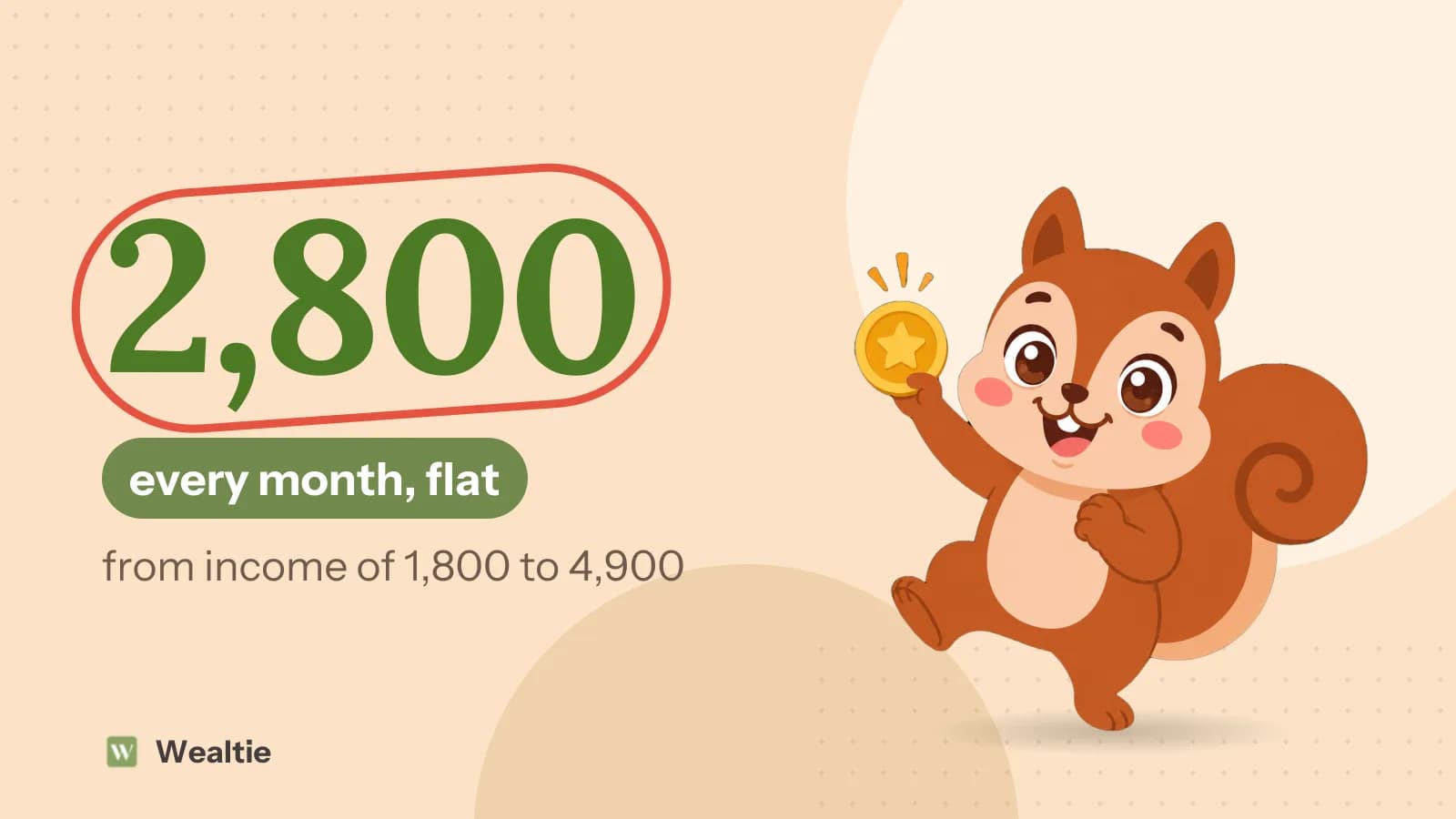
Key takeaways
- A self-employed salary is a fixed transfer from your business account to your personal account on the same date each month.
- Set it at about 90% of your average month after setting tax aside, rounded down: on an average of 3,083, that's 2,800.
- Hold two months of salary in the business account before the first payment; in the worked example the buffer never fell below 4,700.
- Cut the salary if the buffer drops under one month of it, and move anything above three months to savings.
- For a sole proprietor or sole trader, the salary isn't a business expense: the IRS and HMRC tax the profit, not what you take out.
What does paying yourself a salary mean when you're self-employed?
It means separating the money the business earns from the money you live on, with one fixed transfer between them each month. Client payments go into a business account. On the 1st, or whichever day you pick, the same amount moves to your personal account, and you budget on that amount as if it were a payslip.
The point is the fixed amount. Freelance income is uneven, and in the Federal Reserve's 2025 survey, 58% of self-employed adults said their income varied from month to month, and 22% struggled to pay their bills because of it. A salary moves the unevenness into the business account, where a buffer can absorb it, and leaves your rent and groceries with a number that doesn't change.
Is the salary a business expense?
No, not if you're a sole proprietor in the US or a sole trader in the UK. The salary is your share of the profit, and it's the profit that gets taxed.
The IRS puts it plainly in Publication 334: "You can't deduct your own salary or any personal withdrawals you make from your business. As a sole proprietor, you are not an employee of the business." HMRC's guidance on expenses says the same for sole traders: "Allowable expenses do not include money taken from your business for personal use."
So set tax aside before you work out the salary, not after. How much to set aside for taxes when you're self-employed has the 2026 rates. If you trade through a company, such as a US LLC taxed as an S corporation or a UK limited company, salary and dividends have tax rules of their own; this post covers the cash flow, which works the same way either way.
How much should you pay yourself?
Pay yourself about 90% of your average month after tax set-aside, rounded down. The 10% gap is what lets the buffer grow in an ordinary year instead of only holding steady.
Here's a year of income after setting tax aside, in round numbers that work in any currency:
| Month | Income | Month | Income |
|---|---|---|---|
| Jan | 2,800 | Jul | 2,400 |
| Feb | 1,900 | Aug | 1,800 |
| Mar | 3,100 | Sep | 3,300 |
| Apr | 4,600 | Oct | 4,900 |
| May | 2,200 | Nov | 3,700 |
| Jun | 3,800 | Dec | 2,500 |
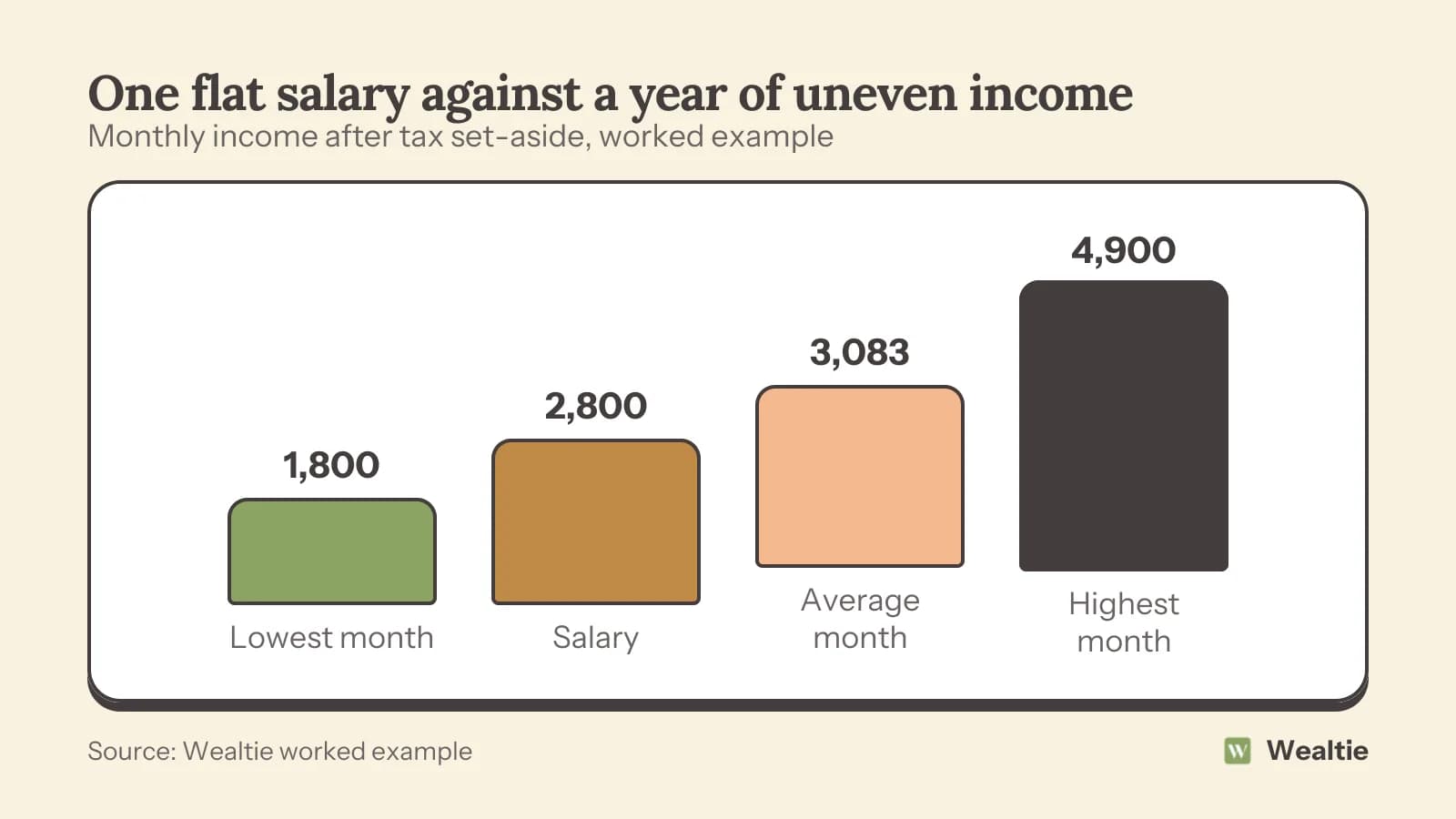
The year comes to 37,000, an average of 3,083 a month. 90% of that is 2,775; rounded to 2,800, that's the salary. Half the months came in under the average, which is normal: a few big months pull it up.
If you have less than a year of history, use what you have and round down harder, to 80% of the average. If you have none, start with what your essential costs need, and treat the first few months as the history.
How big a buffer do you need before you start?
Two months of salary, sitting in the business account before the first payment. On 2,800 that's 5,600.
Here's the same year with a 2,800 salary and a 5,600 starting buffer:
| Month | Income | Salary paid | Buffer at month end |
|---|---|---|---|
| Jan | 2,800 | 2,800 | 5,600 |
| Feb | 1,900 | 2,800 | 4,700 |
| Mar | 3,100 | 2,800 | 5,000 |
| Apr | 4,600 | 2,800 | 6,800 |
| May | 2,200 | 2,800 | 6,200 |
| Jun | 3,800 | 2,800 | 7,200 |
| Jul | 2,400 | 2,800 | 6,800 |
| Aug | 1,800 | 2,800 | 5,800 |
| Sep | 3,300 | 2,800 | 6,300 |
| Oct | 4,900 | 2,800 | 8,400 |
| Nov | 3,700 | 2,800 | 9,300 |
| Dec | 2,500 | 2,800 | 9,000 |
The lowest point is 4,700 in February, still well over a month of salary. The salary arrived in full every month, including August, when the business brought in 1,800.
Building the first 5,600 is the slow part. Until it's there, pay yourself what essential costs need and leave the rest in the business account. The method is the same one behind the guide to how to budget on irregular income.
What do you do in a bad month or a great one?
Use two thresholds and change the salary only when the buffer crosses one of them, not when a single month is good or bad.
- Buffer under one month of salary: cut the salary by about 10% and keep it there until the buffer is back over two months. Three months of 1,800 in a row would take 3,000 out of the starting buffer and leave 2,600, just under one month of salary. That's the point to cut.
- Buffer over three months of salary: move the excess out. In the example that happens in October, when the buffer reaches 8,400. Anything above that can go to savings, toward the emergency fund, or into a one-off payment to yourself.
Review the salary itself once a year, with twelve new months of history. A raise you can see in a year of numbers is safer than one based on a good quarter.
How to run a salary in Wealtie
Set up two accounts, one for the business and one for personal money, and record the monthly salary as a transfer between them. The Free plan includes two accounts, and transfers between your accounts don't count as spending, so the salary doesn't touch your budget twice.
Log client payments as income into the business account, and your everyday spending against the personal account. A monthly budget on the personal side then works on the salary, and the business account's balance is your buffer. The income tracker page covers the income side: a monthly income goal is free, and Pro adds income analytics with sources, a stability score and a projection. The accounts and net worth page shows how both accounts add up to one total.
Questions people ask
Pay yourself about 90% of your average monthly income after setting tax aside, rounded down. On an average of 3,083 a month, that's a salary of 2,800, with the difference building up a buffer.
No, a sole proprietor can't deduct their own salary or withdrawals; the IRS taxes the business profit instead. HMRC treats money a sole trader takes out for personal use the same way.
Once a month on a fixed date is the simplest, because most bills are monthly. Pay yourself every two weeks if your main costs are weekly or fortnightly.
Keep at least two months of your salary in the business account as a buffer, after money set aside for tax. Cut the salary if it drops under one month, and move money out if it goes over three.
Yes, a fixed amount is what makes a salary useful: your personal budget can rely on it. Change it only when the buffer crosses a threshold, or at a yearly review.
Sources
- Economic Well-Being of U.S. Households in 2025: Income and Expenses · Board of Governors of the Federal Reserve System · checked 17 October 2026
- Publication 334, Tax Guide for Small Business (for use in preparing 2025 returns) · Internal Revenue Service · checked 17 October 2026
- Expenses if you're self-employed · GOV.UK (HM Revenue & Customs) · checked 17 October 2026
This article is general information, not financial, tax or legal advice. Your situation is your own; check the numbers that apply to you before you act on them.