Money as a couple: How much does a prenup cost, and is it worth it?
How much does a prenup cost? It turns on how complex your finances are and whether each of you has your own lawyer, and in a worked example a straightforward agreement costs about 2,000 for the couple.
 By Wealtie Team · 3 min read

Key takeaways
- How much a prenup costs depends on the complexity of your finances and legal fees.
- In a worked example, a straightforward agreement costs about 2,000 for the couple.
- Each partner usually has their own lawyer, which adds cost but makes the agreement fairer and stronger.
- Even if you decide against a prenup, talking openly about money before marriage helps.
How much does a prenup cost?
It depends on how complex your finances are, where you live and the lawyers you use. A prenuptial agreement sets out how money, property and debts would be divided if a marriage ended. Writing one involves legal advice, drafting, negotiation and signing, and each partner usually has their own lawyer so that both are properly advised. The more there is to cover, the more it costs. Fees are often charged by the hour, so the time spent negotiating and revising drafts has a big effect on the total.
The legal status of prenups varies a lot between countries, and in some places courts treat them as a guide rather than a binding contract. Get legal advice where you live.
What affects the price?
Here's a worked example of total costs for the couple, in round numbers that work in any currency:
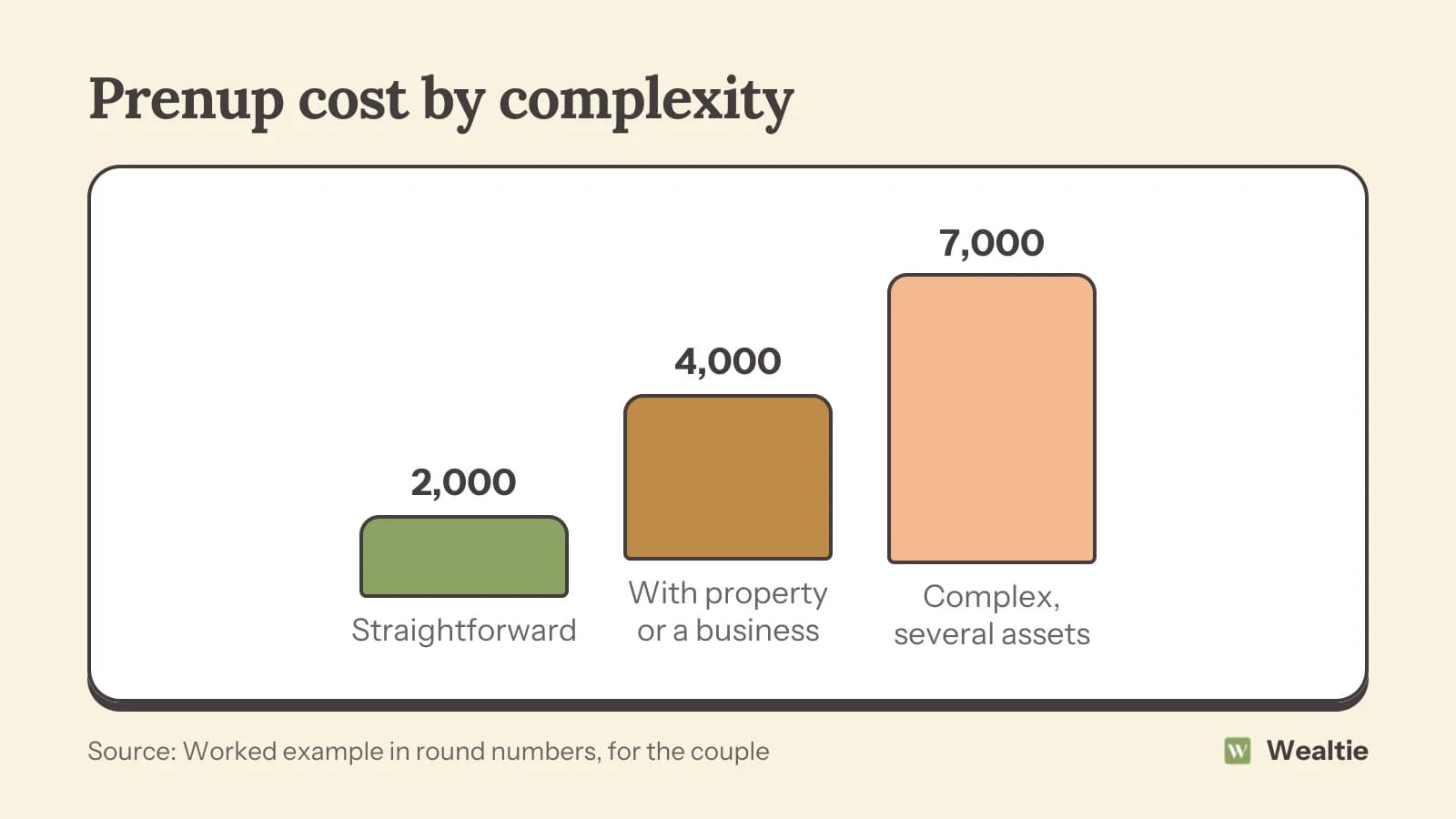
A straightforward agreement, where both partners have simple finances, costs about 2,000 in this example. One involving a home, a business or inherited assets costs more, and a complex agreement with several assets and countries can cost much more. Your own costs could be quite different.
Things that raise the cost include:
- Owning property, a business or investments
- Expected inheritances or family wealth
- Children from previous relationships
- Assets or income in more than one country
- Lots of back-and-forth negotiation
Why does each partner need a lawyer?
Separate advice helps make sure both people understand what they're signing and agree freely. In many places, an agreement is more likely to be upheld if both partners had independent legal advice and full information about each other's finances. It costs more than sharing one lawyer, but it protects you both.
Full disclosure
Most prenups require each partner to share details of their income, savings, debts and assets. Gathering these in advance, in one organised list, saves legal time and therefore money. Hiding or leaving out assets can make an agreement unenforceable, which would waste the money spent on it.
What can a prenup cover?
Commonly, a prenup covers how assets owned before marriage are treated, how property bought together would be split, responsibility for debts, and sometimes what happens to inheritances or a business. In many places, it can't decide child custody or child support, which courts decide based on the child's needs at the time. A lawyer can tell you what's possible where you live. Some couples also include how they'll manage money during the marriage, like how joint savings are built, though rules on what's enforceable vary.
Is a prenup worth it?
It can be, especially if one of you has significant assets, a business, children from a previous relationship or expected inheritances. For couples with few assets and similar finances, it may matter less. Either way, the process of discussing money openly, including debts, goals and how you'll manage finances, is valuable. Money questions to ask before marriage covers those conversations.
Timing matters
Start well before the wedding. Agreements signed in a rush, close to the date, can be seen as signed under pressure. Starting several months ahead gives time to negotiate calmly and reduces the risk of costly delays. Reviewing the agreement after big life changes, like children or a large inheritance, keeps it relevant; some couples agree in advance when they'll review it.
How do you keep the cost down?
Prepare well. Agree the main points together before you meet lawyers, gather your financial documents, and keep the agreement as simple as your situation allows. Ask for fixed-fee quotes, since some lawyers offer them for straightforward agreements. Clear, early decisions mean fewer billable hours. Some couples use a mediator to agree the main terms first, then ask lawyers to draft and check, which can cost less than negotiating through two lawyers.
How does it fit with your wedding budget?
Treat legal costs as part of getting married. If you're planning a wedding, include the prenup in your overall budget, so it doesn't come as a surprise. The wedding budget covers planning the bigger costs. After the wedding, how to combine finances after marriage helps you decide how to manage money day to day.
How do you manage money together in Wealtie?
Track your own accounts and spending in your expense categories, and set shared limits in the budget tracker. Wealtie's sharing lets you share accounts with a partner; the person who shares needs Pro, and the person invited can be on any plan.
Questions people ask
In a worked example, about 2,000 for a straightforward agreement for the couple, more with property, a business or complex assets.
Usually it's recommended, since independent advice helps make the agreement fair and more likely to be upheld.
It can be if one of you has significant assets, a business, children from a previous relationship or expected inheritances.
Several months before the wedding, so there's time to negotiate calmly.
This article is general information, not financial, tax or legal advice. Your situation is your own; check the numbers that apply to you before you act on them.