Budgeting: How much should you spend on groceries a month? 2026 numbers
For one adult, USDA's September 2026 food plans put a home-cooked grocery budget at $305 to $584 a month. For a family of four it's $1,024 to $1,682. That's how much to spend on groceries as a starting point; your last three months of receipts decide where in that range you land.
 By Wealtie Team · 6 min read
Key takeaways
- USDA's September 2026 food plans put one adult's groceries at $305 to $584 a month and a family of four's at $1,024 to $1,682, cooking every meal at home.
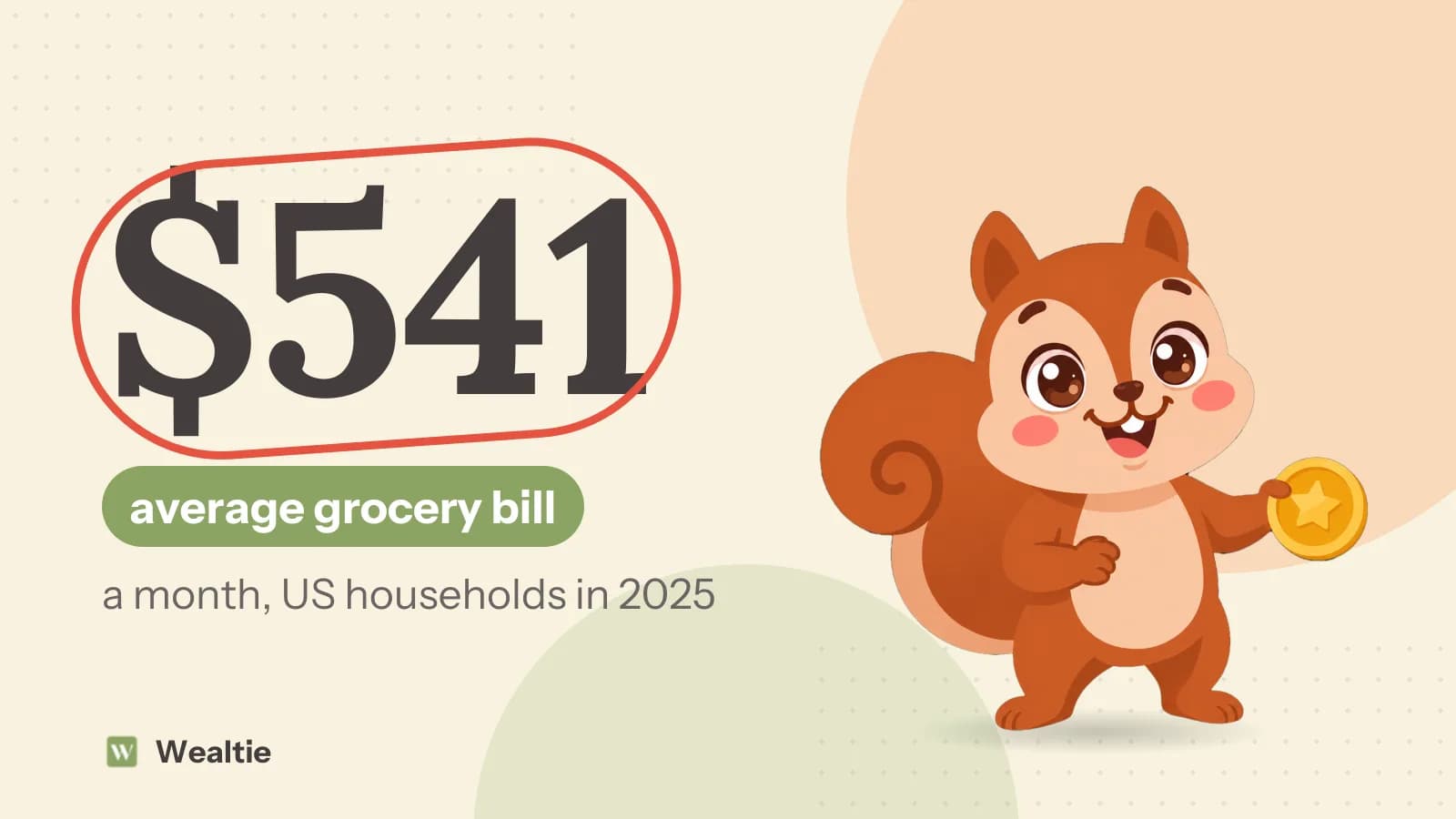
- The average US household spent $6,491 on food at home in 2025, about $541 a month, up 4.3% on 2024, according to the Bureau of Labor Statistics.
- Grocery prices in the US rose 1.8% in the 12 months to September 2026, slower than the 3.7% rise in prices overall.
- To set your own grocery budget, take the USDA figure for your household, compare it with the average of your last three months, and pick a number you'll check every week.
- A grocery budget covers food you cook at home; restaurants, takeaway and toilet paper belong in their own categories.
How much should you spend on groceries a month?
USDA puts it at $305 to $584 a month for one adult and $1,024 to $1,682 for a family of four, in its September 2026 food plans.
The U.S. Department of Agriculture prices four grocery baskets every month: thrifty, low-cost, moderate-cost and liberal. Each is a healthy diet with every meal and snack made at home. The cheaper plans lean on staples and the dearer ones buy more meat, fruit and convenience food. The thrifty plan is the one SNAP benefits are set from; the other three come out in a separate table.
Here's what each plan costs a month for common households, with USDA's adjustments for household size already applied:
| Household | Thrifty | Low-cost | Moderate | Liberal |
|---|---|---|---|---|
| One woman, 20–50 | $305 | $332 | $404 | $516 |
| One man, 20–50 | $383 | $381 | $478 | $584 |
| Couple, both 20–50 | $630 | $653 | $808 | $1,008 |
| Two adults and a child of 6–8 | $821 | $898 | $1,091 | $1,337 |
| Two adults and children of 6–8 and 9–11 | $1,024 | $1,127 | $1,389 | $1,682 |
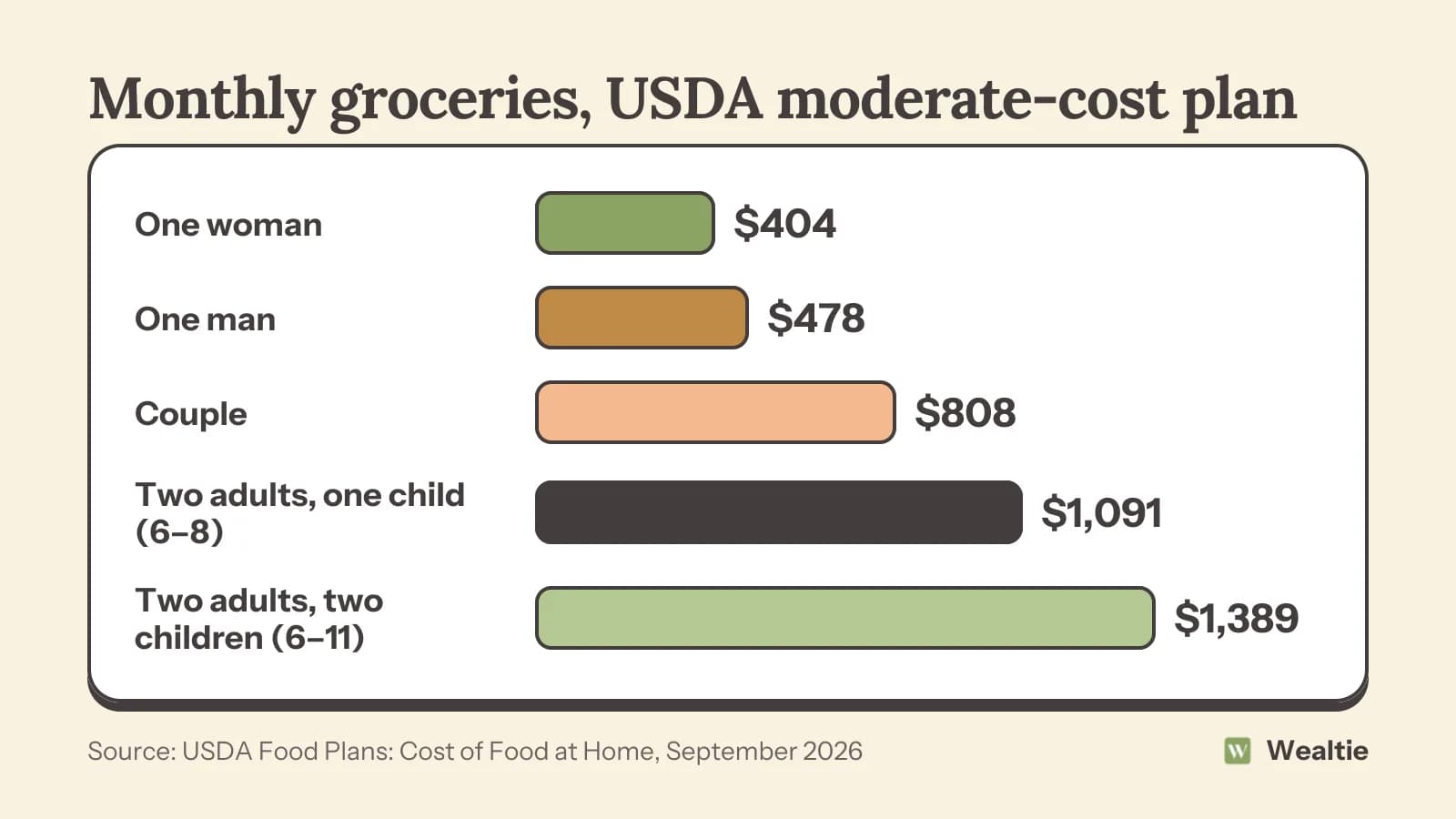
For a single man, the thrifty plan comes out $2 above the low-cost one. That's not a typo. The thrifty plan was rebuilt in 2021 from newer data; the other three still use baskets designed in the 2000s and updated for prices since. Treat the two cheapest columns as about the same.
The moderate-cost plan is a sensible first number if you don't know where to start. It assumes ordinary supermarket shopping, not coupons and not organic everything.
What's the average grocery bill?
The average US household spent $6,491 on food at home in 2025, which is $541 a month.
That's from the Bureau of Labor Statistics' Consumer Expenditure Survey for 2025, published on 29 October 2026. It was 4.3% more than in 2024. Meat, poultry, fish and eggs drove most of the rise, up 11.7% to $1,579 a year.
The same households spent another $4,142 a year on food away from home. Add the two together and food was 13.0% of everything the average household spent, the third-biggest share after housing and transport.
An average across all households mixes single people with families of five, so it's less useful for setting a budget than the USDA table. It's a good check, though. If you're one person and spending well over $541 a month on groceries, something's going into the basket that isn't food for you.
Prices are rising more slowly now. The food at home index rose 1.8% in the 12 months to September 2026 and dipped 0.1% in September itself, while prices overall rose 3.7%.
What percentage of your income should go to groceries?
There's no official percentage. On average, US households spent 5.9% of their pre-tax income on food at home in 2025.
That's $6,491 out of an average income before taxes of $110,847, by the BLS figures. A share of income looks tidy, but groceries don't scale with pay. A family of four on $4,000 a month needs roughly the same food as one on $8,000.
So set the grocery budget in dollars, then see what share of take-home pay it takes. In the 50/30/20 rule, groceries count as a need, alongside rent, bills and minimum debt payments, which together get half your take-home pay. If your grocery number plus housing already takes most of that half, the budget calculator shows what's left for the rest.
How do you set your own grocery budget?
Start from the USDA figure for your household, compare it with what you've spent in the last three months, and pick the number you'll check each week.
- Find your row in the table above. If your household isn't there, add up the per-person costs in the USDA tables and adjust for size, as in the next section.
- Pick a plan. Moderate if you're unsure. Thrifty if money is tight and you cook most meals from scratch.
- Add up your last three months. Bank statements and receipts are enough. Only count supermarket and grocery shops, not restaurants.
- Set the number. If your average is close to the USDA figure, use your average. If it's well above, aim for halfway between the two for a month and see how it goes.
- Turn it into a weekly figure. Divide by 4.33. A weekly number is the one you'll remember at the till.
Here's a worked example in round numbers; the method works the same in any currency. A couple, both in their thirties, take home 5,000 a month between them. USDA's moderate plan says $808 a month for two. Their last three months of grocery shops came to 760, 905 and 840, an average of 835. That's close to the USDA figure, so they set 840 a month, which is 194 a week, or 17% of their take-home pay.
By the 15th of the month, about 420 should be gone. If it's 560, they know with two weeks left, not on the 31st.
How do you adjust for kids and household size?
Add up the cost for each person, then adjust the total for how many people live with you. USDA's tables assume a four-person household, and smaller ones cost more per person.
USDA's adjustments:
| People in the household | Adjust the total by |
|---|---|
| 1 | +20% |
| 2 | +10% |
| 3 | +5% |
| 4 | none |
| 5 or 6 | −5% |
| 7 or more | −10% |
Children cost less than adults until they're about 12, then teenagers cost about as much as adults. A boy aged 14 to 18 is $403.50 a month on the moderate plan, more than a man aged 51 to 70. If your kids are about to hit their teens, plan for the grocery bill to go up.
For a family of five with children of 4, 9 and 14 (a boy), on the moderate plan: $336.40 + $398.40 + $221.50 + $349.70 + $403.50 = $1,709.50, minus 5% for a five-person household, is $1,624 a month.
What counts as groceries in a budget?
Food and drink you buy to make at home. Takeaway, delivery, restaurants and work lunches go in a separate eating-out category.
USDA's plans assume every meal is cooked at home, and the BLS keeps food at home and food away from home apart. Do the same in your budget. If you eat out twice a week, your grocery bill should come in under the USDA figure, because some of your meals aren't in it.
Cleaning products, toilet paper and toiletries often go through the same till. They aren't food, and putting them in groceries makes the category look bigger than it is. Give them a household category of their own, even if it's one line a month. Alcohol, pet food and baby formula are worth splitting out too, if you buy them.
How do you stay on your grocery budget?
Check the weekly number, not the monthly one, and log each shop on the day.
Groceries are spending you repeat every few days, so a month can go over without any single shop looking expensive. Two habits help:
- Shop against the weekly figure. At 194 a week, the second shop of the week gets what's left after the first. If the first came to 150, the second is 44.
- Plan the next few days before you shop, not the whole month. A list covering four or five dinners cuts the extra items without asking you to eat the same thing every night.
Store brands, buying staples in bulk and planning meals around what's on offer all lower the bill, but they work better once you know the number you're aiming at. If groceries are one of several categories that keep running over, how to stop overspending goes through the others.
Wealtie is an expense tracker where you log a shop in a few taps, including cash at a market stall, which a bank feed would miss. Put groceries in their own category and give it a share of your monthly budget. Budget Health warns you mid-month if your spending pace will take you over. On Pro, the receipt scanner reads the shop, date, total and each line of a receipt, so you can log a big shop as one expense or split the toilet paper out of it.
If you're working out a whole budget, not only food, how to make a budget starts from take-home pay and builds every category in five steps. Couples sharing the bill can see how to split bills as a couple for 50/50, by-income and pooled setups.
Questions people ask
Between $305 and $584 a month in USDA's September 2026 food plans, cooking at home. The moderate-cost plan, a middle choice, is $404 for a woman aged 20 to 50 and $478 for a man. Those figures include USDA's 20% add-on for one-person households.
$1,024 a month on USDA's thrifty plan and $1,389 on the moderate-cost plan in September 2026, for two adults aged 20 to 50 and children aged 6 to 8 and 9 to 11. The liberal plan is $1,682.
$630 to $1,008 a month for two adults aged 20 to 50 in USDA's September 2026 plans, including the 10% add-on for two-person households. The moderate-cost plan is $808, or about $186 a week.
There's no official percentage. US households spent 5.9% of pre-tax income on food at home in 2025, by BLS figures. Set the budget in dollars from the USDA plans and your receipts, then check what share of take-home pay it takes.
For one adult, yes: $500 is above USDA's moderate-cost plan for a woman ($404) or a man ($478) in September 2026. For a couple it's under the thrifty plan's $630, so it would take tight meal planning.
Divide your monthly grocery budget by 4.33, the number USDA uses. $808 a month is $186 a week, and $1,024 a month is $236 a week. A weekly number is easier to check at the till than a monthly one.
Sources
- Official USDA Thrifty Food Plan: U.S. Average, September 2026 · USDA Food and Nutrition Administration · checked 1 November 2026
- Official USDA Food Plans: Cost of Food at Home at Three Levels, U.S. Average, September 2026 · USDA Food and Nutrition Administration · checked 1 November 2026
- Consumer Expenditures – 2025 · U.S. Bureau of Labor Statistics · checked 1 November 2026
- Consumer Price Index – September 2026 · U.S. Bureau of Labor Statistics · checked 1 November 2026
- Family spending in the UK: April 2024 to March 2025 · Office for National Statistics · checked 1 November 2026
- Family spending workbook 1: detailed expenditure and trends, FYE 2025 (table A1) · Office for National Statistics · checked 1 November 2026
This article is general information, not financial, tax or legal advice. Your situation is your own; check the numbers that apply to you before you act on them.