Saving: Average net worth by age: the 2025 Fed numbers, and yours
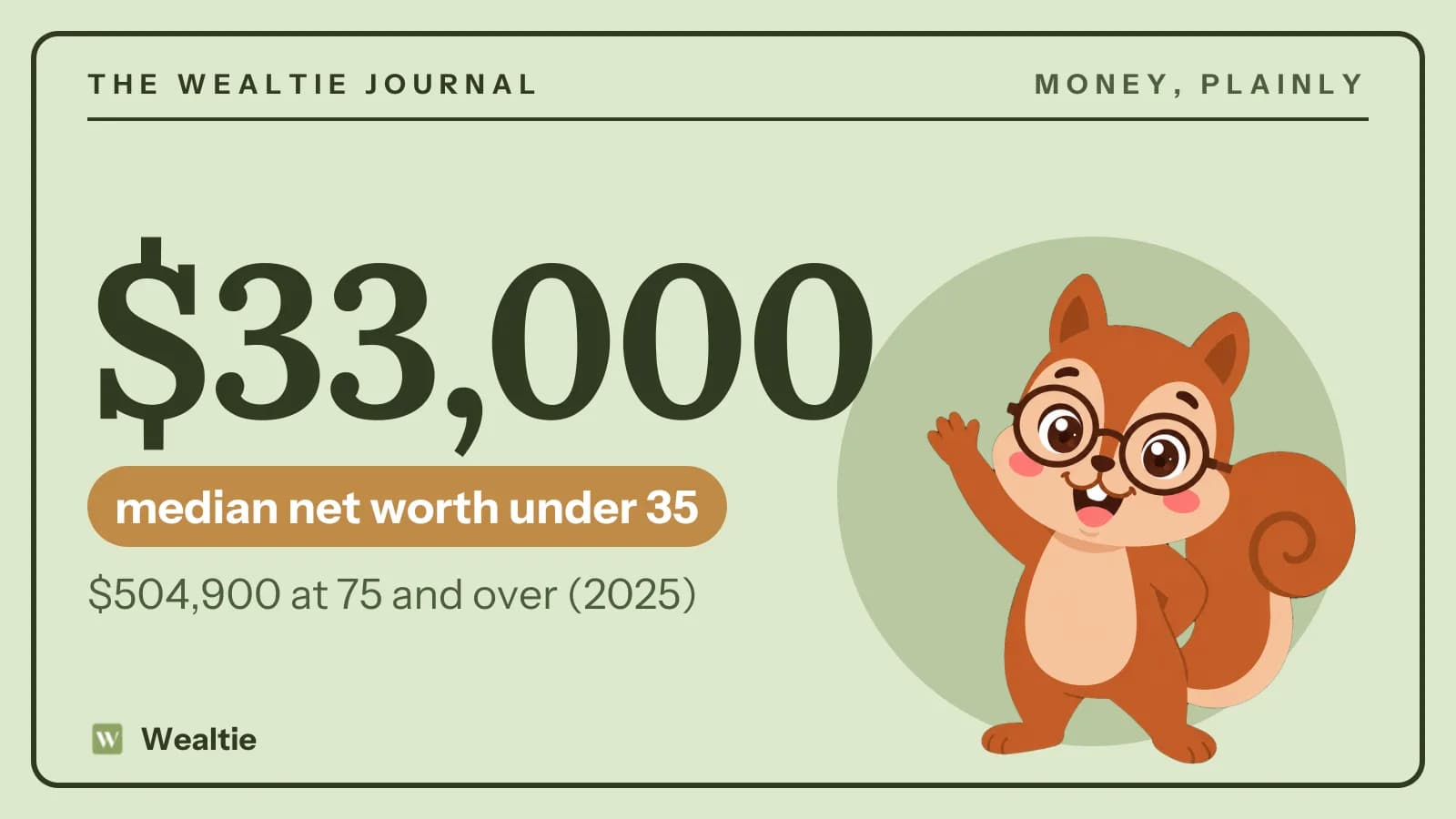
US families headed by someone under 35 had a median net worth of $33,000 in 2025, rising to $504,900 at 75 and over, in the Federal Reserve's Survey of Consumer Finances. That's average net worth by age; your own is everything you own minus everything you owe.
 By Wealtie Team · 3 min read
Key takeaways
- The median US family had a net worth of $215,900 in 2025, up 2% on 2022 after inflation, according to the Federal Reserve's Survey of Consumer Finances.
- Median net worth rose with age, from $33,000 for families headed by someone under 35 to $504,900 at 75 and over.
- The mean was $1,241,500, more than five times the median, because a small number of families hold very large fortunes.
- Homeowners had a median net worth of $458,900; renters had $10,600, which is the widest gap in the survey.
- Net worth is assets minus debts; work it out once a year and compare it with your own last year, not with the average.
What is the average net worth by age?
The median family headed by someone under 35 had a net worth of $33,000 in 2025, according to the Federal Reserve's Survey of Consumer Finances. By 75 and over, it was $504,900.
| Age of family head | Median net worth (2025) | Mean net worth (2025) |
|---|---|---|
| Under 35 | $33,000 | $135,400 |
| 35 to 44 | $155,600 | $681,900 |
| 45 to 54 | $253,700 | $1,244,500 |
| 55 to 64 | $411,900 | $1,878,000 |
| 65 to 74 | $431,300 | $1,897,500 |
| 75 and over | $504,900 | $1,962,200 |
| All families | $215,900 | $1,241,500 |
These figures, from the survey's detailed tables, count families by the age of the person who heads them, so a couple and a single person are each one family. The survey runs every three years; 2025 is the latest.
Across all families, median net worth rose 2% between 2022 and 2025 after inflation. Not every age group shared in it. The median for families under 35 fell from $42,700 to $33,000 in 2025 dollars, a drop of about a fifth.
What is net worth?
Everything you own minus everything you owe.
What you own includes cash, savings, investments, retirement accounts, the value of your home, and the value of a car or anything else you could sell. What you owe includes a mortgage, student loans, a car loan, credit card balances and any other debt. The difference is your net worth. It can be negative, especially early on, when student loans or a car loan are bigger than savings.
Why is the mean so much higher than the median?
Because a small number of families hold enormous fortunes. The mean net worth across all families was $1,241,500 in 2025, more than five times the median of $215,900.
The median is the family in the middle: half had more, half had less. It's the better picture of a typical household. When a headline says the "average American" is worth over a million dollars, it's the mean, and it describes almost nobody.
What makes the biggest difference to net worth?
Owning a home. In 2025, the median homeowning family had a net worth of $458,900. The median renting family had $10,600.
Some of that gap is age, since homeowners tend to be older and have had longer to save. But home equity is also the largest single asset most families have, and paying a mortgage builds it month by month in a way rent doesn't. That doesn't make buying right for everyone; it explains why the averages look the way they do. How to save money for a house works out what a deposit takes.
The other big factors are time and debt. Every year of steady saving compounds, and every year of high-interest debt does the opposite.
How do you work out your own net worth?
List what you own, list what you owe, and subtract. It takes about 20 minutes the first time.
Here's a worked example in round numbers, the same in any currency:
| What you own | Value |
|---|---|
| Current account and cash | 8,000 |
| Savings and emergency fund | 15,000 |
| Retirement account | 22,000 |
| Car (what it would sell for) | 9,000 |
| Total assets | 54,000 |
| What you owe | Balance |
|---|---|
| Car loan | 6,000 |
| Credit card | 2,500 |
| Student loan | 11,000 |
| Total debts | 19,500 |
Net worth: 54,000 − 19,500 = 34,500.
Use what things would sell for today, not what you paid. A car is worth less every year; a home's value is your best estimate of its sale price, minus the mortgage.
Is your net worth good for your age?
Compare it with yourself, not with the average. The useful question is whether your net worth went up over the last year, and why.
Net worth grows in two ways: saving more, and owing less. Paying 2,000 off a credit card raises your net worth by 2,000, just as saving 2,000 does, and usually saves interest too. If yours went down, look at what changed: a new loan, a big purchase, or a market fall in your investments. One bad year isn't a trend.
If you're below the median for your age, the next step is the same as for everyone else: a fixed amount saved every payday and a plan for high-interest debt. Average savings by age has the cash side of the same survey, and debt snowball vs avalanche covers paying debts down in the cheapest order.
How do you track net worth over time?
Work it out once a year, or once a quarter if you're paying off debt and want to see progress, and keep the numbers.
In Wealtie, add your accounts, including cash, savings and the cards you owe on, and the net worth tracker shows them in one total. Transfers between your own accounts aren't counted as spending, so the total moves only when you actually save, spend or pay something off. The Free plan includes two accounts; Pro has unlimited accounts for everything you want to include. A monthly budget is what makes the yearly number go up: it decides how much is left to save before the month starts.
Questions people ask
Median net worth in 2025 was $33,000 under 35, $155,600 at 35 to 44, $253,700 at 45 to 54, $411,900 at 55 to 64, $431,300 at 65 to 74 and $504,900 at 75 and over, according to the Fed's Survey of Consumer Finances.
$215,900 per family in 2025, according to the Federal Reserve's Survey of Consumer Finances, up 2% from 2022 after inflation. The mean was $1,241,500, pulled up by the wealthiest families.
Add up everything you own (cash, savings, investments, retirement accounts, your home's value, your car's value) and subtract everything you owe (mortgage, loans, card balances). What's left is your net worth.
Positive and rising. The median for families headed by someone under 35 was $33,000 in 2025. A better test is whether yours grew over the last year, from saving, paying down debt or both.
Home equity is the biggest asset most families have. In 2025, homeowners had a median net worth of $458,900 and renters $10,600. Owners tend to be older too, which widens the gap.
Sources
- Changes in U.S. Family Finances from 2022 to 2025: Evidence from the Survey of Consumer Finances · Board of Governors of the Federal Reserve System · checked 6 November 2026
- 2025 Survey of Consumer Finances, historical tables (internal data, 2025 dollars), Table 4 · Board of Governors of the Federal Reserve System · checked 6 November 2026
This article is general information, not financial, tax or legal advice. Your situation is your own; check the numbers that apply to you before you act on them.