Budgeting: How to get out of your overdraft for good, step by step
To get out of your overdraft, pay it down in steps, like 100 a month, while lowering the limit as you go, so the space can't be spent again. An 800 overdraft cleared at 100 a month takes eight months, and a small buffer stops you slipping back.
 By Wealtie Team · 3 min read
Key takeaways
- Find out how far into your overdraft you go before each payday, since that's the real amount to clear.
- Paying down 100 a month clears an 800 overdraft in eight months.
- Ask your bank to lower the limit as you go, so the space you free up can't be spent again.
- A small buffer once you're out stops one bad week sending you back in.
How do you get out of your overdraft?
Pay it down in steps and shrink the limit as you go. It's one of the most common money problems, and one of the most fixable. Living in an overdraft usually means your pay goes in, clears the overdraft, and then you slide back into it before the next payday. Breaking that cycle needs a plan, because the overdraft is quietly acting as part of your monthly income.
How deep are you really?
Look at your balance the day before payday for the last three months. That lowest point is the real amount you're borrowing every month, even if the account looks fine for a few days after you're paid. Say it's about 800, in round numbers that work in any currency. Write that number down, since it's your starting point and you'll want to see it fall.
Check what your bank charges for it, too. Some charge interest, some a daily or monthly fee, and some offer a small interest-free part. Knowing the cost helps you decide how fast to move.
How fast can you clear it?
Pick an amount you can manage every month and stick to it. Here's 800 cleared at 100 a month:
| Month | Lowest balance before payday |
|---|---|
| Start | −800 |
| 2 | −600 |
| 4 | −400 |
| 6 | −200 |
| 8 | 0 |
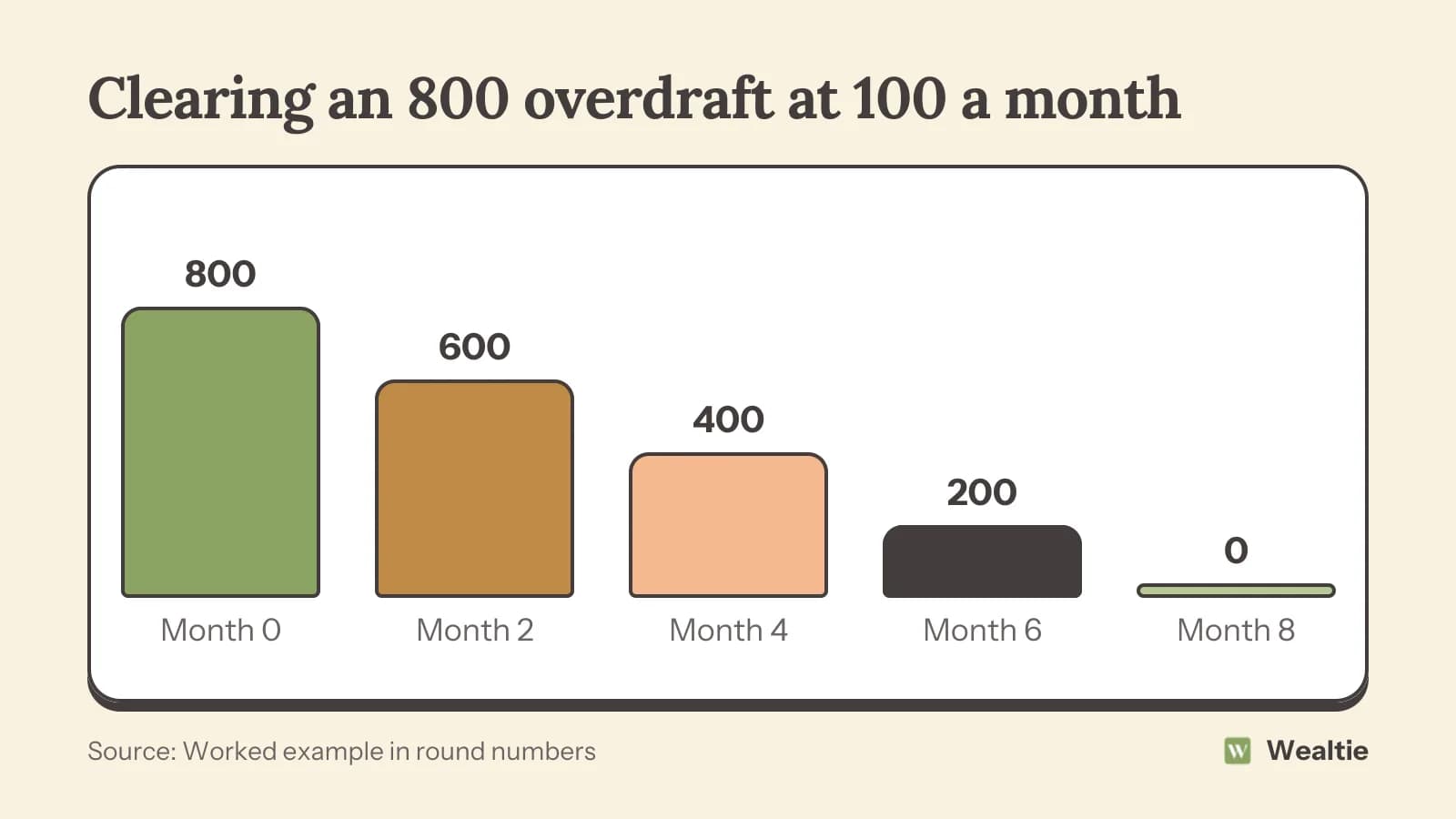
The trick is that the 100 has to come from spending less, not from shuffling money around. Each month, your lowest balance needs to be 100 higher than the month before. The payday forecast calculator gives you a daily figure to aim for.
Why should you lower the limit?
So you can't spend the space you've freed. If your limit stays at 1,000 while you pay the overdraft down, a bad week can undo two months of progress. Ask your bank to reduce the limit by 100 each month, or every couple of months, as your balance improves. Most banks let you do this in the app.
When you're out, think about whether you want an overdraft at all. Some people keep a small one for emergencies. Others remove it entirely, so the temptation's gone.
Where does the 100 a month come from?
From one or two categories you can cut without much pain. Eating out and shopping are common ones. Look at your last month's spending and pick the biggest flexible line. Treat the 100 as a bill on payday: note it, and don't count it as spendable. How to stop overspending has practical ideas.
If there's nothing to cut, look at fixed costs, like phone and insurance, or at income, like extra hours. How to negotiate bills can free up money in an afternoon.
Should you use savings or a loan to clear it?
If you've got savings beyond a small emergency cushion, using them to clear an expensive overdraft often makes sense, since the overdraft probably costs more than savings earn. Just make sure you keep enough aside for a surprise, or you'll be straight back in.
A cheaper loan or an interest-free balance transfer card to clear it can work, as long as you check the fees and the date the offer ends, but only if you also close or reduce the overdraft. Otherwise you end up with the loan and a full overdraft again.
What stops you slipping back?
A buffer. Once you're out, keep a small amount in your account that you treat as zero, even 100 or 200. That absorbs the timing problems that pushed you into the overdraft in the first place. Build it after the overdraft's cleared, by keeping the same 100 a month aside for one or two months. How to avoid overdraft fees covers the habits that keep you out, like low-balance alerts and moving bills to after payday.
What if it's more than you can manage?
Talk to your bank. Many have support for customers who are struggling, like a plan to reduce the overdraft gradually or a pause on charges. If you've got other debts too, free advice from a non-profit or government-backed service can help you work out the order.
How do you track an overdraft in Wealtie?
Add your current account with today's balance, including a negative one if you're overdrawn, and log spending as you go. Your net worth tracker shows the balance improving month by month. A monthly limit in the budget tracker, with Budget Health, warns you mid-month if your pace would push you back into the overdraft.
Questions people ask
Pay it down by a set amount each month, like 100, by spending less, and ask your bank to lower the limit as you go so you can't spend the space again.
Divide the overdraft by what you can pay off each month. An 800 overdraft at 100 a month takes eight months.
Often, if the overdraft costs more than savings earn and you can keep a small emergency cushion.
Keep a small buffer in your account, set low-balance alerts and move bills to just after payday.
This article is general information, not financial, tax or legal advice. Your situation is your own; check the numbers that apply to you before you act on them.



