Budgeting: The denomination effect: why big notes make you spend less
The denomination effect is our tendency to spend money more easily in small notes and coins than in one large note of the same value. Five small notes slip away on snacks and coffee, while a single 50 tends to stay in the wallet.
 By Wealtie Team · 3 min read
Key takeaways
- The denomination effect means small notes and coins get spent faster than large notes.
- Breaking a big note makes the rest feel like loose change.
- Carrying one larger note can slow casual spending.
- Card spending has its own traps, so track whichever way you pay.
What is the denomination effect?
The denomination effect is the finding that people are more likely to spend money when it's in small units than when the same amount is in one large note. The researchers Priya Raghubir and Joydeep Srivastava described it in a 2009 study. People given several small notes spent more readily than people given one large note of the same total value.
The reason is partly emotional. A large note feels like real money, something to protect, and breaking it feels like a loss. Small notes and coins feel like loose change, and loose change is easy to part with. Once a big note is broken, the leftover small notes are spent with the same ease, which is why many people notice their cash disappearing soon after they get change.
How big is the difference in a week?
Here's a worked example, in round numbers that work in any currency. You take out 50 in cash for the week's small purchases. In one week, you carry it as five 10s. In another, you carry a single 50.
| How you carry 50 | Spent in a week |
|---|---|
| Five 10s | 38 |
| One 50 | 20 |
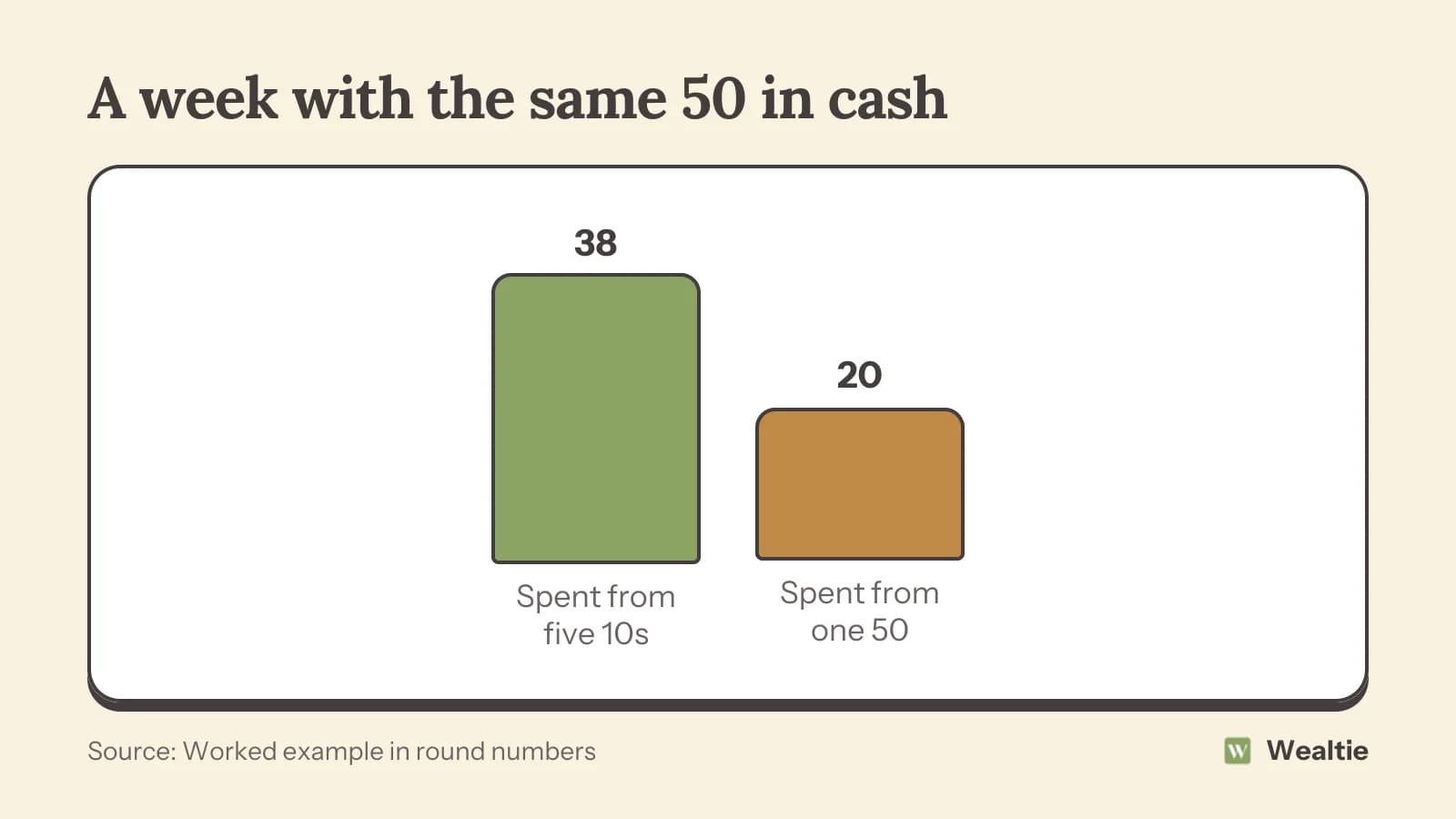
With small notes, a coffee here and a snack there feel trivial, and by Friday most of it is gone. With the single note, you think twice before breaking it, so you only spend when you mean to. These numbers are made up, but many people recognise the pattern when they try it.
Why does breaking a note feel so different?
Big notes feel like savings
A large note seems like a unit of value to keep whole. Spending part of it feels like starting to use up savings, which creates a small barrier.
Change feels like leftovers
Once you've broken the note, what's left feels like it's already been spent. That makes it easy to use on things you wouldn't have bought otherwise.
Coins feel like almost nothing
Coins are the easiest of all to spend. A jar or purse full of coins can disappear on vending machines and small treats without ever feeling like a purchase.
How can you use the denomination effect?
Carry one larger note for the week
If you use cash for small spending, take it out as one or two larger notes. You'll be more careful about when you break them.
Bank or save your change
Put coins and small notes in a jar at the end of each day instead of carrying them. Once a month, pay the jar into your savings. It turns the easiest money to waste into money you keep.
Pair it with envelopes
Envelope budgeting works well with this effect. Put a single larger note into each envelope, so breaking it feels like a decision.
Watch the after-change spending
The moment you get change is when spending speeds up. Noticing that is enough to slow it down. How to stop impulse buying has more quick rules.
Does the denomination effect apply to card spending?
Cards don't have notes to break, but a similar pattern shows up with small purchases. A coffee or snack on a card feels as weightless as loose change, so they add up the same way. How much do you spend on coffee? shows how small daily habits grow over a year. With cards, the fix isn't carrying big notes but setting a weekly limit for small spending and checking it often.
How do you keep track of cash you spend?
The simplest fix is to write cash down as you spend it, so it doesn't vanish without a trace. How to track cash spending covers quick ways to do it, and keeping it up for a few weeks shows where the change goes.
It also helps to decide in advance what your small-spending cash is for. If 50 a week is meant to cover lunches and travel, a coffee or magazine bought on a whim eats into money you'll need later in the week. Knowing the purpose of the note gives you another reason to keep it whole until you need it, and makes the week's spending feel planned rather than random.
How does Wealtie help with cash?
Add a cash account in Wealtie and log each purchase as you make it, in its own expense categories. Set a weekly or monthly budget for snacks, coffee and other small spending, and you'll see when broken notes start adding up before the week is out.
Questions people ask
The denomination effect is the tendency to spend money more easily when it's in small notes and coins than when it's in one large note.
Small notes and coins feel like loose change, while a large note feels like real money to protect, so breaking it creates a pause.
Carry one larger note for the week instead of several small ones, and put your coins and change in a savings jar each day.
Not directly, but small card purchases can feel just as weightless as loose change, so a weekly limit for small spending helps.
This article is general information, not financial, tax or legal advice. Your situation is your own; check the numbers that apply to you before you act on them.