Budgeting: The cost of woodworking as a hobby: tools, wood and space
The cost of woodworking as a hobby depends mostly on tools: a basic hand-tool kit is cheap, while power tools and a workshop cost much more. In a worked example, a first year with a starter set of tools and a few projects costs about 600.
 By Wealtie Team · 3 min read

Key takeaways
- The cost of woodworking as a hobby depends mostly on the tools you buy.
- In a worked example, a first year costs about 600.
- Start with hand tools and add power tools only when a project needs them.
- Reclaimed wood and second-hand tools cut costs a lot.
What is the cost of woodworking as a hobby?
Woodworking lets you make furniture, shelves, toys, gifts and repairs around the home, and many people find it deeply satisfying. The cost depends mostly on tools. You can start with a small set of good hand tools and simple projects for a modest sum. Power tools speed things up and make bigger projects possible, but they add cost quickly. Wood is an ongoing expense, and you'll need some safety gear and somewhere to work. In a worked example, a first year with a starter set of tools and a few projects costs about 600.
The most common mistake is buying lots of tools before knowing what you'll make. A better approach is to choose a first project, buy what it needs, and let your toolkit grow with your skills.
Good first projects include a small shelf, a box, a stool or a chopping board. Each one teaches measuring, cutting, joining and finishing, and uses only a little wood. Once you've made a few, you'll know which tools you reach for most and which ones you'd buy next. That knowledge saves far more money than any sale, because it stops you buying tools that sit unused on a shelf. Many experienced woodworkers say their most-used tools are a handful of simple ones they bought early on.
What does a first year of woodworking cost?
Here's a worked example, in round numbers that work in any currency:
| Item | First year |
|---|---|
| Hand tools | 200 |
| A couple of power tools | 200 |
| Wood | 100 |
| Clamps and workbench | 60 |
| Safety gear | 40 |
| Total | 600 |
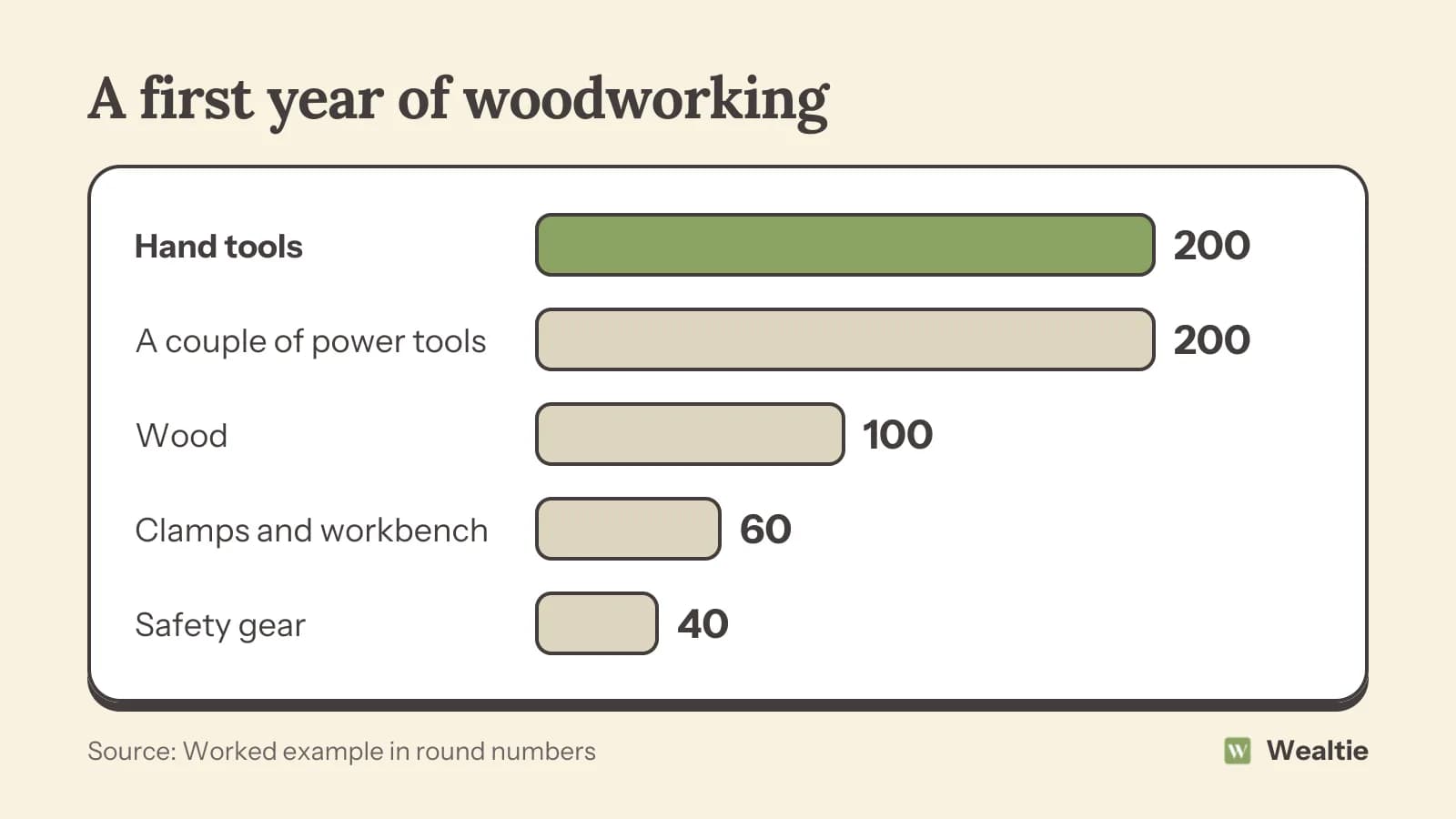
Hand tools might include a saw, chisels, a hand plane, a square, a tape measure and a mallet. Two power tools, like a drill and a jigsaw, cover many beginner projects.
What are the main woodworking costs?
Hand tools
Good hand tools last a lifetime, so it's worth buying decent ones. Second-hand chisels, planes and saws are often excellent and cheap, since older tools were well made. A little sharpening brings them back to life.
Power tools
A drill and a jigsaw are useful first power tools. Larger machines, like table saws and planers, are expensive, need space and need careful use. Many hobbyists never buy them, or use them at a shared workshop.
Wood
Wood prices vary with the type and thickness. Softwoods are cheaper for practice and simple projects. Hardwoods look beautiful but cost more. Reclaimed wood from pallets, old furniture and building sites can be free or very cheap.
Clamps and a workbench
Clamps hold work while glue dries, and you'll always want more. A sturdy workbench makes work safer and easier, and building one is a classic first project.
Safety gear
Eye protection, ear protection and a dust mask are essential, especially with power tools. Don't skip them to save money.
What else adds to the cost of woodworking as a hobby?
Space is the hidden cost. A garage or shed workshop needs light, power and somewhere to store tools and wood. If you don't have space, community workshops and maker spaces rent bench time and give access to big machines. Finishes like oil, varnish and paint, plus sandpaper, glue and screws, add up over a year. Sharpening equipment for chisels and planes is another early purchase. Courses can help you learn safely and avoid wasted wood. A weekend course on sharpening or basic joints can save months of trial and error, and some community workshops include safety training on their machines as part of membership.
It's also worth thinking about noise and dust if you live in a flat or close to neighbours. Hand tools are quiet and make little dust, which is one more reason to start with them. Power tools are louder, so working at reasonable hours keeps the peace.
How can you do woodworking for less?
Start with hand tools and small projects, buy tools second-hand, and use reclaimed wood for practice. Borrow or rent power tools you'll rarely use. Rent, borrow or buy tools covers how to decide. Join a community workshop to use big machines without buying them. Plan projects carefully and cut pieces efficiently to reduce waste.
Can woodworking pay for itself?
Some woodworkers sell chopping boards, small furniture or commissions to friends. It can cover the cost of wood and tools, and sometimes more. How to earn money selling crafts covers pricing. Work out the cost per use of tools you're thinking of buying, and see how to save money on a hobby for more ways to keep costs in check.
How do you track woodworking costs in Wealtie?
Add a woodworking category to your expense categories and set a budget for tools and wood. If you sell what you make, log it in the income tracker to see the hobby's real cost.
Questions people ask
In a worked example, a first year with hand tools, two power tools, wood, clamps, a workbench and safety gear costs about 600.
A saw, chisels, a hand plane, a square, a tape measure, clamps and safety gear, plus a drill and a jigsaw for many projects.
Buy hand tools second-hand, use reclaimed wood, rent power tools you'll rarely use and join a community workshop.
Not to start. Small projects can be done on a sturdy bench, and community workshops rent space and machines.
This article is general information, not financial, tax or legal advice. Your situation is your own; check the numbers that apply to you before you act on them.