Budgeting: The cost of a model railway: starter sets, layouts and upgrades
The cost of a model railway starts with a starter set of a train, track and controller, then grows with extra track, scenery, buildings and rolling stock. In a worked example, a first year with a small layout costs about 400.
 By Wealtie Team · 3 min read
Key takeaways
- The cost of a model railway starts with a starter set and grows with the layout.
- In a worked example, a first year with a small layout costs about 400.
- Planning the layout first stops you buying track and trains you won't use.
- Second-hand trains and handmade scenery keep costs down.
What is the cost of a model railway?
Model railways are a hobby that combines engineering, history, art and storytelling. Most people start with a starter set, which includes a locomotive, a few carriages or wagons, an oval of track and a controller. From there, the layout grows: more track, points to create junctions, a baseboard, scenery, buildings and more trains. In a worked example, a first year with a small layout costs about 400.
The cost depends on the scale you choose, how detailed you want the scenery and how many trains you collect. Smaller scales take less space but can cost as much per item. Digital control systems add features but cost more than simple analogue controllers.
A simple plan on paper before you buy anything saves a lot. Measure the space you have, sketch where the track will go and decide what kind of railway you want to model, such as a country branch line or a busy city station. A clear plan stops you buying track that doesn't fit, trains from the wrong era or scenery that clashes. It also makes the hobby more satisfying, since every purchase moves the layout forward.
Many people come back to the hobby after years away, often with children or grandchildren, and find it brings back happy memories. Others start from scratch and enjoy the planning and building as much as running the trains. Either way, it's a hobby that rewards patience, and building slowly is easier on the budget too.
What does a first year with a model railway cost?
Here's a worked example of a small layout, in round numbers that work in any currency:
| Item | First year |
|---|---|
| Starter set | 150 |
| Extra track and points | 80 |
| Scenery and buildings | 100 |
| Baseboard | 40 |
| Extra wagons | 30 |
| Total | 400 |
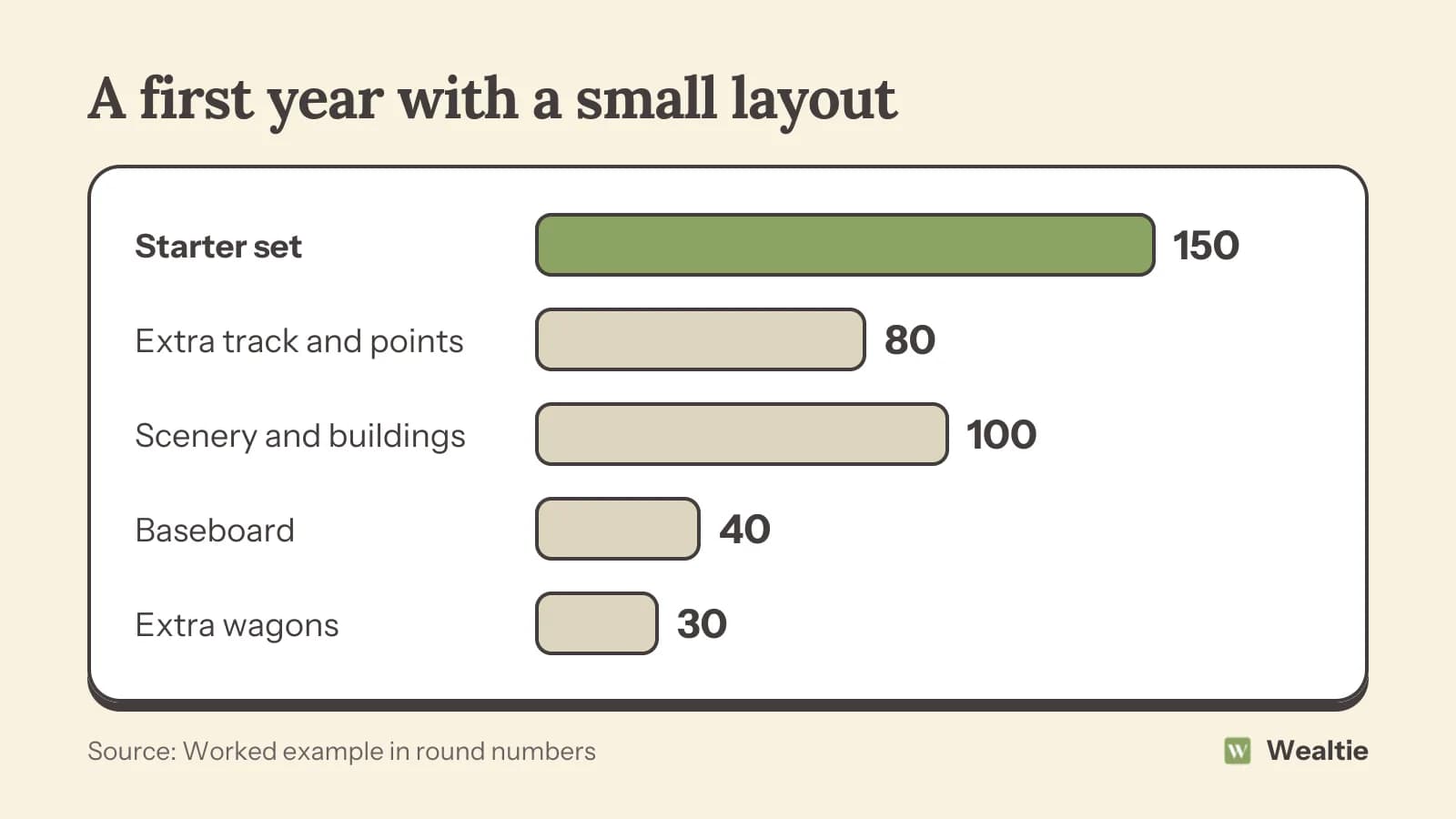
A larger layout with digital control and detailed locomotives can cost many times more. A simple layout built slowly over time costs much less each month.
What are the main model railway costs?
Starter set
A starter set is usually the cheapest way to get a train, track and controller together. It lets you find out whether you enjoy the hobby before spending more.
Track and points
Extra track and points let you build more interesting layouts. Plan the layout first, so you buy only what you need. Free track-planning software and printed templates let you test ideas on screen or on the floor before buying a single piece.
Baseboard
A sturdy board to build on, often made from plywood or foam board. Building your own is cheaper than buying ready-made. A board that splits into sections is easier to store and move, which matters if the layout lives in a spare room that's needed for other things.
Scenery and buildings
Grass, trees, hills, buildings and figures bring the layout to life. Kits and ready-made pieces cost money, but much scenery can be made from cheap materials.
Locomotives and rolling stock
Trains are where costs can climb quickly. Detailed locomotives can be expensive, and collectors often keep adding more.
What else adds to the cost of a model railway?
Space is a hidden cost: a layout needs somewhere to live, like a spare room, loft or shed. Digital control systems, sound-fitted locomotives and automation add a lot. Tools for building scenery and kits, like knives, glue and paint, add up. Exhibitions and club memberships cost a little but are a great way to learn. Repairs and servicing keep locomotives running smoothly.
How can you build a model railway for less?
Plan your layout before buying, so you only get the track and trains you need. Buy second-hand trains and track from swap meets, clubs and online. Make scenery from cheap materials like foam, cardboard and natural items. Build in stages, adding a little each month. Stick to one era and region so purchases fit together. How to save money on a hobby has more tips.
Sell what you don't use
Model trains often hold their value. Selling items that don't fit your layout funds new ones. How to sell things you don't use covers how. If you're building with children, how to save money on toys has ideas too. Work out the cost per use of big purchases: a locomotive that runs every week is better value than one that stays in its box.
How do you track model railway costs in Wealtie?
Add a hobby category to your expense categories and set a monthly budget for it, so building the layout bit by bit stays within what you can afford.
Questions people ask
In a worked example, a first year with a starter set, extra track, scenery, a baseboard and a few wagons costs about 400.
Start with a starter set, then plan your layout before buying extra track and trains.
Buy second-hand, make scenery from cheap materials, build in stages and stick to one era and region.
Often, yes, which means selling items you don't use can help fund new ones.
This article is general information, not financial, tax or legal advice. Your situation is your own; check the numbers that apply to you before you act on them.