Budgeting: How much do martial arts classes cost? A yearly budget
The cost of martial arts covers monthly class fees, a uniform, grading and licence fees, and protective gear for sparring. In a worked example, a year of training twice a week costs about 700.
 By Wealtie Team · 3 min read

Key takeaways
- The cost of martial arts covers class fees, a uniform, gradings, licences and gear.
- In a worked example, a year of training twice a week costs about 700.
- Grading fees rise as you move up the belts, so ask about them upfront.
- Long contracts and expensive starter packs are worth questioning.
How much do martial arts classes cost?
Martial arts like karate, judo, taekwondo, jiu-jitsu and kickboxing are popular with adults and children. Most clubs charge a monthly fee, often with a set number of classes a week or unlimited training. On top of that come a uniform, grading fees as you move up through the belts, a yearly licence or insurance fee, and protective gear if you spar. In a worked example, a year of training twice a week costs about 700.
Prices vary a lot between clubs. A small community club run by volunteers can cost a fraction of a large commercial gym. The style matters too: some need very little gear, while others need gloves, guards and pads.
What does a year of martial arts cost?
Here's a worked example for training twice a week, in round numbers that work in any currency:
| Item | A year |
|---|---|
| Monthly fees | 480 |
| Grading fees | 90 |
| Uniform | 50 |
| Licence and insurance | 40 |
| Sparring gear | 40 |
| Total | 700 |
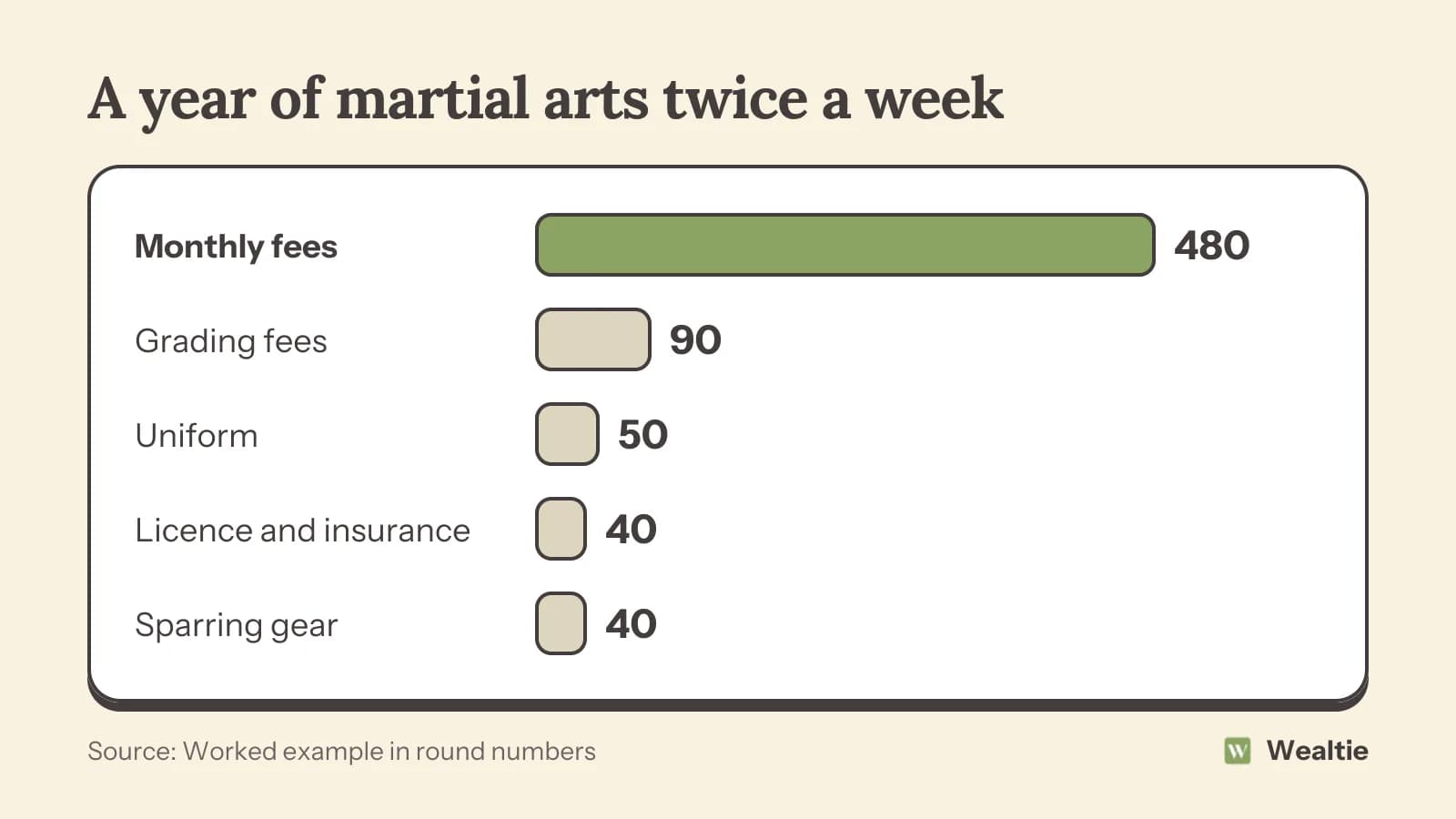
The monthly fees are 40 a month. The grading figure assumes three gradings a year at 30 each, which is common for beginners and children.
What are the main costs of martial arts?
Monthly fees
Most clubs charge monthly, sometimes by direct debit with a minimum term. Some offer pay-as-you-go classes, which suit people with irregular schedules. Family memberships can cut the cost for several children.
Uniform
Many martial arts need a uniform, often called a gi or dobok. A basic one is affordable, and children outgrow them regularly. Some clubs ask you to buy a branded uniform from them.
Grading fees
Moving up a belt usually means passing a grading, which has a fee. Fees often rise at higher grades, and black belt gradings can be expensive. Ask how often gradings happen and what they cost.
Licences and insurance
Many clubs belong to a governing body and need members to pay a yearly licence, which often includes insurance.
Gear
Sparring styles need gloves, shin guards, a mouth guard and sometimes head guards. Grappling styles need little beyond a uniform and a mouth guard.
What else adds to the cost of martial arts?
As you progress, other costs can appear. Competitions bring entry fees, travel and sometimes hotel stays. Seminars with visiting instructors cost extra. Some clubs sell branded clothing, bags and equipment, and there can be gentle pressure to buy. Private lessons help with specific skills but cost far more per hour. Injuries, though not common with good coaching, can bring physiotherapy costs. A quick question about these extras before joining helps you compare clubs fairly. Two clubs with the same monthly fee can cost very different amounts over a year.
How can you train for less?
- Try a free trial class: most clubs offer one or two before you join.
- Compare clubs: community and volunteer-run clubs are often far cheaper than commercial gyms.
- Avoid long contracts: be wary of clubs that push long minimum terms or big upfront payments.
- Question starter packs: a pack with uniform, gear and gradings may cost more than buying items separately.
- Buy gear second-hand: gloves and pads are easy to find used, though buy mouth guards new.
- Ask about family discounts: common when several children train.
Watch out for pressure selling
Some clubs push expensive programmes, like fast-track black belt courses, with large upfront fees. Take time to read the terms before signing anything. A good club is happy for you to think it over.
Check the instructor and the club
Before paying, watch a class and ask about the instructor's experience and qualifications, and whether the club is insured. A well-run club with fair prices is worth more than a cheap one with poor coaching, since good teaching keeps you safe and helps you progress without wasting money on extra lessons later.
Are martial arts worth the cost?
For many people, yes. They build fitness, confidence and discipline, and they can replace a gym membership. For children, they're often among the more affordable regular activities. How to save money on kids' activities covers keeping the overall cost down, and how to save money on sports kit helps with gear. If you're comparing ways to keep fit, the cost of yoga classes covers another option.
How do you track martial arts costs in Wealtie?
Add the monthly fee as a recurring transaction, so it logs itself on its date. Put gradings, gear and competitions in a sport category among your expense categories, and set a budget for it.
Questions people ask
In a worked example, a year of training twice a week costs about 700, including monthly fees, gradings, a uniform, a licence and gear.
Fees paid to take a test to move up a belt. They often rise at higher grades, so ask about them before joining.
Try a free class, compare clubs, avoid long contracts, question starter packs and buy gear second-hand.
Usually not compared with many activities, but gradings, uniforms and competitions add up. Ask for a list of expected costs upfront.
This article is general information, not financial, tax or legal advice. Your situation is your own; check the numbers that apply to you before you act on them.