Budgeting: How to budget for medical bills and costs you can see coming
To budget for medical bills, list the health costs you can predict for the year, like prescriptions, dental and glasses, add a cushion for the unexpected, and set aside a monthly amount. In a worked example, that's 75 a month.
 By Wealtie Team · 3 min read
Key takeaways
- List the health costs you can predict, like prescriptions, dental care and glasses, and add them up for the year.
- In a worked example, predictable costs plus a cushion come to 900 a year, or 75 a month.
- Check what your insurance or health system covers, including any amount you pay before cover starts.
- If you get a bill you can't pay, ask for an itemised bill and a payment plan before it goes to collection.
How do you budget for medical bills?
Split them into the costs you can predict and the ones you can't, then plan for both. How much you'll pay depends a lot on where you live and what cover you have, but nearly everyone has some regular health costs and some risk of a larger bill.
Which health costs can you predict?
More than people think. Look at last year's spending and your family's needs. Here's a worked example for one person, in round numbers that work in any currency:
| Cost | Per year |
|---|---|
| Prescriptions | 180 |
| Dental check-ups | 160 |
| Glasses or contact lenses | 260 |
| Cushion for the unexpected | 300 |
| Total | 900 |
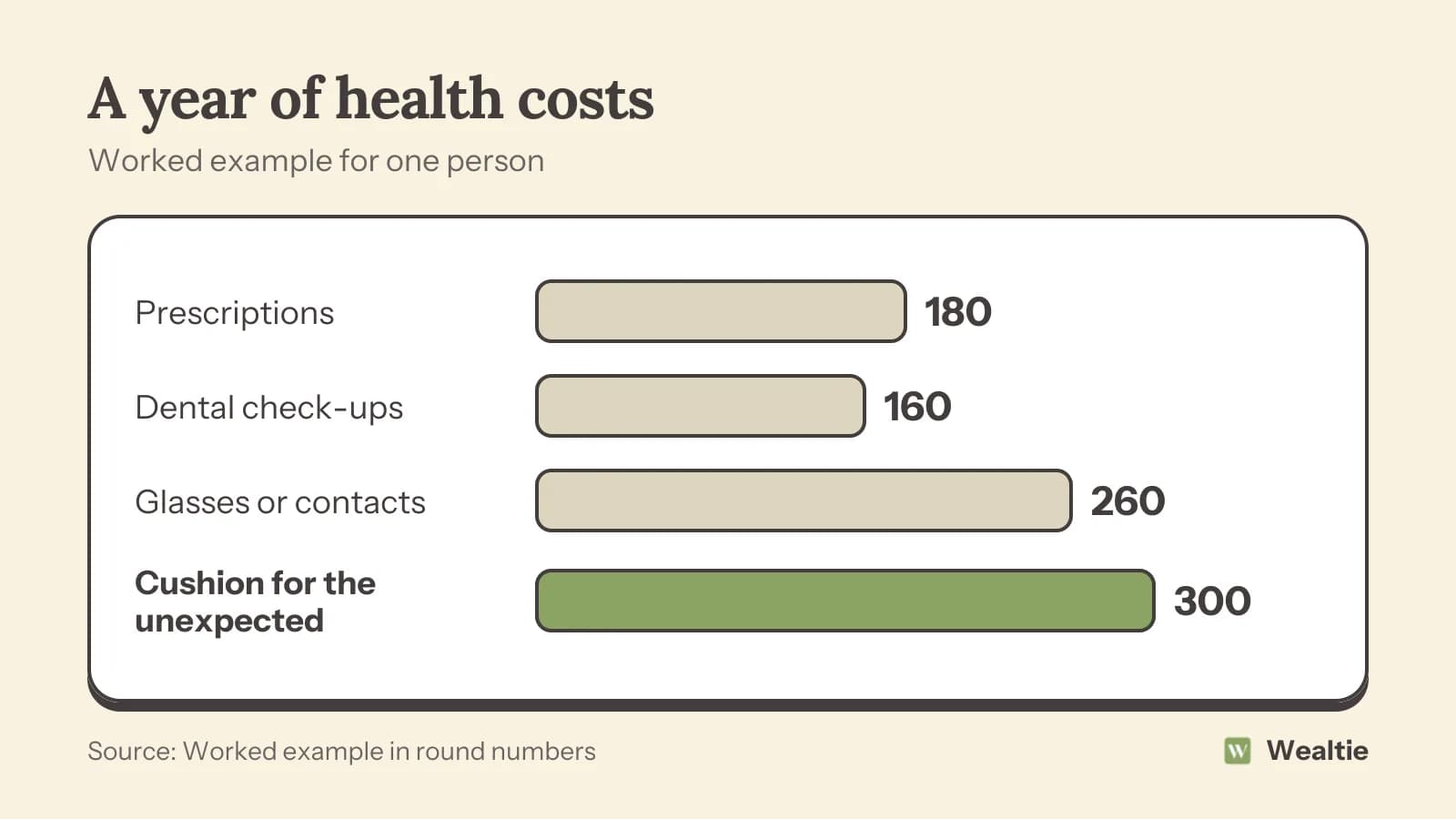
That's 75 a month. Look back over the last two years if you can, since some costs, like new glasses, don't come every year. Add anything else that applies to you: physiotherapy, therapy, regular appointments, a child's orthodontics, or a pet's vet bills if you'd like to keep them together.
What should you check about your cover?
What you'll pay before your cover pays, and what it doesn't cover at all. Depending on your system, there may be a set amount you pay each year first, a share you pay of each bill, or a fixed charge per appointment or prescription.
Keep a copy of your policy's summary somewhere easy to find, so you're not searching for it during an illness. Write down the most you could have to pay in a year under your plan, if there's a limit. That's a useful number to know, because it tells you the size of the worst year. If your system has annual prescription passes or pre-payment options, check whether they'd cost less than paying each time.
How should you save for health costs?
Set aside the monthly amount in a separate pot, so the money's there when a bill arrives. A sinking fund works well for the predictable costs.
For the larger, unexpected ones, your emergency fund is the backstop. If your cover leaves you open to a big bill, it's worth building the emergency fund to at least that amount. How much should be in an emergency fund helps set the target.
Some countries offer tax-advantaged accounts for health costs. If yours does and you're eligible, they can make the money go further.
What if you get a bill you can't pay?
Don't ignore it, and don't put it on a credit card straight away. Steps that often help:
- Ask for an itemised bill and check it for errors
- Check whether your insurer should have paid part of it
- Ask the provider about a payment plan, which is often interest-free
- Ask whether they offer financial assistance or a discount for paying in full
- Get free advice from a non-profit if the bill is large
Keep notes of every call: the date, who you spoke to and what was agreed. Providers usually have more options before a bill goes to collection than after. Paying a medical bill with a credit card can turn an interest-free payment plan into expensive debt.
How do you lower regular health costs?
Ask your pharmacist whether a larger supply at once costs less overall. Ask about generic versions of medicines, which are often much cheaper. Compare prices for glasses and contact lenses, including online. Keep up with routine check-ups, which tend to cost less than treating problems later. Use any free screenings or services your system offers.
Review your cover each year, especially if your needs have changed, like a new baby or a long-term condition.
How do you plan for a family?
Do the same exercise for each person, then add them up. Children's costs can include dental work, glasses and frequent minor illnesses, and they can come in bursts, like a year of braces. If you've got a long-term condition in the family, put its regular costs in your monthly budget as a fixed bill, rather than in the cushion. The family budget puts health alongside the other family costs.
How do you track health costs in Wealtie?
Give health its own line in your expense categories, so you can see what it costs over a year. Add a separate savings account for the health pot and move the monthly amount in as a transfer, which isn't counted as spending. Regular costs, like a monthly prescription, can be set up as a recurring transaction, and a monthly limit in the budget tracker keeps the rest of the month on track.
Questions people ask
Add up the costs you can predict, like prescriptions, dental and glasses, then add a cushion. A worked example comes to 900 a year, or 75 a month.
Ask for an itemised bill, check for errors and insurance coverage, then ask about a payment plan or financial assistance before it goes to collection.
Usually not straight away, because providers often offer interest-free payment plans. A card can turn the bill into expensive debt.
Keep a health pot for predictable costs and build your emergency fund to at least the most your cover could leave you paying in a year.
This article is general information, not financial, tax or legal advice. Your situation is your own; check the numbers that apply to you before you act on them.



